Eurasian jayGarrulus glandarius — habitat, diet and reproduction
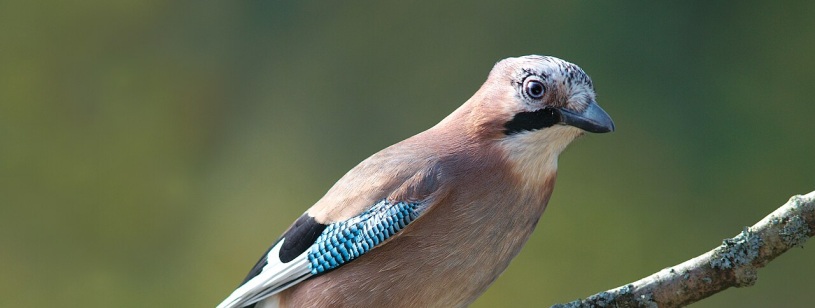
Eurasian jay (Garrulus glandarius) with pinkish-brown plumage and barred blue wing feathers. · Luc Viatour / https://Lucnix.be / CC BY-SA 3.0 (https://creativecommons.org/licenses/by-sa/3.0/). Cropped and resized. Source: https://commons.wikimedia.org/wiki/File:Garrulus_glandarius_1_Luc_Viatour.jpg
The Eurasian jay (Garrulus glandarius) is a woodland corvid recognised by its barred blue wing panel. It stores acorns for later meals. Some unrecovered seeds germinate, linking its feeding behaviour with the spread of oak trees.
Quick facts
| Common name | Eurasian jay |
| Scientific name | Garrulus glandarius |
| Lifespan | BTO estimates around 4 years for birds reaching breeding age; some exceed 16 years |
| Length | 32–36 cm |
| Weight | 150–190 g |
| Diet | Acorns, seeds, fruit and small animals |
| Predators | Birds of prey |
| Conservation status | Least Concern globally |
| Distribution | Europe, Asia and northwest Africa |
| Habitat | Woodland, parks and mature gardens |
| Family | Corvidae |
| Reproduction | Usually one annual brood; commonly 4–5 eggs |
- Primary category:Birds
- Explore this animal's categories:
Interesting facts
- Unrecovered cached acorns can develop into new oaks.
- Jays can imitate other birds’ calls.
- Raised crown feathers form a small crest.
- Experiments show they can wait for a preferred food reward.
Records and extremes
BTO records a ringed jay that lived for 16 years and more than nine months. This is a record within the British ringing database.
A Cambridge experiment tested ten Eurasian jays with immediate and delayed food choices. Individuals that waited longer also performed better on the cognitive tasks used in the study.
Characteristics
Pinkish-brown body feathers contrast with a black tail and white rump. Blue wing panels are crossed by black bars.
The head has dark facial markings and elongated crown feathers. Males and females look similar, and the robust bill handles a varied diet.
Behaviour
Jays often remain concealed among branches, with harsh calls revealing their presence. They become more conspicuous during autumn acorn gathering.
Food is hidden in several places in soil or leaf litter and retrieved later. Radio-tracking studies of tagged acorns help researchers understand where birds place their stores.
Habitat and distribution
The species ranges across Europe and Asia into northwest Africa. It breeds widely in Romania and is mainly resident there.
Broadleaf woodland is particularly suitable, but mixed forests, conifers, parks and mature gardens can also provide food and nesting sites.
Diet and feeding
Insects and larvae are important during spring and summer. Jays also take eggs and nestlings from other birds.
Acorns, nuts, seeds and fruit become more prominent in colder seasons. Caches extend access to food, while unrecovered acorns may contribute to woodland regeneration.
Reproduction and life cycle
Both adults help build a twig nest and feed the young. The nest is generally hidden in a tree canopy.
BTO gives a typical clutch of 4–5 eggs, while Romanian sources describe a broader species range. Incubation takes roughly 16–19 days and young leave the nest at about 19–23 days.
Juveniles remain dependent on their parents for several weeks after fledging.
Name and history
Garrulus refers to the bird’s noisy character, while glandarius reflects its association with acorns. Linnaeus described the species in 1758.
Eurasian jay and acorn jay are English names used for this bird. It belongs to the same family as ravens and magpies.
Conservation and threats
Eurasian jays are globally Least Concern, although local conditions differ. Loss of wooded habitat and disturbance during nesting can affect populations.
Poor acorn crops reduce an important food supply. Connected woodland and mature trees offer feeding and breeding opportunities.
Its role as a seed transporter links jay conservation with the regeneration of oak woodland.
Frequently asked questions
Does the jay remain in Romania during winter?
It is mainly resident and can be seen throughout the year.
How can it be identified in flight?
Look for the white rump and blue-and-black wing panel.
Why does it bury acorns?
They provide stored food for less productive periods.
Does it eat only acorns?
It also eats insects, fruit, other seeds and occasionally eggs or small animals.
Can it mimic other birds?
It can reproduce calls of other species.
Do all cached acorns become trees?
Many are retrieved or eaten; some remaining seeds germinate under suitable conditions.