HippopotamusInteresting facts and information
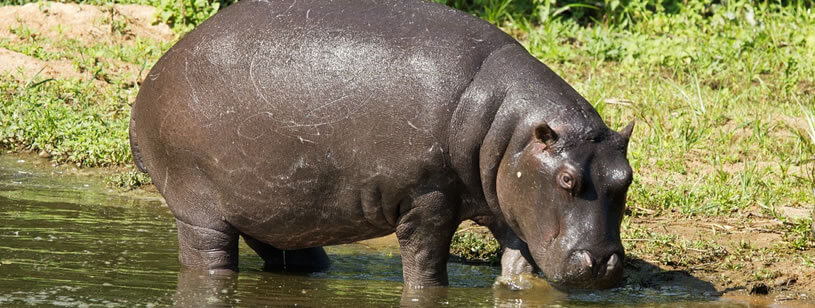
The common hippopotamus (Hippopotamus amphibius) is a large African mammal that spends much of the day in water and feeds mainly on grass on land. Whales and dolphins are its closest living relatives as a group.
Hippos spend much of the day in water and usually graze on land at night. How much they eat depends on the animal and the conditions.
Hippos can move quickly and can be dangerous when threatened or approached. They use their large jaws and canine teeth in fights; there is no reliable ranking of their bite force against other animals.
Quick facts
| Common name | Hippopotamus |
| Scientific name | Hippopotamus amphibius |
| Typical lifespan | About 40 years in the wild, up to about 50-60 years in captivity |
| Maximum speed | About 30 km/h on land over short distances |
| Dimensions | 3.5 - 5 m long, 1.3 - 1.6 m tall at the shoulder |
| Weight | Females: 1,300 - 1,800 kg; males: 1,500 - 3,200 kg |
| Diet type | Herbivore (mainly grass, occasionally fruit) |
| Main predators | Crocodiles and lions (mainly calves), humans |
| Conservation status | Vulnerable (IUCN) |
| Distribution | Sub-Saharan Africa |
| Habitat | Rivers, lakes, swamps |
- Primary category:Mammals
- Explore this animal's categories:
Interesting facts
- Hippos have large jaws and prominent canine teeth used during conflicts.
- They are at home underwater - Hippos can close their nostrils and ears and stay underwater for about 5 minutes.
- They "sweat blood" - Their skin produces a reddish, oily liquid that acts as a natural sunscreen and helps protect against germs.
- They can outrun a person - Although a hippo weighs more than 1,500 kg, it can reach about 30 km/h over short distances.
- They are very dangerous to people - Hippos are thought to kill hundreds of people in Africa every year, often more than lions do.
- They communicate with low sounds - Hippos grunt and bellow, and some of their calls travel through both water and air.
- Calves can be born underwater - Newborn hippos can swim almost at once and may even suckle underwater.
Records and remarkable features
- The common hippopotamus is the third-largest living land mammal, after elephants and the white rhinoceros.
- Its closest living relatives are whales and dolphins.
Characteristics
Hippos are huge semi-aquatic mammals adapted to life both on land and in water. Their massive bodies, thick skin and aggressive behaviour make them some of the most impressive herbivores in Africa.
Main physical features:
| Feature | Details |
|---|---|
| Body length | 3.5 - 5 m |
| Height at the shoulder | 1.3 - 1.6 m |
| Weight | 1,300 - 3,200 kg (males are heavier) |
| Bite force | Large jaws and canine teeth; no reliable bite-force figure is given here |
| Canine teeth | Up to about 50 cm long |
| Top speed on land | About 30 km/h |
| In water | Hippos mostly walk or bounce along the bottom rather than swim |
| Time underwater | About 5 - 6 minutes |
Special adaptations:
- A huge but streamlined body - Its shape and short legs help the hippo move through water and over muddy ground.
- Thick skin with natural protection - A reddish, oily secretion protects the hippo from sunburn and infection.
- Nostrils and ears that close - They seal completely underwater to keep the water out.
- Enormous canines - Used in fights over territory and in self-defence.
- Eyes, ears and nostrils on top of the head - The hippo can see, hear and breathe while the rest of its body stays underwater.
Habits and behaviour
Hippos are territorial and can be very aggressive. They spend most of the day in water and come out onto land mainly to feed. Although they look slow, they can move fast and are extremely dangerous.
Social behaviour:
- They live in groups of about 10-30 - A dominant male controls a stretch of river or lake shore and the females and young living there.
- Communication with sound - Hippos grunt, honk and bellow, both above and below the water.
- Territory marking - Males spray their dung with a quick wagging of the tail to announce their presence.
- Violent fights - Males fight for control of territory, using their huge canine teeth.
Feeding and activity:
- Night-time grazers - Hippos leave the water at night to graze, eating around 35-40 kg of grass.
- Little chewing - Hippos crop grass with their lips and grind it with their cheek teeth; their large canines are not used for eating.
- Water is essential - Hippos need water to stay cool and protect their skin; they also drink.
Self-defence and survival:
- Among the most dangerous animals in Africa - Hippos may attack boats, people and other animals, especially if they feel threatened.
- Fast on land - They can reach about 30 km/h, faster than a person can run.
- Moving in water - Hippos usually move by walking or pushing off from the river bed rather than by swimming.
Habitat and geographic distribution
Hippos are found only in Africa, where they live in rivers, lakes and swamps and spend the hot day in the water.
Habitat types:
| Habitat | Notes |
|---|---|
| Large rivers and lakes | The main habitat of the common hippopotamus (Hippopotamus amphibius) |
| Coastal wetlands | Isolated populations in West Africa |
| River systems such as the Zambezi and Congo | Some of the densest hippo populations |
| Seasonal swamps in the savanna | Used when water levels rise in the rainy season |
Geographic distribution:
- Sub-Saharan Africa - The largest populations are in countries such as Zambia, Tanzania, Uganda and the Democratic Republic of the Congo.
- The Nile (in the past) - Hippos were once common in Egypt but disappeared from there about two centuries ago.
- West Africa - Populations are small and fragmented, but hippos still live in countries such as Nigeria and Cameroon.
Impact of climate change and human activities:
- Habitat loss - Drought, dams and farming reduce hippos' access to water and grazing land.
- Illegal hunting - Hippos are killed for their meat and for the ivory of their teeth.
- Conflict with people - Hippos raid crops and sometimes attack farmers and fishermen.
Hippos are important for freshwater ecosystems, but their numbers are falling, so they need protection.
Diet and feeding
Hippos are herbivores that spend the day in water and come out at night to graze. Despite their huge size, they eat less than you might expect, because they use little energy while resting in the water.
Types of food:
| Food group | Examples |
|---|---|
| Grasses | Short savanna grasses; their main food |
| Reeds and other waterside plants | Eaten occasionally |
| Fruit (rarely) | Fallen fruit |
| Water plants | Not an important part of the diet |
Feeding methods:
- Up to about 40 kg of grass a night - Hippos pluck grass with their broad, tough lips.
- Canines are not for eating - Their impressive canine teeth are used for fighting and defence, not for chewing.
- Regular paths - Night after night, hippos use the same trails between the water and their grazing areas, creating clear paths through the vegetation.
- Grazing range - A hippo may walk several kilometres from the water in a night to find grass.
Hippos are herbivores, but there are rare reports of them eating meat, usually from carcasses; this behaviour is unusual.
Reproduction and life cycle
Dominant male hippos mate with several females. Mating usually takes place in the water, and calves are often born there too, where they are safer from predators.
Life cycle stages:
| Stage | Approximate timing | What happens |
|---|---|---|
| Pregnancy | About 8 months | Calves are often born in water. |
| Newborn | 0 - 6 months | Suckles from its mother and stays close to her. |
| Juvenile | 6 - 18 months | Starts going ashore with its mother to graze. |
| Young adult | 3 - 6 years | Becomes more independent; young males may be driven out of the group. |
| Maturity | About 5 - 10 years | Strong males try to win their own territory. |
| Adult | Up to about 40 - 50 years | Males fight for territory and access to females. |
Reproductive behaviour:
- One calf at a time - Births often take place in the rainy season, when food is plentiful.
- Birth in or near water - A newborn calf must swim or be helped to the surface to take its first breath.
- Suckling underwater - Calves can suckle underwater, closing their nostrils and ears.
- Fierce fights between males - Males use their long canines to fight rivals.
Hippos breed slowly, which makes their populations vulnerable to decline.
Name and history
The hippopotamus family has a long history: the ancestors of modern hippos lived millions of years ago, and hippos once lived in Europe and Asia as well as Africa. Their name comes from ancient Greek and refers to their life in rivers.
Origin of the name:
- "Hippopotamus" comes from the Greek hippopotamos, meaning "river horse" (hippos = horse, potamos = river).
- The scientific name Hippopotamus amphibius refers to its life both in water and on land.
Taxonomic classification:
| Taxonomic rank | Name |
|---|---|
| Kingdom | Animalia |
| Phylum | Chordata |
| Class | Mammalia |
| Order | Artiodactyla |
| Family | Hippopotamidae |
| Species | Hippopotamus amphibius |
The hippopotamus in history and culture:
- Ancient Egypt - Hippos were both honoured and feared, and the goddess Taweret, protector of childbirth, had the form of a hippo.
- Ancient Rome - Hippos were brought to Rome to be shown in the arena.
- African traditions - Some peoples see hippos as spirits of the rivers.
- European explorers - In the 19th century, European hunters and explorers described hippos in detail and hunted them heavily.
Hippos remain powerful symbols in many cultures and are among Africa's most iconic animals.
Cultural significance and mythology
In many ancient cultures, especially in ancient Egypt and sub-Saharan Africa, hippos were symbols of power, fertility and protection. Elsewhere, they were seen as dangerous and unpredictable, which gave them an important place in myths and superstitions.
The hippopotamus in myths and beliefs:
- Ancient Egypt - Hippos were both respected and feared. The goddess Taweret, who protected pregnant women, was shown as a hippo standing on two legs. At the same time, wild hippos were hunted because they were a danger to boats on the Nile.
- African traditions - Some peoples see hippos as protective spirits of rivers, while others tell of hippos that drag people into the water.
- Ancient Greece and Rome - The Romans displayed hippos in the arena, and Greek writers described them as exotic animals from Egypt.
- Modern beliefs - In some parts of Africa, hippos are linked with supernatural powers, and hunting them is avoided for spiritual reasons.
What the hippopotamus symbolises:
- Power and aggression - Hippos are seen as symbols of raw strength and territorial dominance.
- Protection and fertility - In ancient Egypt, they were linked with Taweret, the protector of childbirth.
- A link between two worlds - Because they live both in water and on land, hippos can symbolise the connection between earth and water, or life and death.
Conservation status and threats
The common hippopotamus is listed as Vulnerable by the IUCN, and its numbers have fallen significantly because of habitat loss and poaching. Despite their strength, hippos are increasingly threatened by human activities.
Conservation status
| Species | Status (IUCN) |
|---|---|
| Common hippopotamus (Hippopotamus amphibius) | Vulnerable |
| Pygmy hippopotamus (Choeropsis liberiensis) | Endangered |
Main threats:
- Habitat loss - Drought, dams and farming reduce hippos' access to rivers and lakes.
- Poaching for ivory and meat - Hippos are killed for their teeth, which are carved like ivory, and for their meat.
- Conflict with people - Hippos often damage crops and sometimes attack boats, which leads to revenge killings.
- Climate change - Long droughts reduce food and water and force hippos to move into risky areas.
Conservation efforts:
- Protection in national parks - Hippos are protected in parks and reserves in countries such as Tanzania, Zambia and Uganda.
- Trade controls - International trade in hippo teeth is regulated under CITES.
- Monitoring - Research programmes follow hippo numbers and the health of their habitat.
Hippos are not yet critically endangered, but habitat destruction and illegal hunting threaten their survival.
In popular culture
Hippos in literature:
- The Hippopotamus (Stephen Fry, 1994) - A comic novel whose title refers to the nickname of its main character.
- George and Martha (James Marshall, from 1972) - A series of children's books about two friendly hippos.
- Nature books - Hippos often appear in books about African wildlife and ecology.
Hippos in film and television:
- Madagascar (DreamWorks, 2005) - Gloria the hippo is one of the main characters of the series.
Hippos in games:
- Hungry Hungry Hippos - A classic children's game in which plastic hippos "gobble up" marbles.
The hippopotamus as a cultural symbol:
- Logos - Hippos are sometimes used in logos as symbols of strength and protection.
- Toys and children's products - Hippos are popular in toys and decorations for children.
- Friendly cartoon characters - Although they are dangerous in reality, hippos are often shown as kind, good-natured characters.