Common breamAbramis brama — habitat, diet and reproduction
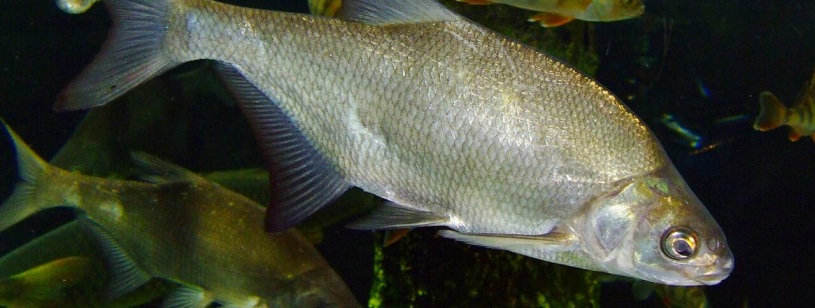
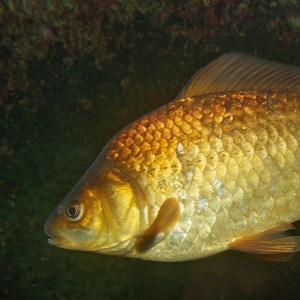
Common bream (Abramis brama) in an aquarium. · Микова Наталия / Public domain ().
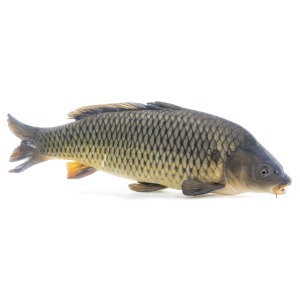
The common bream has a deep body flattened from side to side. Shoals move through lakes and slow rivers, feeding near the bottom. Its mouth can extend forwards and downwards to collect food. Young fish are usually silvery, while larger adults often develop a bronze colour.
Quick facts
| Common name | Common bream |
| Scientific name | Abramis brama |
| Lifespan | About 15–20 years under favourable conditions |
| Diet | Omnivore; many invertebrates and zooplankton |
| Predators | Pike, zander and fish-eating birds, particularly for smaller fish |
| Conservation status | Least Concern (LC), global assessment 2023 |
| Distribution | Europe and parts of Asia |
| Habitat | Lakes, ponds, canals and slow rivers |
| Length | Often 30–40 cm; larger individuals occur |
| Family | Leuciscidae |
| Reproduction | Adhesive eggs in shallow water |
Interesting facts
- The deep body looks much narrower from the front.
- A long-based anal fin helps identification.
- An extendable mouth collects food from sediment.
- Breeding males may develop small bumps on the head.
Characteristics
The back forms a pronounced arch above a relatively small head. Broad flanks distinguish bream from more cylindrical fishes. The tail is forked and the fins generally grey or brown.
A silvery juvenile can look different from a bronze adult. Body shape, mouth position and anal-fin outline should therefore be considered together. Size alone cannot provide an exact age because growth depends on available resources.
Behaviour
Bream gather in shoals and move between resting and feeding areas. They are not distributed evenly throughout a lake: groups use places that provide suitable conditions.
Behaviour changes during spawning. Males may defend parts of the breeding ground, and movements towards the margins become more conspicuous. Smaller fish are especially exposed to pike, zander and fish-eating birds.
Habitat and distribution
The native range extends across Europe into parts of Asia. In Romania, bream occupy lowland rivers, lakes and floodplain waters.
Slow-moving habitats with food on the bottom are frequently used. Some populations also enter slightly brackish water, without becoming marine fish. The Danube Delta’s network of channels, lakes and vegetated margins offers neighbouring habitats with different conditions.
Diet and feeding
Important foods include insect larvae, worms, crustaceans and small molluscs. Young fish consume much zooplankton, the tiny animals living in the water column.
Bream can also filter small food particles from water. Diet changes with fish size and local availability. The extendable mouth suits feeding on the substrate, making the often-unseen lake bottom important to the species.
Reproduction and life cycle
Spawning takes place in spring or early summer, depending on water temperature. Shallow areas with plants or suitable attachment surfaces are valuable. Eggs are adhesive.
Males may develop pale breeding tubercles on the head and front of the body. These are associated with the reproductive season. Young fish use different resources from large adults, so varied depths and vegetated edges support multiple life stages.
Name and history
The scientific name is Abramis brama, placed in Leuciscidae by the current FishBase classification. Older references to the carp family use a broader grouping.
Common bream is distinct from other fishes also called bream, including unrelated marine species. Scientific names help prevent confusion when comparing guides written in different languages.
Conservation and threats
The global category is Least Concern. Widespread species can still have local populations affected by habitat change.
Pollution, loss of marginal plants and isolation of floodplain waters can reduce habitat quality. Managing lakes also requires attention to the invertebrates that provide food. Protecting the whole freshwater community supports bream as well as their prey and predators.
Frequently asked questions
How do you recognise common bream?
Look for a deep, flattened body, relatively small head and long-based anal fin.
Is bream a specialised predator?
No. It is an omnivore eating many invertebrates rather than a specialised fish-hunter like pike.
Why are some bream silver?
Young fish are generally more silvery; adults may develop bronze tones.
Does bream live alone?
It generally forms shoals, although behaviour changes during breeding.