Common roachRutilus rutilus — habitat, diet and reproduction
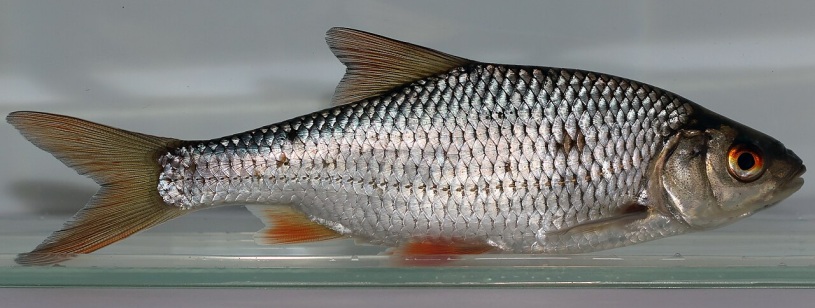
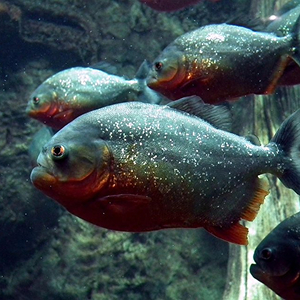
Common roach (Rutilus rutilus) photographed in an aquarium. · George Chernilevsky / CC BY 4.0 (https://creativecommons.org/licenses/by/4.0). Cropped and resized.
The common roach is a silvery fish with often reddish eyes and coloured lower fins. It forms shoals in lakes, ponds and slow rivers. Although it resembles rudd, mouth shape and fin position help distinguish them. A varied diet allows it to feed both near the bottom and among plants.
Quick facts
| Common name | Common roach |
| Scientific name | Rutilus rutilus |
| Lifespan | Around a decade, varying between populations |
| Diet | Omnivore |
| Predators | Predatory fish, herons and cormorants |
| Conservation status | Least Concern (LC), global assessment 2024 |
| Distribution | Europe and Asia; introduced elsewhere |
| Habitat | Lakes, ponds, canals and slow rivers |
| Length | Around 25 cm is common; larger fish occur |
| Family | Leuciscidae |
| Reproduction | Adhesive eggs laid in spring |
Interesting facts
- Red eye colour may be less obvious in young fish.
- Fin colour varies between individuals and different fins.
- Shoals may contain many fish in favourable areas.
- New larvae first use nutrients stored in their yolk sac.
Characteristics
The body is laterally compressed but lacks the very deep profile of an adult bream. Silvery scales reflect light, and the back is darker than the belly.
The mouth opens at the end of the head, whereas rudd have a more upturned mouth. In roach the dorsal fin begins roughly above the pelvic fins. Age, light and individual variation affect colour, so several features should be considered together.
Behaviour
Roach commonly move in shoals. Groups use areas with food and cover, changing their distribution with season and water conditions.
Short movements towards spawning places occur in spring, while deeper water may be used in cold periods. There is no compulsory migration to the sea. As prey for other animals, roach connect smaller food organisms with larger predators.
Habitat and distribution
The species ranges widely across Europe and Asia. Romanian populations occur in many lowland waters, including the Danube system and associated lakes.
Ponds, canals and slow river sections are used. Some populations also occupy brackish water, where fresh and salty water mix. Plant-covered margins provide resources different from open water, making habitat variety important.
Diet and feeding
Roach eat insect larvae, small crustaceans, molluscs and zooplankton, alongside plants, seeds and organic debris. The proportions change with age and local availability.
Using several foods reduces dependence on one prey type, but food supply still influences growth and competition. Roach themselves feed predatory fishes and birds. Herons can catch individuals in shallow water.
Reproduction and life cycle
Spawning generally takes place in spring, with timing influenced by temperature. Adhesive eggs attach to plants, roots or other submerged surfaces, often in shallow water.
Larvae initially remain close to the support and use their own nutrient reserves before feeding actively. A small vegetated margin can therefore serve as a nursery. Removing all plants or rapidly lowering water levels can remove these conditions.
Name and history
Rutilus rutilus identifies the European common roach. Current classification places it in Leuciscidae, although many older guides use the carp family in a broader sense.
The English word roach can also abbreviate cockroach, but here it refers to a fish. Comparisons with rudd are common because the species share some features and habitats.
Conservation and threats
The global category is Least Concern. This does not guarantee a healthy population in every lake or river.
Pollution and damage to spawning areas can affect breeding. Water quality matters both to the fish and to the small animals it eats. Conserving wetland mosaics and vegetated banks helps maintain the wider freshwater community.
Frequently asked questions
Are roach and rudd the same fish?
No. Mouth shape and fin position help distinguish these different species.
Does roach eat only plants?
No. It also consumes invertebrates, zooplankton and other food.
Are the eyes always red?
Colour varies and may be less obvious in juveniles.
Where are eggs laid?
In shallow water on vegetation, roots or other surfaces to which eggs can attach.