Northern lapwingVanellus vanellus — habitat, diet and reproduction
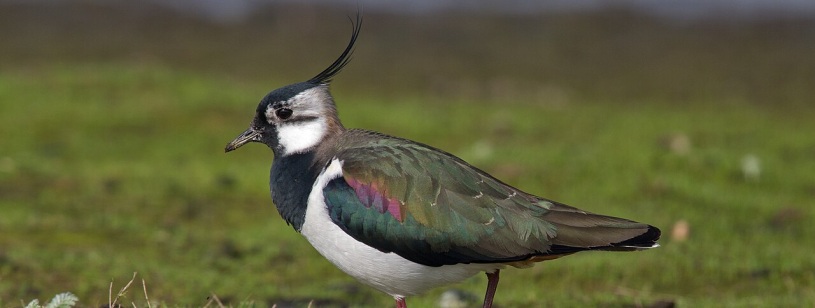
Northern lapwing (Vanellus vanellus) on grassland. · Andreas Trepte / CC BY-SA 2.5 (https://creativecommons.org/licenses/by-sa/2.5). Cropped and resized.
The northern lapwing is an open-country bird recognised by its long crest and broad wings. At close range, its dark back shows green and purple reflections. It nests directly on the ground, and chicks soon walk among the plants. This dependence on the ground makes it vulnerable to agricultural operations.
Quick facts
| Common name | Northern lapwing |
| Scientific name | Vanellus vanellus |
| Lifespan | About 5 years, BTO typical value for birds reaching breeding age |
| Length | 28–31 cm |
| Wingspan | 82–87 cm |
| Weight | 128–330 g |
| Diet | Carnivore: chiefly invertebrates |
| Conservation status | Near Threatened (NT), global assessment 2025 |
| Distribution | Europe and Asia; also winters in parts of northern Africa |
| Habitat | Grassland, farmland and open wetlands |
| Family | Charadriidae |
| Reproduction | Usually 4 eggs in a shallow ground scrape |
- Primary category:Birds
- Explore this animal's categories:Animals of AfricaAnimals of AsiaAnimals of EuropeAnimals of RomaniaAnimals of Romania’s grasslands and plainsAnimals of the Danube DeltaBirdsBirds of RomaniaCarnivoresEgg-laying animalsFeathered animalsFlying animalsInsect-eating animalsMigratory animalsMigratory birdsNVertebratesWetland animalsWild animals
Interesting facts
- Broad rounded wings create a distinctive flight shape.
- Dark plumage looks black at a distance but has coloured reflections.
- Chicks forage on foot under adult protection.
- Foot trembling sometimes accompanies searches for invertebrates.
Characteristics
A narrow upward-curving crest is conspicuous. Back and wings have green and purple gloss, contrasting with the white belly. The black breast area is more clearly defined in breeding males.
In flight the wings are broad with rounded tips, unlike the pointed outline of many other open-country birds. Females generally have shorter crests and less sharply contrasting head markings. Light and season affect apparent colour.
Behaviour
Breeding lapwings defend their nesting area. Display flights combine turns and broad wing movements with calls.
On the ground they walk and pause to locate food, foraging by day or night. Groups form outside breeding. Adults may call vigorously around an intruder, and prolonged disturbance can keep them away from eggs or chicks.
Habitat and distribution
The breeding range extends across Europe and Asia. Grassland, arable fields and open wetlands are used, with short vegetation allowing a clear view.
In Romania the species occurs across many lowland areas and generally avoids mountains. Most migrate, but some remain in winter, especially in the south. Wet grassland and pool margins provide important resources within farmland.
Diet and feeding
Food includes earthworms, insects and larvae, spiders, snails and other invertebrates. Prey is taken from the surface or accessible soil.
Foot trembling can help reveal prey. Moist ground and short vegetation assist foraging, whereas dry conditions may restrict access. Chicks need many small captures: an open field is not necessarily suitable without invertebrates and damp patches.
Reproduction and life cycle
The nest is a shallow scrape with a little plant lining. Mottled eggs blend with the soil, and four are usually laid. Incubation lasts roughly three to five weeks depending on conditions and population.
Down-covered chicks walk soon after hatching. They find their own food but still require adult protection and warmth. Flight becomes possible after about five to six weeks. Machinery can harm both fixed nests and mobile chicks.
Name and history
Vanellus vanellus is linked to a Latin term for a small fan, associated with the wings. The species belongs to Charadriidae, a family of plovers and related birds.
Its English name also draws attention to flight. Wing shape helps identification when the crest is too distant to see.
Conservation and threats
The 2025 global assessment lists the lapwing as Near Threatened, with a decreasing population. Habitat change and inadequate breeding success are major concerns.
Drainage, simplified landscapes and farming operations during nesting can reduce survival. Retaining damp areas and adjusting work around occupied breeding sites can help. Conservation must connect wetland needs with farmland management.
Frequently asked questions
Does a lapwing nest in trees?
No. It uses a shallow scrape on the ground, usually among short vegetation.
Can chicks walk immediately?
They move very early and find food, but still need adult protection.
Is the lapwing endangered?
Its current global category is Near Threatened, with a declining population. This differs from the Endangered category.
Why can farming affect it?
Eggs and chicks are on the ground. Machinery, drainage and reduced food can lower breeding success.