ServalLeptailurus serval — habitat, diet and reproduction
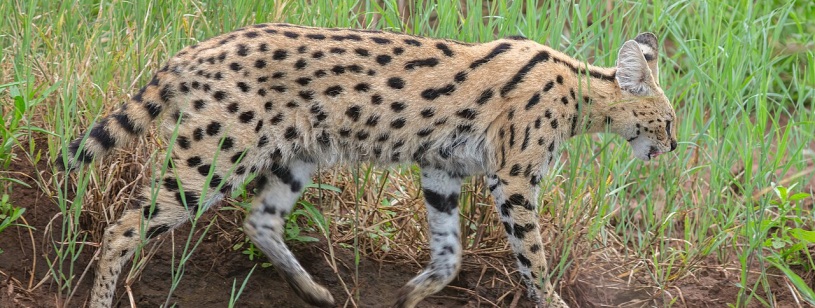
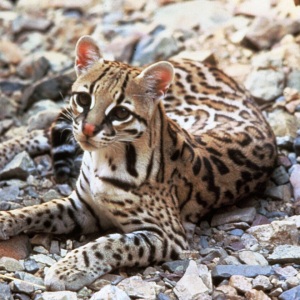
Serval with large rounded ears and a yellowish coat covered in black spots. · Diego Delso, delso.photo / Wikimedia Commons / CC BY-SA 4.0 (https://creativecommons.org/licenses/by-sa/4.0/). Cropped and resized. Source: https://commons.wikimedia.org/wiki/File:Serval_(Leptailurus_serval),_parque_nacional_Serengueti,_Tanzania,_2024-05-26,_DD_06.jpg
The serval (Leptailurus serval) is an African wild cat with exceptionally long legs and large ears. It listens for rodents moving through grass, then pounces with its front paws. Its spotted coat conceals it in vegetation. Grasslands and savannas near water provide suitable hunting grounds.
Quick facts
| Common name | Serval |
| Scientific name | Leptailurus serval |
| Lifespan | Around 10 years in some wild estimates; 22.4 years documented in captivity |
| Length | 59–100 cm head and body; tail about 28–38 cm |
| Weight | 7–18 kg |
| Diet | Mostly rodents, plus birds and other small animals |
| Predators | Leopards, hyenas and African wild dogs |
| Conservation status | Least Concern globally; regional populations may be vulnerable |
| Distribution | Mainly sub-Saharan Africa; isolated northern populations |
| Habitat | Grassland, wet savanna, reedbeds and watersides |
| Family | Felidae |
| Reproduction | Usually 2–3 kittens after roughly two and a half months of gestation |
Interesting facts
- Rotating ears help pinpoint prey hidden in vegetation.
- Long legs raise the head above grass and power a pounce.
- A forepaw can reach into a burrow to extract prey.
- Black individuals occur, especially in some East African highlands.
Records and extremes
Relative to body size, servals have exceptionally large ears and long legs among cats. These proportions suit hunting in tall vegetation.
Zoological sources describe vertical leaps of approximately 3 m. Birds and insects can be struck in the air, while rodent attacks end with the front paws landing on prey.
AnAge records a captive lifespan of 22.4 years. This exceptional record differs from typical wild lifespan estimates.
Characteristics
A small head and long neck sit above a slender body. Large rounded ears have dark backs with a pale marking.
The coat ranges from pale yellow to brownish gold. Black spots merge into stripes around the neck and shoulders. The relatively short tail is ringed and black-tipped.
Compared with a caracal, the serval has a conspicuously spotted coat and rounded ears without long tufts. Males are generally larger.
Behaviour
Adults usually live alone and mark territories with scent. Calls include meows, growls, hisses and purring. Encounters between adults are generally brief.
Hunting often occurs around dawn, dusk and at night. Cooler conditions or the demands of feeding kittens can increase daytime activity.
A hunting serval pauses to listen, approaches carefully and pounces. Dense plants and abandoned shelters provide resting places.
Habitat and distribution
The species occurs mainly south of the Sahara. Northern populations are isolated and their situation is less certain. Water and prey influence local distribution.
Wet grassland, savanna, marshes and riverside reeds are favoured. Agricultural areas may be used where cover and rodents remain.
Tall grass offers concealment and food. Vegetated connections between wet areas help movement across the landscape.
Diet and feeding
Rodents dominate the diet in many regions. Birds, frogs, reptiles, large insects and occasional fish add variety according to local availability.
Large ears detect faint movements, while long forelegs reach into hiding places. Curved claws secure captured animals.
Stalking, pouncing and probing with a paw provide several ways to catch prey. Rodent predation helps shape local food webs.
Reproduction and life cycle
A female gives birth among dense grass, rocks or in an abandoned burrow. Gestation lasts roughly two and a half months, usually producing 2–3 kittens.
She raises them alone and may move the hiding place. Milk is gradually supplemented with meat brought back from hunts.
Youngsters develop hunting skills before becoming fully independent. Separation is gradual, and young females may remain near their mother longer.
Name and history
Schreber described the species in 1776 as Felis serval. Its accepted scientific name is Leptailurus serval.
The common name is associated with a Portuguese term for a lynx. Modern classification places the serval separately from Lynx, closer to the caracal and African golden cat.
Conservation and threats
Globally classified as Least Concern, servals still face local pressures. Wetland loss, trapping and hunting for spotted skins affect populations.
Poultry losses can lead to conflict. Protecting domestic birds and preserving habitat can reduce pressure on wild cats.
WWF describes the challenges of meeting a serval’s wild behavioural and space needs in a home. Specialist facilities or observation in suitable habitat offer more appropriate ways to learn about it.
Frequently asked questions
How does it find prey in tall grass?
Sensitive hearing and mobile ears help locate hidden movements.
Is it the same as a caracal?
They are separate species. A serval has a spotted coat and large rounded ears.
What does it eat most often?
Rodents, supplemented by birds and other small animals.
Can it catch flying birds?
Yes. Vertical leaps and strikes with the front paws can capture birds in the air.
Who raises the kittens?
The female shelters and feeds them as they gradually develop hunting skills.
Is it suited to life as a pet?
Its wild behaviour and space needs are difficult to meet in a household.