Hammerhead sharkInteresting facts and information
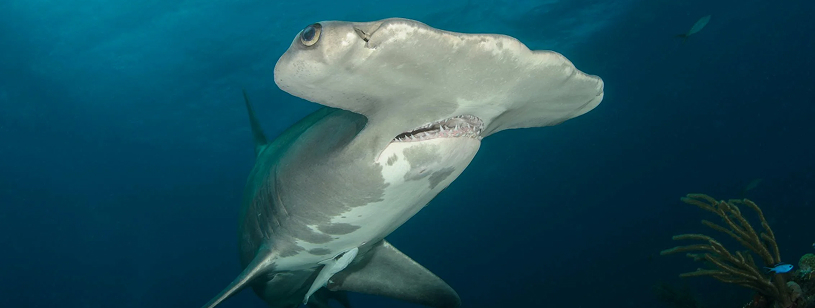
Hammerhead sharks belong to the family Sphyrnidae. Their broad, flattened heads carry sensory organs used to detect their surroundings and prey. The different species vary greatly in size, habitat and conservation status.
Hammerheads include several species. Examples are:
- Great hammerhead (Sphyrna mokarran) — a large hammerhead species.
- Scalloped hammerhead (Sphyrna lewini) — sometimes forms large schools.
- Bonnethead (Sphyrna tiburo) — a smaller member of the family.
Fishing pressure threatens several hammerhead species. Their roles and conservation status need species-specific descriptions.
Quick facts
| Common name | Hammerhead shark |
| Scientific name | Sphyrnidae (family) |
| Typical lifespan | About 20-30 years or more, depending on species |
| Length | About 0.9-6 m, depending on species |
| Weight | About 3-580 kg |
| Diet type | Carnivore (fish, squid, crustaceans, stingrays, smaller sharks); the bonnethead also eats seagrass |
| Main predators | Larger sharks, orcas; humans (overfishing) |
| Conservation status | Assess separately by species; the great and scalloped hammerheads are Critically Endangered |
| Distribution | Warm temperate and tropical seas worldwide |
| Living environment | Coastal waters, continental shelves, coral reefs, estuaries, seamounts |
- Primary category:Fish
- Explore this animal's categories:
Interesting facts
- Wide-angle vision - Because its eyes are at the ends of the "hammer", a hammerhead can see above and below at the same time.
- A strong electrical sense - The wide head carries many ampullae of Lorenzini, organs that detect the weak electric fields of prey hidden in the sand.
- Pinning prey - Great hammerheads have been seen pinning stingrays to the sea floor with their heads before biting them.
- Long journeys - A great hammerhead tracked by scientists travelled about 1,200 km in about two months.
- Large schools - Unlike most sharks, scalloped hammerheads gather by day in schools of hundreds of animals, for example around the Galápagos and Cocos Island.
Records and remarkable features
- Hammerhead sharks belong to the family Sphyrnidae. Their broad, flattened heads carry sensory organs used to detect their surroundings and prey. The different species vary greatly in size, habitat and conservation status.
Physical characteristics and unique adaptations
Hammerhead sharks are among the most distinctive sharks because of their unusually shaped head, which helps them find prey and manoeuvre.
Essential physical adaptations
- A hammer-shaped head (cephalofoil) - Its width varies between species; it spreads out the eyes, nostrils and electrical sensors, helping the shark find prey.
- A streamlined body - Its long, muscular body allows fast swimming and sharp turns.
- A tall dorsal fin - The great hammerhead (Sphyrna mokarran) has a very tall, sickle-shaped first dorsal fin.
- A mouth under the head - Suited to catching prey on or near the sea floor.
- Countershading - Grey-brown or olive above and white below, which makes the shark harder to see from above or below.
Dimensions and variations between species
| Species | Maximum length | Maximum weight |
|---|---|---|
| Great hammerhead (Sphyrna mokarran) | About 6 m | About 580 kg |
| Scalloped hammerhead (Sphyrna lewini) | About 4 m | About 150 kg |
| Bonnethead (Sphyrna tiburo) | About 1.5 m | About 10 kg |
Habits and behaviour
Hammerheads are active, mobile predators, and some species behave quite differently from other sharks.
Life Mode
- Solitary and social species - The great hammerhead usually lives alone, while the scalloped hammerhead often forms large schools by day.
- Night hunting - Many hammerheads hunt mostly at night; scalloped hammerheads leave their daytime schools to feed alone.
- Migration - Some hammerheads travel hundreds or thousands of kilometres, often following warm water.
- Depth - Most are found in fairly shallow coastal waters, but scalloped hammerheads can dive to several hundred metres at night.
Social organisation
- Schools - Scalloped hammerhead schools are often made up mostly of females.
- Position in the school - Larger females tend to swim in the middle of the school and use head shakes and other movements towards one another.
Communication
- Body language - Head shakes, body bends and fin positions seem to be used as signals in schools.
- Senses - Hammerheads also use smell, vision and electrical senses to find prey and other sharks.
Defence techniques
- Speed and agility - Hammerheads can turn very sharply and accelerate quickly.
- Schooling - Swimming in large groups may offer young sharks some protection from larger predators.
- Shallow nurseries - Young hammerheads grow up in shallow coastal waters, where there are fewer large predators.
Habitat and geographic distribution
Hammerhead sharks live in warm temperate and tropical waters around the world, mostly near coasts and continental shelves.
Population distribution
| Region | Species present |
|---|---|
| Western Atlantic | Sphyrna mokarran, Sphyrna lewini, Sphyrna tiburo |
| Eastern Pacific | Sphyrna lewini, Sphyrna tiburo, Sphyrna corona, Sphyrna media |
| Indian Ocean | Sphyrna mokarran, Sphyrna lewini, Sphyrna zygaena |
| Indo-Pacific coasts | The winghead shark (Eusphyra blochii), with the widest head of all |
Habitats
- Coastal areas - Many hammerheads live near coral reefs and over continental shelves.
- Open waters - Some species, such as the great and scalloped hammerheads, also move into deeper, more open waters.
- Estuaries and seagrass beds - The bonnethead (Sphyrna tiburo) prefers shallow bays, estuaries and seagrass meadows.
- Seamounts and islands - Scalloped hammerheads gather around underwater mountains and oceanic islands.
Impact of environmental change
- Overfishing - Hammerheads are caught in large numbers, and their fins are highly valued in the shark fin trade.
- Climate change - Warming seas may change where hammerheads and their prey live.
- Coastal development - Damage to shallow nursery areas affects young sharks.
Diet and feeding
Hammerhead sharks are predators that feed on a wide range of marine animals. Their head shape helps them find and catch prey.
What does the hammerhead eat?
| Food type | Specific examples |
|---|---|
| Fish | Sardines, herring, mackerel, groupers, flatfish |
| Cephalopods | Squid and octopus |
| Crustaceans | Crabs, shrimps, lobsters |
| Other sharks | Smaller sharks, sometimes other hammerheads |
| Stingrays | A favourite food of the great hammerhead |
| Seagrass | The bonnethead also eats and digests seagrass |
Method of feeding
- Electrical sensing - Ampullae of Lorenzini help hammerheads find prey hidden under the sand.
- Pinning prey - The great hammerhead uses its wide head to press stingrays against the sea floor before biting them.
- Sweeping the bottom - Hammerheads swing their heads from side to side over the sea floor, like a metal detector.
Reproduction and life cycle
Hammerhead sharks are viviparous: the young develop inside the mother, fed through a placenta, and are born live and able to look after themselves.
Breeding season
- Larger species, such as the great hammerhead, usually breed every two years.
- During mating, the male bites the female to hold on, as in many other sharks.
- Females often give birth in warm, shallow coastal waters.
Pregnancy and childbirth
| Characteristic | Details |
|---|---|
| Type of reproduction | Viviparous, with a placenta (live young) |
| Duration of pregnancy | About 5 months (bonnethead) to about 11 months (great hammerhead) |
| Number of young per birth | About 4-40, depending on species |
| Length of pups at birth | About 30-70 cm |
| Full independence | Immediately after birth |
- Young are born in shallow bays and coastal waters, which act as nurseries.
- The mother does not look after her pups; they must find food on their own.
- Young hammerheads stay in shallow waters, where they are safer from large predators.
Name and history
Origin of name
- The name "hammerhead" comes from the shape of the head, which looks like a hammer.
- The genus name Sphyrna comes from the Greek word sphyra, meaning "hammer".
Taxonomic Classification
| Classification | Name |
|---|---|
| Kingdom | Animalia |
| Phylum | Chordata |
| Class | Chondrichthyes |
| Order | Carcharhiniformes |
| Family | Sphyrnidae |
| Genus | Sphyrna (and Eusphyra) |
| Main species | Sphyrna mokarran, Sphyrna lewini, Sphyrna zygaena, Sphyrna tiburo |
Evolution and fossils
- Hammerhead sharks probably appeared about 20 million years ago, as a branch of the ground sharks (Carcharhiniformes).
- Their closest relatives are the requiem sharks, such as tiger sharks and reef sharks.
- Genetic studies suggest that the winghead shark, with the widest head, belongs to one of the oldest branches of the family, so early hammerheads may already have had wide heads.
Cultural significance and mythology
Hammerhead sharks have an important place in the traditions of some Pacific island peoples and today attract divers from all over the world.
- Hawaii - In Hawaiian tradition, some families had sharks as ʻaumakua, ancestral guardian spirits; the hammerhead is called manō kihikihi.
- Torres Strait - For some Torres Strait Islander communities, the shark is an important clan totem.
- Diving - Schools of scalloped hammerheads around the Galápagos, Cocos Island (Costa Rica) and Malpelo (Colombia) are among the most famous sights in the diving world.
Conservation status and threats
Many species of hammerhead sharks are endangered, mainly because of overfishing for their meat and fins.
Conservation status
| Species | IUCN Status | Trends |
|---|---|---|
| Great hammerhead (Sphyrna mokarran) | Critically Endangered | Decreasing |
| Scalloped hammerhead (Sphyrna lewini) | Critically Endangered | Decreasing |
| Bonnethead (Sphyrna tiburo) | Endangered | Decreasing |
Main threats
- Fishing for fins - Hammerhead fins are among the most valuable in the trade for shark fin soup.
- Bycatch - Hammerheads are often caught by accident in nets and on longlines set for other fish, and many die quickly once caught.
- Loss of nursery areas - Coastal development and pollution damage the shallow waters where pups grow up.
- Climate change - Warming seas may change their movements and food supply.
Protection measures
- Trade controls - Since 2014, international trade in several hammerhead species has been controlled under CITES.
- Fishing bans and limits - Some countries ban the landing of hammerheads or the removal of shark fins at sea.
- Marine protected areas - The Galápagos Marine Reserve and Cocos Island National Park protect important hammerhead gathering sites.
- Research and tracking - Scientists use satellite and acoustic tags to follow hammerhead movements.
In popular culture
Films and cartoons
- "Finding Nemo" (2003) - Anchor, a hammerhead shark, is one of the members of the "Fish are friends, not food" shark group.
- Nature documentaries - Schools of hammerheads and the great hammerhead hunting stingrays appear in many films about the ocean.
Mascots and symbols
- Shark conservation - The hammerhead's unusual head makes it one of the most recognisable sharks and a symbol of campaigns against finning.
- Diving tourism - Dive centres in places such as the Galápagos and Costa Rica often use the hammerhead in their logos.