Black pantherInteresting facts and information
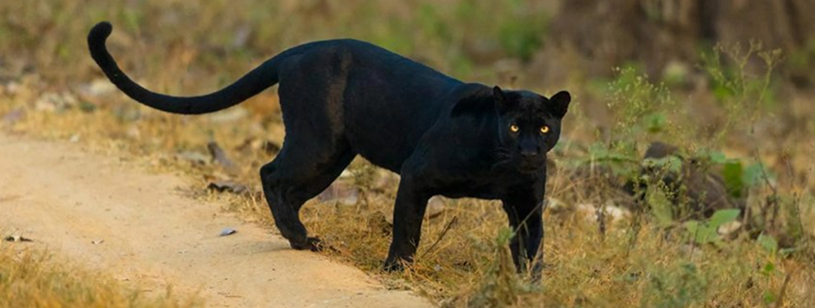
Black panther refers to melanistic leopards or jaguars, not a separate species.
Black panthers are powerful predators that often hunt at night and are well camouflaged in dense, shady forests. They are much rarer than spotted leopards and jaguars in most places, and they have long fascinated people as symbols of power, mystery and elegance.
Quick facts
| Common name | Black panther |
| Scientific name | Panthera pardus or Panthera onca (melanistic individuals) |
| Typical lifespan | About 12-15 years in the wild, over 20 years in captivity |
| Maximum speed | Varies with species or individual, distance and conditions |
| Height to shoulder | About 45 - 80 cm |
| Length | About 1.5 - 2.7 m (including tail) |
| Weight | About 30 - 90 kg (leopard) / 55 - 120 kg or more (jaguar) |
| Diet type | Carnivore (small and large mammals, birds, reptiles, fish) |
| Main predators | Humans; tigers, lions and large crocodiles occasionally |
| Conservation status | Assess separately by species and population; different taxa and regions have different needs |
| Habitat | Tropical forests, mountains, swamps; less often savannas |
- Primary category:Mammals
- Explore this animal's categories:
Interesting facts
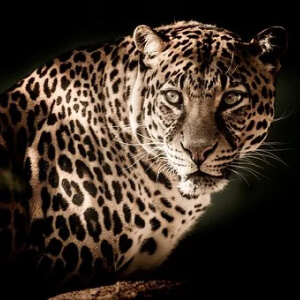
- Hidden spots - A black panther's coat is not completely black; in the right light, the rosettes typical of leopards or jaguars can still be seen.
- Not one species - In Africa and Asia, black panthers are melanistic leopards; in Central and South America, they are melanistic jaguars.
- Different genetics - In leopards, black coat colour is caused by a recessive gene, while in jaguars it is caused by a dominant one.
- Good swimmers - Jaguars, including black ones, are strong swimmers and often hunt in and near water.
- Solitary cats - Leopards and jaguars live and hunt alone and mark their territories with scratches and scent.
- A powerful bite - The jaguar has one of the strongest bites of any cat relative to its size and can bite through turtle shells.
- Shining eyes - A reflective layer at the back of the eye, called the tapetum lucidum, helps these cats see well at night.
Records and remarkable features
- Black panther refers to melanistic leopards or jaguars, not a separate species.
- In the southern Malay Peninsula, almost all leopards are black.
Physical characteristics and adaptations
The black panther is a melanistic, or dark-coloured, form of the leopard (Panthera pardus) or the jaguar (Panthera onca). Apart from its colour, it is the same as other leopards or jaguars.
Distinguishing physical appearance
- Black coat with hidden rosettes - The coat looks black, but the usual spots can be seen in bright light.
- Bright eyes - The eyes are green, yellow or amber and shine at night because of the tapetum lucidum.
- A muscular, agile body - Built for powerful attacks and long leaps.
- A long tail - Helps with balance when climbing and running.
Adaptations for survival
- Camouflage - A dark coat can help them hide in dense, shady forests.
- Great strength - Jaguars can kill prey with a bite to the skull and crack the shells of turtles.
- Swimming - Jaguars swim well and hunt fish, caimans and turtles.
- Climbing - Leopards climb trees easily and often haul their prey up into the branches.
Habits and behaviour
Like other leopards and jaguars, black panthers are mostly solitary and often hunt at night or at dusk.
Solitary and territorial behaviour
- Living alone - Adults live alone and mark their territories with urine, droppings and scratches on trees.
- Avoiding larger predators - Leopards avoid lions, tigers and hyenas, which can kill them or steal their food.
Hunting techniques
| Technique | Description |
|---|---|
| Stalking | Creeping close to prey through vegetation before a short, fast attack. |
| Night hunting | Excellent night vision helps them hunt in the dark. |
| Powerful bites | Jaguars often kill with a bite to the skull; leopards usually bite the throat. |
| Storing prey | Leopards carry prey into trees to keep it away from other predators. |
Communication and interactions
- Territorial marks - Scratches on trees and scent marks tell other cats who lives in an area.
- Calls - Leopards make a rasping "sawing" call, and jaguars make deep grunting roars; like other big cats, they cannot purr continuously.
- Meeting only to mate - Males and females usually meet only to mate.
Habitat and geographic distribution
Black panthers occur where leopards and jaguars live, but they are much more common in some regions than in others.
Geographical distribution
| Region | Melanistic species |
|---|---|
| South and Southeast Asia | Melanistic leopard (Panthera pardus), common in Malaysia, Java and southern India |
| Africa | Melanistic leopard (Panthera pardus), rare; recorded in Ethiopia and Kenya |
| South America | Melanistic jaguar (Panthera onca) |
| Central America | Melanistic jaguar (Panthera onca) |
Habitats
- Tropical forests - Black panthers are most common in dense, humid forests, such as those of Malaysia, India and the Amazon.
- Other habitats - Leopards and jaguars also live in savannas, dry forests, swamps and mountains, but black individuals are rarer there.
- Mountains - Black leopards have been recorded in mountain forests, for example in Ethiopia.
Habitat threats
- Deforestation - Habitat loss reduces prey and brings big cats into conflict with people.
- Poaching - Leopards and jaguars are killed for their skins, bones and other body parts.
- Conflict with farmers - When they kill livestock, they are sometimes killed in revenge.
Diet and feeding
Black panthers are top predators with few natural enemies apart from humans. Their diet depends on the habitat and the prey available.
What does the black panther eat?
| Type of prey | Examples |
|---|---|
| Large mammals | Deer, wild pigs, antelopes; capybaras and peccaries (jaguars) |
| Small mammals | Hares, rodents, monkeys |
| Birds | Peafowl, junglefowl, water birds |
| Reptiles | Snakes, turtles, caimans (jaguars) |
| Fish | Freshwater fish (especially jaguars) |
Hunting techniques
- Camouflage - In dark forests, the black coat helps these cats get close to their prey.
- The killing bite - Jaguars often bite through the skull, while leopards usually bite the throat or neck.
- Night hunting - They often hunt at night, when their excellent night vision gives them an advantage.
- Carrying prey - Leopards drag their prey up trees, out of reach of hyenas and lions.
Reproduction and life cycle
Black panthers breed like other leopards and jaguars, and a black cub can be born in a litter with normally spotted siblings.
Breeding and birthing of young
| Characteristic | Details |
|---|---|
| Breeding season | All year round in most areas |
| Pregnancy period | About 90-105 days |
| Number of young | Usually 1-4 cubs |
| Independence of young | About 1-2 years |
- Males and females meet only to mate.
- The mother raises the cubs alone, protecting them and teaching them to hunt.
- Cubs are born blind and are very vulnerable in their first months.
Survival of young
- Many cubs die young, killed by other predators, disease or lack of food.
- Mothers hide their cubs in dense vegetation, caves or hollow trees and move them often.
Longevity
- In the wild, leopards and jaguars usually live about 12-15 years; in captivity they can live more than 20 years.
Name and history
Origin of the name "Black Panther"
- "Panther" comes from the Greek panthēr, often explained as "all-beast", although this is probably a folk explanation.
- "Black" refers to melanism, an excess of dark pigment in the coat.
Taxonomic Classification
| Kingdom | Animalia |
|---|---|
| Phylum | Chordata |
| Class | Mammalia |
| Order | Carnivora |
| Family | Felidae |
| Genus | Panthera |
| Associated species | Panthera pardus (leopard) or Panthera onca (jaguar), depending on the individual |
History and documentation
- Black leopards and jaguars have long been known to local people in Asia and the Americas.
- Genetics - Research in the early 2000s identified the gene changes that cause melanism in leopards and jaguars.
- Africa - In 2019, scientists in Kenya published camera-trap images of a black leopard, one of very few confirmed records from Africa.
Cultural significance and mythology
Black panthers and their spotted relatives have been symbols of power and mystery in many cultures.
Big cats in mythology and religion
- The Aztecs - Jaguar warriors were an elite group of Aztec soldiers, and the jaguar was linked with the god Tezcatlipoca, the "smoking mirror".
- The Maya - Maya rulers wore jaguar skins, and jaguar gods were linked with the night and the underworld.
- India - Black leopards, such as the famous black panther of Kabini forest, attract many wildlife photographers and tourists.
- Africa - Leopard skins were symbols of power and rank in many African cultures.
Black Panther Symbolism
| Context | Meaning |
|---|---|
| Mesoamerica | Power, night and rulership |
| Modern culture | Strength, elegance and mystery |
| Social movements | Courage and self-defence, as in the Black Panther Party |
| Sport | Speed, power and agility |
Beliefs about the black panther
- Because they are rare and hard to see, black panthers have often been surrounded by mystery and legend.
- Reports of "black panthers" in places where no wild big cats live, such as Britain, are usually mistaken sightings or escaped animals.
Conservation status and threats
Black panther refers to melanistic leopards or jaguars, not a separate species.
Main threats
- Deforestation - Tropical forests in South America, Africa and Asia are cleared for farming and development.
- Poaching - Leopards and jaguars are killed illegally for skins, trophies and body parts used in traditional medicine.
- Conflict with people - When they kill livestock, they may be killed by farmers.
- Loss of prey - Hunting of deer, pigs and other prey by people leaves less food for big cats.
Conservation status (IUCN)
| Species | Status |
|---|---|
| Leopard (Panthera pardus) | Vulnerable |
| Jaguar (Panthera onca) | Near Threatened |
Conservation efforts
- Protected areas - Reserves such as Nagarahole (Kabini) in India and large protected areas in the Amazon help protect leopards and jaguars.
- Laws against poaching - International trade in leopard and jaguar parts is banned under CITES, but enforcement is difficult in some regions.
- Wildlife tourism - Responsible tourism can raise money for protecting habitats.
In popular culture
Thanks to its rare and striking look, the black panther has become a powerful symbol in films, literature, sport and politics.
Black Panther in Literature and Comics
- "The Jungle Book" (Rudyard Kipling, 1894) - Bagheera, a black panther, is Mowgli's wise protector.
- Marvel Comics - Black Panther, the superhero T'Challa, king of the fictional African nation of Wakanda, first appeared in 1966.
Black panther in movies and animations
- "Black Panther" (2018, Marvel Studios) - A hugely successful film about T'Challa and Wakanda.
- "The Jungle Book" (Disney, 1967 and 2016) - Bagheera is one of the best-known black panthers in film.
Black panther in sports and emblems
- Sport - The Carolina Panthers, an American football team, have a black panther in their logo.
- Social movements - The Black Panther Party, founded in the USA in 1966, took the black panther as its symbol.