Snow leopardInteresting facts and information
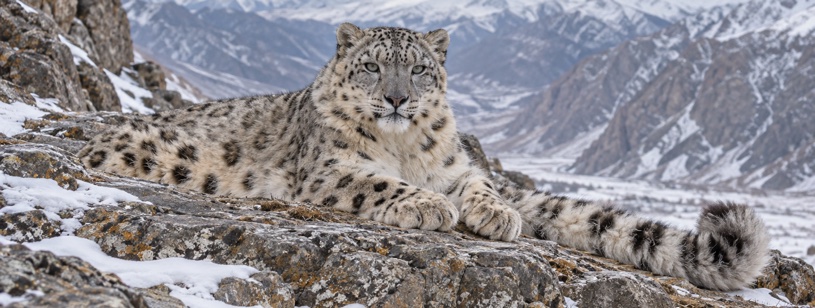
AI illustration of a snow leopard in a mountain setting.
The snow leopard (Panthera uncia) is a wild cat of Asia’s mountains, adapted to cold, rocks and steep slopes. It has greyish fur with dark rosettes, broad paws and a very long tail that helps with balance.
Also called the ounce or irbis, it is a distinct species, rather than a pale form of the leopard. It lives an elusive life, hunts mainly mountain animals and is classified as Vulnerable on the IUCN Red List.
Quick facts
| Common names | Snow leopard; ounce; irbis |
| Scientific name | Panthera uncia |
| Class / order / family | Mammalia / Carnivora / Felidae |
| Body length | Approximately 90–120 cm, excluding the tail |
| Tail length | Approximately 80–100 cm |
| Weight | Usually about 30–50 kg; varies between individuals |
| Diet | Carnivorous: mainly wild sheep and goats, with smaller animals too |
| Habitat | Rocky mountains, alpine grasslands and subalpine regions |
| Distribution | Mountain regions in 12 Asian countries |
| Activity | Often dawn and dusk; generally solitary |
| Reproduction | Pregnancy of about 3 months; the female raises the cubs alone |
| Conservation status | Vulnerable (VU), IUCN |
- Primary category:Mammals
- Explore this animal's categories:
Curiosities and fascinating facts
- A tail with two jobs: it helps with balance on rocks and can be wrapped around the body for warmth during rest.
- Broad, furry paws spread the animal's weight over snow, rather like natural snowshoes.
- It cannot roar like a lion. Snow leopards make several calls, but not the deep roar associated with lions and tigers.
- “Ghost of the mountains” refers to its camouflage and elusive behaviour. Its patterned coat blends into rocky surroundings.
- It does not live only in snow. Many home ranges include dry slopes, loose stones and low vegetation.
- It can be studied without being followed directly. Camera traps record this secretive cat in places that are difficult for people to reach.
Records and remarkable features
The snow leopard's mountain adaptations are striking. The following figures describe reported capabilities and ranges, rather than performances achieved by every individual.
- Leaps of up to about 10 metres: powerful hind limbs help it cross obstacles and pursue prey over broken ground.
- A tail nearly as long as the body: an adult's tail can measure around a metre, an impressive proportion for a cat.
- Home ranges exceeding 1,000 square kilometres: in some landscapes with scarce prey, an individual may use a very large area.
Physical characteristics
The snow leopard has a powerful body, a well-developed chest, a rounded head and small ears. Dense fur protects it from cold. Dark rosettes break up its outline, making the cat difficult to distinguish among rocks.
| Feature | How it helps |
|---|---|
| Dense, greyish fur | Insulation and camouflage |
| Small, rounded ears | Reduced heat loss |
| Broad paws | Support on snow and difficult ground |
| Powerful hind limbs | Jumping and climbing slopes |
| Long, bushy tail | Balance and additional warmth during rest |
It is a different species from the leopard, Panthera pardus. Similar names and spotted coats do not make them the same animal. Its evolutionary relationship is particularly close to that of the tiger.
Habits and behaviour
Snow leopards are generally solitary and often most active around dawn and dusk. Females with cubs and pairs during the breeding season are natural exceptions. They do not form permanent social groups like lion prides.
They signal their presence through scent marks and scrapes in the ground. Another snow leopard can detect these messages without a direct encounter. Ridges and routes beside cliffs are important travel paths.
Home-range size depends on the landscape and available prey. Individuals in different regions may therefore use very different areas. A rare photograph alone cannot tell us how many snow leopards live in a mountain range.
Habitat and geographical distribution
Snow leopards inhabit Asia's major mountain systems, including the Himalaya, Karakoram, Pamir, Hindu Kush, Tian Shan and Altai. They favour rocky slopes, ravines and cliffs that provide cover and good viewpoints.
Their range extends across parts of Afghanistan, Bhutan, China, India, Kazakhstan, Kyrgyzstan, Mongolia, Nepal, Pakistan, Russia, Tajikistan and Uzbekistan. Suitable habitat is limited to particular regions within these countries.
In the Himalaya they are often found around 3,000–5,400 metres above sea level. In Mongolia and Russia they can occur much lower. They are mountain animals, rather than polar animals, and do not occur naturally in Romania. The common name refers to a cold mountain environment.
Diet and feeding
The snow leopard is a carnivore. Important prey include bharal, also called blue sheep, ibex and argali. Its diet depends on the animals available in each region.
- Main prey: wild mountain sheep and goats.
- Smaller prey: marmots, hares, pikas and some birds.
- Sometimes livestock: attacks on domestic animals can bring the cats into conflict with herders.
The cat uses the terrain for concealment and approaches before attacking at close range. Slopes and rocks help it surprise prey. A large kill can supply food for several days, so feeding does not always require a new hunt.
Reproduction and life cycle
Mating generally takes place from January to March. After a pregnancy of around 93–110 days, the female gives birth in a sheltered den, such as a cavity among rocks. Litters can contain between one and five cubs.
| Stage | What happens |
|---|---|
| At birth | The cubs depend entirely on their mother and have closed eyes. |
| Around 2 months | They begin eating solid food. |
| Around 3 months | They start following their mother and learning important behaviour. |
| Approximately 18–22 months | They become independent and establish their own ranges. |
The mother raises the cubs alone. They need to learn where to find food and how to move over steep ground. From the limited wild data available, Snow Leopard Trust suggests a likely lifespan of around 10–12 years in the wild. Some animals in human care have reached 22 years.
Name and history
The current scientific name is Panthera uncia. Older books may use Uncia uncia; this is an earlier classification of the same animal. Other common names include “ounce” and “irbis”.
The word “leopard” can cause confusion. Correct identification depends on the species, rather than the common name alone. This matters when comparing the distribution, adaptations and conservation needs of different cats.
Cultural significance and mythology
Snow leopards have cultural and spiritual significance in some Asian mountain communities. Traditions vary between regions; there is no single legend shared by everyone across the species' range.
Conservation programmes also work with local cultural practitioners and guardians of sacred places. These relationships can support protection of the animal and its habitat. Spiritual meanings are cultural beliefs, rather than biological properties of the species.
Conservation status and threats
The IUCN Red List classifies the snow leopard as Vulnerable (VU), meaning that it faces a high risk of extinction in the wild. This is a specific category, distinct from Endangered (EN).
Reliable global counts are difficult because these secretive cats occupy large, inaccessible areas. Estimates from different periods and methods should not be presented as one exact census.
- Poaching and illegal trade in skins and other body parts;
- Loss of wild prey through hunting and competition with livestock;
- Conflict with herders after livestock are attacked;
- Habitat fragmentation caused by infrastructure, extraction and expanding human activity;
- Climate change affecting mountain environments and their resources.
Conservation includes protecting habitats and prey, tackling illegal trade and working with local communities. Stronger livestock enclosures, compensation and locally managed insurance can reduce losses and retaliatory killing.
In popular culture
Wildlife documentaries have introduced this elusive cat to a wider audience. The mountains episode of the BBC series Planet Earth II features snow leopards and the challenges of filming them in their natural habitat.
Such footage reveals behaviour that is difficult to observe directly, but shows only fragments of an animal's life. Field research is also needed to understand its diet, reproduction and conservation.
Frequently asked questions
- Is a snow leopard the same as a leopard? No. The snow leopard is Panthera uncia and the leopard is Panthera pardus; they are different species.
- Where do snow leopards live? In mountain regions of 12 Asian countries, including China, Mongolia, Nepal, India and Pakistan. They do not occur naturally in Romania.
- What do snow leopards eat? Mainly wild mountain sheep and goats, as well as smaller animals such as marmots and hares.
- Why is the tail so long? It helps with balance on uneven ground and can provide warmth when wrapped around the resting body.
- How far can a snow leopard jump? Up to about 10 metres has been reported. The distance depends on the situation and is not the length of every leap.
- Can a snow leopard roar? It cannot produce the deep roar of a lion or tiger, but communicates through other calls.
- Is the snow leopard threatened? Yes. It is classified as Vulnerable (VU), with pressures on the cats, their prey and their habitat.
- Is it active only at night? No. Dawn and dusk are often especially active times, and activity varies with conditions.
Did you know? About snow leopard
- “Ghost of the mountains” refers to this cat’s camouflage and elusive behaviour.
- Snow leopards can communicate through scent without meeting another individual.
- Mothers teach their cubs to survive in mountain terrain.
- Vulnerable is a defined Red List category; it does not mean that a species is safe.