Indochinese tigerInteresting facts and information
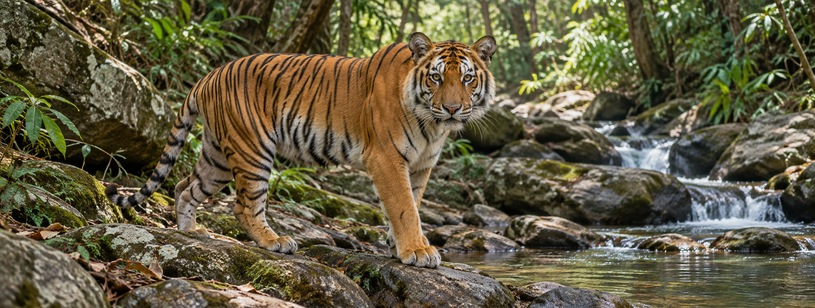
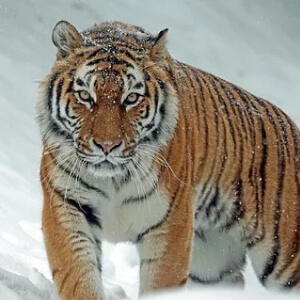
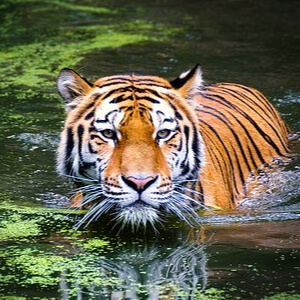
AI illustration of indochinese tiger.
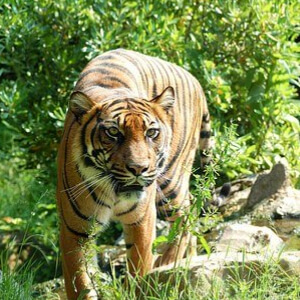
The Indochinese tiger is a mainland Southeast Asian tiger population with an important stronghold in Thailand’s forests. Its orange coat has dark stripes, and its carnivorous diet consists mainly of hoofed mammals.
It is also known by the traditional name Panthera tigris corbetti. Its range has contracted greatly, making forest and prey protection essential. A historical country list should not be read as a map of populations confirmed today.
Quick facts
| Species | Panthera tigris |
| Traditional subspecies name | Panthera tigris corbetti |
| Two-subspecies classification | Panthera tigris tigris; subspecies boundaries are under review |
| Class / order / family | Mammalia / Carnivora / Felidae |
| Distribution | Mainland Southeast Asia; main strongholds in Thailand, also Myanmar |
| Habitat | Tropical and seasonal forests, including wooded hills and mountains |
| Diet | Carnivorous (deer, wild pigs, wild cattle) |
| Size | Males about 150–195 kg, females about 100–130 kg; smaller than large Bengal tigers |
| Social organisation | Mainly solitary; the female raises the cubs |
| Gestation | Approximately 100–106 days |
| Independence of young | Usually around two years old, with variation |
| Conservation | Panthera tigris species: Endangered (EN); extinct in Cambodia, Laos and Vietnam |
- Primary category:Mammals
- Explore this animal's categories:
Interesting facts
- It can be studied without capture. Camera traps photograph the stripes identifying each individual.
- Good local news can coexist with a difficult regional situation. Some Thai forests have seen recovery, while tigers have disappeared elsewhere in the former range.
- Prey helps determine forest suitability. Trees alone cannot support a tiger if its food animals are absent.
- It uses more than evergreen tropical forest. Habitats can include seasonal forests and hilly terrain.
- Malayan tigers were once included in the same group. Genetic studies changed that interpretation in the traditional classification.
Records and remarkable features
It is not the largest tiger. It is generally smaller than large Bengal tigers. Males usually weigh about 150–195 kg and females about 100–130 kg.
A conservation outcome matters more than a size record. In 2024, WCS announced an increase of approximately 250% during 2007–2023 in the studied population of Thailand’s Western Forest Complex.
This shows what long-term protection and prey recovery can achieve. It does not describe all of Indochina or mean that every population increased at the same rate.
Characteristics
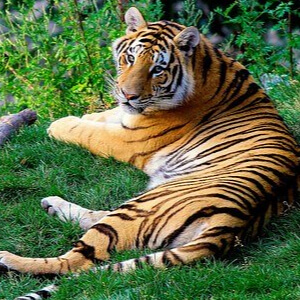
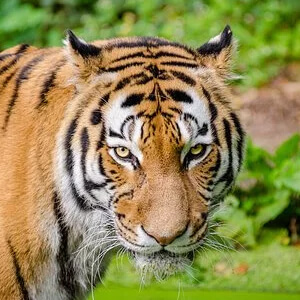
The Indochinese tiger has a muscular body, broad head and powerful paws. Dark stripes cross the orange coat; cheeks and underside are paler. It is usually described as darker than the Bengal tiger.
| Feature | Importance |
| Individual stripe patterns | Allow identification during monitoring |
| Powerful shoulders and paws | Help bring down prey |
| Retractile claws | Gripping and marking trees |
| Sensitive whiskers | Detect contact with nearby objects |
Like all tigers, it has striped skin as well as striped fur, and no two tigers have exactly the same pattern.
Tigers belong to Felidae, alongside other cats. Relatedness to lions and leopards does not give them identical social organisation or hunting strategies.
Habits and behaviour
Adults are mainly solitary. Females with cubs form the most visible family groups. Males and females meet to mate but do not normally form a pair hunting and raising cubs together.
Territories are advertised through scent, scratches and sounds. Signals can pass information between animals using the same forest at different times.
It can hunt at night and in dim light. Activity changes with prey and disturbance. Long-term monitoring helps distinguish real patterns from impressions based on a few photographs.
Independent young tigers must find available space. Connected forests can allow their movements to support recovery where tigers have become scarce.
Habitat and geographic distribution
Thailand is a major conservation area for Indochinese tigers. Tigers also occur in Myanmar, although distribution and condition are uneven. The historical range included countries where functioning natural populations are no longer confirmed.
An important landscape is Thailand’s Western Forest Complex, including sanctuaries such as Huai Kha Khaeng and Thung Yai Naresuan. Connections allow movement across an area larger than one reserve.
- Forests offer camouflage and shelter.
- Valleys and waterways can form part of the areas used.
- Forested hills and mountains can support tigers where prey is available.
- Corridors connect breeding areas with other suitable habitat.
Tigers are now thought to be extinct in the wild in Cambodia, Laos and Vietnam, where snares wiped out both the tigers and much of their prey.
Diet and feeding
Deer, wild pigs and bovids are important resources. Relevant prey in Thai forests includes sambar and banteng. Proportions differ between places and periods.
A tiger relies on stalking and a quiet approach, then attacks at close range. Not every attempt succeeds. Vegetation helps reduce the distance to prey.
Large prey can provide several meals. Tigers may conceal remains and return if undisturbed. Food availability influences both territory size and females’ chances of raising cubs.
Prey recovery is central to conservation. Removing snares helps twice, reducing danger to tigers and to the mammals they eat.
Reproduction and life cycle
As in other tigers, gestation lasts approximately 100–106 days. Cubs are born in a hidden place with closed eyes. During the first weeks they depend on their mother’s milk and protection.
As they grow, they begin eating meat and exploring. Sibling play develops coordination; following their mother exposes them to real hunting situations.
| Stage | What matters for survival |
| Birth shelter | Quiet and protection |
| Early months | Enough food for female and cubs |
| Learning to hunt | Time spent with the mother |
| Independence | Corridors and available territories |
Young tigers usually become independent around two years old. A female photographed with cubs demonstrates breeding, but recovery requires monitoring over time: not every cub survives to reproduce.
Name and history
The name refers to Indochina, a region of mainland Southeast Asia. The traditional scientific name is Panthera tigris corbetti, given in 1968 in honour of Jim Corbett, the tiger hunter who became a famous conservationist in India.
Genetic research published in 2004 supported separating Malay Peninsula tigers from the northern Indochinese group. In the two-subspecies classification, both fall within Panthera tigris tigris, the mainland group.
These classifications use different levels of grouping. The species remains Panthera tigris, and the subspecies debate does not reduce the need to protect local populations and their genetic diversity.
Conservation status and threats
The tiger species is Endangered (EN), and its mainland Southeast Asian situation is particularly fragile. Old distribution lists can exaggerate the area still occupied.
Poaching, snares, prey depletion and habitat fragmentation interact. A forest accessible to poachers can lose large animals even if many trees remain standing.
WCS links Thai recovery results with more effective protection and recovery of prey animals. Consistent patrols, field data and cooperation between authorities help more than brief interventions without follow-up.
In popular culture
Camera-trap images have brought Indochinese tigers to public attention. WCS’s 2024 communication presented photographs and videos from Thai forests alongside monitoring results.
These sequences show an elusive animal and can educate viewers. To estimate real changes in numbers, researchers identify each tiger by its stripes and compare records from many years.
Discover other tigers
Read about Tiger or explore: Sumatran tiger · Bengal tiger · Siberian tiger · Malayan tiger · South China tiger.
Frequently asked questions
- Where does the Indochinese tiger still live? Thailand contains an important stronghold. Tigers also occur in Myanmar; the historical range is wider than the functioning populations confirmed today.
- What is its scientific name? The species is Panthera tigris. The traditional subspecies name is Panthera tigris corbetti; the two-subspecies classification places it in the mainland Panthera tigris tigris group.
- What does it eat? Deer, wild pigs and bovids, depending on region. Sambar and banteng are important in Thai forests.
- Is it the same as the Malayan tiger? They are distinct populations in the traditional classification. Genetic studies published in 2004 supported their separation.
- Does it hunt only at night? No. It can be active at night, in dim light or by day, depending on prey and disturbance.
- How long is gestation? Approximately 100–106 days, as in other tigers. The mother raises cubs, which usually become independent around two years old.
- Have numbers increased in Thailand? In 2024, WCS reported an approximately 250% increase during 2007–2023 in the studied Western Forest Complex population. That result does not apply to all Indochina.
- What is the main danger? Poaching and snares, together with prey loss and habitat fragmentation, can eliminate local populations.