Brown troutSalmo trutta — habitat, diet and reproduction
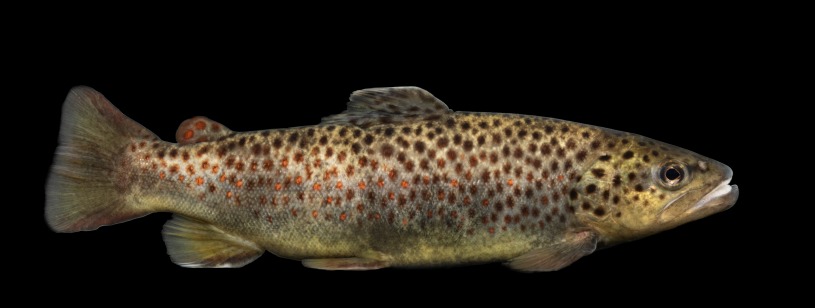
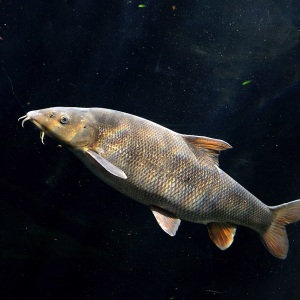
Brown trout (Salmo trutta). · Sam Stukel / U.S. Fish and Wildlife Service, public domain
Brown trout (Salmo trutta) are predatory fish associated with cool, oxygen-rich water. They inhabit streams, rivers and lakes. Their elongated bodies and dark spots, often accompanied by red spots, make them distinctive. Brown trout and rainbow trout (Oncorhynchus mykiss) are different species.
Quick facts
| Common name | Brown trout |
| Scientific name | Salmo trutta |
| Lifespan | Approximately 5–12 years in many populations; some individuals live longer |
| Length | Often 20–30 cm in Romanian mountain waters; some lake and migratory forms grow much larger |
| Weight | Often 200–600 g for the mountain fish described in Romanian sources; not a species maximum |
| Diet | Carnivorous: insects, larvae, crustaceans and small fish |
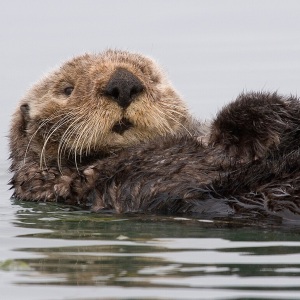
| Predators | Otters, fish-eating birds and predatory fish, including larger trout |
| Conservation status | Least Concern (LC), globally |
| Distribution | Native to Europe, western Asia and northern Africa; introduced widely elsewhere |
| Habitat | Cool, well-oxygenated streams, rivers and lakes |
| Family | Salmonidae |
| Reproduction | Eggs laid in gravel, generally in autumn and early winter in Europe |
- Primary category:Fish
- Explore this animal's categories:
Interesting Facts
- One species can follow different life histories. Some brown trout remain in freshwater, while sea trout feed at sea and return to rivers to reproduce.
- They have an adipose fin. This small fin sits between the dorsal fin and the tail.
- Newly hatched trout carry food reserves. They initially use an attached yolk sac before feeding independently.
- Adults can spawn more than once. Reproduction does not automatically end their lives.
Records and Extremes
A trout in a small mountain stream may remain only a few tens of centimetres long, while exceptionally large individuals can exceed one metre. Habitat, food, population and age all affect growth. Individuals older than 15 years have also been documented. These exceptional sizes and ages should not be treated as typical for every stream population.
Characteristics
Brown trout have elongated bodies, small scales and toothed mouths. They may have brown or olive backs, golden or silvery sides and paler bellies. Red and dark spots sometimes have pale borders.
| Feature | Brown trout | Rainbow trout |
|---|---|---|
| Scientific name | Salmo trutta | Oncorhynchus mykiss |
| Sides | Often golden-brown, with dark and sometimes red spots | Often a pink band along the body |
| Tail | Generally lacks the abundant fine black spotting typical of rainbow trout | Usually has many small black spots |
| Native region | Europe and neighbouring regions | The North Pacific region |
Appearance changes with age and environment. Identification should consider body shape, spots and fins together, rather than relying on colour alone.
Behaviour
River trout may defend good feeding positions. They often face upstream and take invertebrates carried by the current. Rocks, roots and undercut banks provide shelter close to feeding areas.
Large fish may retreat into deeper pools. Monitoring in Romania’s upper Dâmbovița basin describes adults active particularly around dusk or at night, with young fish also active by day. Activity varies with local conditions.
Habitat and Distribution
The native range includes Europe and parts of western Asia and northern Africa. Introductions by people have extended the distribution to many other regions.
Brown trout in Romania
They are characteristic of cold, oxygen-rich mountain waters and also occur in mountain lakes. Fish surveys document them in the upper Dâmbovița basin, while Romsilva describes trout in mountain waters managed in Alba County.
Different life stages require different habitats: gravel for eggs, sheltered margins for young fish and larger refuges for adults. Connections between feeding, nursery and spawning areas allow fish to move as their needs change.
Diet and Feeding
Brown trout are carnivores. Small fish mainly eat invertebrates, including insect larvae, insects falling onto the water and crustaceans. Larger trout may take small fish, including other trout.
They feed in the water column, near the bottom and at the surface. When insects become abundant, trout may concentrate on them, producing the rises and rings sometimes visible on a river. The menu changes with food availability and the size of prey a fish can capture and swallow.
Reproduction and Life Cycle
In Europe, spawning generally occurs in autumn and early winter, with regional variation. Females make depressions in river gravel. Eggs are fertilised externally and covered with gravel.
| Stage | Development |
|---|---|
| Eggs | Develop among stones where flowing water supplies oxygen. Temperature affects hatching time. |
| Alevins | Initially remain in the gravel and feed from their attached yolk sacs. |
| Fry | Emerge and begin feeding on tiny organisms; sheltered water and cover are important. |
| Adults | Maturity occurs after several years, often around 2–5 years depending on sex and population. |
Egg development takes weeks or months, rather than a fixed number of days everywhere. Surviving adults can return to reproduce in later years.
Name and History
Carl Linnaeus established the scientific name Salmo trutta in 1758. The species belongs to the salmon family, Salmonidae.
The name Salmo trutta fario is often used for river-resident trout in Romanian sources. Historical river, lake and sea-trout names reflect differing forms and life histories; a habitat difference does not automatically identify a separate species.
Recreational fishing and hatchery production helped spread brown trout beyond their native range. Imports to the United States began in the nineteenth century. Introduced populations can have different ecological effects from those living within the native range.
Conservation and Threats
Salmo trutta is currently classified globally as Least Concern (LC). This does not guarantee that every local population is healthy.
- Warming water can reduce suitable habitat for a cold-water fish.
- Fine sediment in spawning gravel can obstruct water flow and the supply of oxygen to eggs.
- Habitat degradation and reduced flows affect feeding, shelter and breeding areas.
Otters, birds and other fish are part of natural food webs. Protecting habitat and water quality is central to sustaining wild trout populations.
In some introduced ranges, brown trout affect native fish through predation and competition. Protecting native populations and managing introductions require different conservation decisions.
Frequently asked questions
Are brown and rainbow trout the same species?
No. Brown trout are Salmo trutta and rainbow trout are Oncorhynchus mykiss.
Where do brown trout live in Romania?
Mainly in cool, oxygen-rich mountain rivers and streams, and in some mountain lakes.
What do they eat?
Insects, larvae, crustaceans and, especially as they grow, small fish.
How big do they grow?
Romanian mountain fish are often 20–30 cm long, while some lake and migratory forms grow much larger.
How long do they live?
Approximately 5–12 years in many populations, with local variation and some longer-lived individuals.
When do they spawn?
Usually in autumn and early winter in Europe, depending on local conditions.
Why lay eggs in gravel?
Water flowing between the stones brings oxygen to the eggs and the gravel shelters early life stages.
Do they die after spawning?
Not necessarily. Surviving adults can reproduce over several years.