ThylacineThylacinus cynocephalus — habitat, diet and reproduction
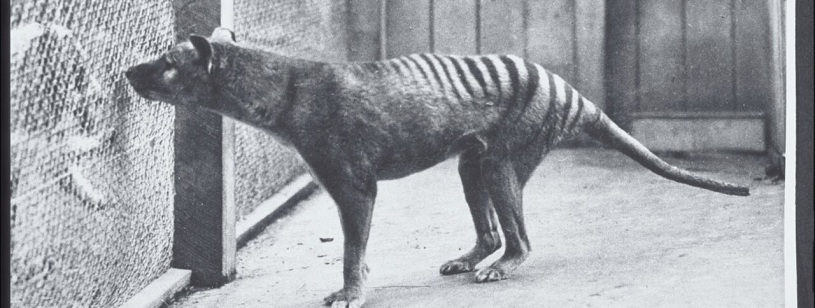
Thylacine (Thylacinus cynocephalus) at Hobart Zoo, 1928. · Harry Burrell / Public domain ().
The Tasmanian tiger, scientifically called the thylacine, was a carnivorous marsupial from Australia that looked like a large dog with stripes on its back. It survived in Tasmania until the twentieth century, when organised hunting drove it to extinction. The last known individual died in 1936 at Hobart Zoo.
Quick facts
| Common name | Thylacine, Tasmanian tiger, Tasmanian wolf |
| Scientific name | Thylacinus cynocephalus |
| Lifespan | About 5–7 years in the wild; up to about 9 in captivity |
| Length | Body about 100–130 cm, plus a tail of about 50–65 cm |
| Weight | About 15–30 kg |
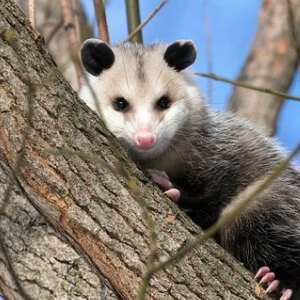
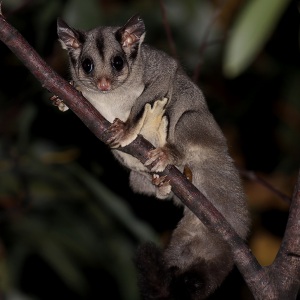
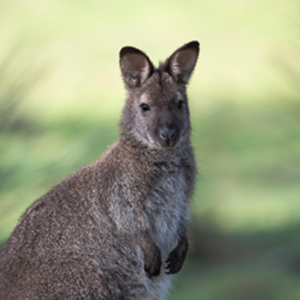
| Diet | Carnivore: small kangaroos, wallabies, possums, birds |
| Predators | Humans; on the mainland, competition with dingoes |
| Conservation status | Extinct (EX); the last known individual died in 1936 |
| Distribution | Tasmania; formerly mainland Australia and New Guinea |
| Habitat | Open forest, scrub, grassland |
| Family | Thylacinidae |
| Pouch | In females, opening towards the rear |
- Primary category:Mammals
- Explore this animal's categories:
Interesting facts
- Its back and rump had between 13 and 21 dark stripes.
- It could open its jaws very wide, much more than a dog.
- Between 1888 and 1909, the Tasmanian government paid bounties for 2,184 thylacines killed.
- Many sightings have been reported since 1936, but none has been confirmed.
Characteristics
The thylacine looked like a dog or wolf but was a marsupial, more closely related to kangaroos than to wolves. Its short fur was yellow-brown with dark stripes on the back and rump.
The tail was thick at the base and stiff, like a kangaroo’s. Females had a rear-opening pouch for carrying young. Its wolf-like look is an example of convergent evolution.
Behaviour
The thylacine was active mainly at night and dusk, resting by day in hollow logs, rock crevices or dense scrub.
Accounts from the time say it hunted alone or in pairs and followed prey over long distances, relying on patience rather than speed. It gave a short, cough-like bark.
Habitat and distribution
The thylacine once lived on mainland Australia and in New Guinea. It disappeared from the mainland about 3,000 years ago, probably because of humans and competition with dingoes.
In Tasmania, which dingoes never reached, it survived into the twentieth century in open forest and scrub.
Diet and feeding
The thylacine was a carnivore, eating mainly small kangaroos, wallabies, possums, bandicoots and birds.
European settlers accused it of killing sheep, leading to its persecution. Recent skull studies show relatively weak jaws, suited to small and medium prey rather than large sheep.
Reproduction and life cycle
Females usually carried 2–4 young in the rear-opening pouch for about three months; the young then stayed in a den while the mother hunted.
Few young were born in captivity, and zoo breeding attempts failed.
Name and history
The scientific name Thylacinus cynocephalus means “dog-headed pouched one”. The name “tiger” comes from its stripes, “wolf” from its body shape.
The last known thylacine died on 7 September 1936 at Hobart Zoo. That date is now Australia’s National Threatened Species Day. Black-and-white film of this animal is among the best-known footage of an extinct species.
Conservation and threats
The thylacine was officially declared extinct in the 1980s. The main causes were bounty hunting, habitat loss, disease and competition with settlers’ dogs.
Legal protection was granted only 59 days before the last known individual died. Its story shows why species protection must begin in time.
Frequently asked questions
Does the thylacine still exist?
There is no evidence. The last known individual died in 1936, and later sightings have not been confirmed.
Was the thylacine a tiger or a wolf?
Neither. It was a carnivorous marsupial; its names come from its stripes and body shape.
Why did the thylacine go extinct?
Mainly because of bounty hunting, plus habitat loss and disease.
What did the thylacine eat?
Small kangaroos, wallabies, possums, bandicoots and birds.