DromedaryInteresting facts and information
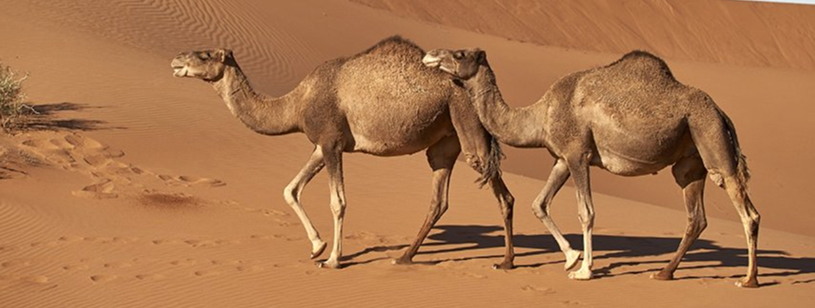
The dromedary (Camelus dromedarius) is the one-humped domestic camel. It is kept for work and products such as milk and meat in dry regions of Africa and Asia. Free-ranging Australian dromedaries descend from introduced domestic animals; they are feral rather than a surviving original wild population. Related profile: Animals of Asia.
A dromedary stores fat in its single hump. Australia’s free-ranging dromedaries descend from imported domestic camels and are feral populations. Related profile: Camel. Related profile: Animals of Australia.
Quick facts
| Common name | Dromedary (Arabian camel) |
| Scientific name | Camelus dromedarius |
| Typical lifespan | Usually about 25-40 years |
| Maximum speed | Racing camels can reach about 60 km/h over short distances |
| Height | About 1.8 - 2.1 m at shoulder |
| Length | About 2.2 - 3.4 m |
| Weight | About 400 - 600 kg (males) / 300 - 500 kg (females) |
| Diet type | Herbivore (dry grasses, leaves, shrubs, thorny and salty plants) |
| Main predators | Humans; in the past lions, wolves and hyenas; dingoes may take calves in Australia |
| Conservation status | Domestic camel; feral populations are distinct from the separate threatened wild camel species |
| Propagating areas | North and East Africa, the Middle East and South Asia; introduced feral populations in Australia |
| Special adaptations | It stores fat in the hump, resists extreme dehydration, has double rows of eyelashes and nostrils that close against sand |
- Primary category:Mammals
- Explore this animal's categories:
Interesting facts
- A huge drink - A very thirsty dromedary can drink more than 100 litres of water in about ten minutes; its red blood cells can swell without bursting as the water is absorbed.
- Saving water through the nose - Its complex nasal passages cool the air it breathes out and take back much of the moisture.
- The hump contains fat, not water - The hump is a store of fat that provides energy when food is scarce.
- A changing body temperature - A dromedary's body temperature can rise from about 34 °C at night to about 41-42 °C by day, so it sweats less and saves water.
- Dromedaries introduced to Australia established feral populations. Their abundance and environmental effects vary across regions and over time.
- Dromedary milk is food, not an established treatment for diabetes or lactose intolerance. It contains lactose and milk proteins. Related profiles: Cow and Desert animals.
- Built for long journeys - Working dromedaries can carry loads for many days across the desert, drinking only when they reach water.
Records and remarkable features
- The dromedary has one hump, which stores fat rather than a reservoir of liquid water.
- It can survive losing about a quarter of its body water, far more than most mammals.
Physical characteristics and unique adaptations
The dromedary (Camelus dromedarius) is a large mammal with a single hump and many adaptations for life in hot, dry places. Its long legs keep its body away from the hot ground. Related profile: Mammals.
Body structure and physical features
- Insulating fur - Its coat, from cream to dark brown, protects it from the strong sun by day and the cold at night.
- A fatty hump - Dromedaries store fat in the hump, which they use for energy when food is scarce.
- Broad, padded feet - Two toes joined by a wide, leathery pad help it walk on sand without sinking.
- Tough mouth - Its thick, split upper lip and tough mouth let it eat dry and thorny plants.
Adaptations for Desert Survival
- Water-saving nose - Its nasal passages take back moisture from the air it breathes out.
- Eye protection - Long double rows of eyelashes and a thin third eyelid protect the eyes from sand; its nostrils can close in sandstorms.
- Variable body temperature - Its body temperature can change by several degrees during the day, which reduces sweating and saves water.
- Efficient kidneys and gut - It produces concentrated urine and dry droppings, losing very little water.
Habits and behaviour
Dromedaries are social animals. Free-living groups usually consist of females and their young with one adult male. They are usually calm, but males can become aggressive in the breeding season.
Method of life and social hierarchy
- Social groups - Groups usually include several females, their young and a dominant male; young males form bachelor groups.
- Communication - Dromedaries moan, grunt, bellow and roar, and also use body language.
- Rivalry - In the breeding season, males threaten and fight each other, trying to bite their rival's legs and neck or push him over.
Specific behaviors
- Saving energy - In very hot weather, dromedaries move less and may lie facing the sun to expose less of their body to it.
- Rest in the heat - They are often most active in the morning and evening and rest during the hottest hours.
- Drinking - After long periods without water, they can drink large amounts quickly without harm.
Habitat and geographic distribution
The dromedary is a domestic animal kept in dry regions of North and East Africa, the Middle East and South Asia. No truly wild dromedaries survive; the free-ranging camels of Australia are feral descendants of domestic animals. Related profile: Animals of Africa.
Distribution areas
| Region | Population information |
|---|---|
| North and East Africa | Millions, especially in Somalia, Sudan, Kenya, Ethiopia and the Sahara |
| Arabian Peninsula | Used for milk, meat, racing and tourism |
| South Asia | India and Pakistan, used for work, transport and milk |
| Australia | Introduced feral populations; abundance varies by place and assessment date |
Adaptation to environment
- Hot deserts - Dromedaries are well adapted to heat and dry ground and can go for long periods without drinking, especially when they eat green plants.
- Dry grasslands - They are kept by herders in dry savannas and steppes.
- Australia - Introduced in the 19th century for transport, feral dromedaries spread across the dry interior, where they can damage vegetation and water sources.
Diet and feeding
Dromedaries are herbivores that eat many kinds of dry, salty and thorny desert plants. Their digestive system gets the most out of poor food.
See the list of all the herbivores.
What do dromedaries eat?
| Food group | Examples |
|---|---|
| Dry grasses | Drought-resistant grasses |
| Shrubs and leaves | Acacia, tamarisk, saltbush |
| Salty plants | Plants that many other herbivores avoid |
| Thorny plants | Salvadora persica (the "toothbrush tree") and other thorny shrubs |
| Dates and other food from people | Domestic camels are also fed dates, hay and grain |
Adaptations for feeding
- Tough lips and mouth - The dromedary's thick, flexible lips let it eat thorny plants without hurting itself.
- Chewing the cud - Like cattle, it brings food back up to chew it again, although camels are not true ruminants.
- A three-chambered stomach - Microbes in the stomach break down tough plant fibres.
Seasonal changes in diet
- In the rainy season, it eats fresh grass and juicy leaves, which also provide water.
- In the dry season, it relies on shrubs, thorny plants and dry grass.
Reproduction and life cycle
Dromedaries usually breed in the cooler, rainy part of the year, when food is more plentiful. Males compete strongly for females.
Mating and courtship rituals
- Males become aggressive in the breeding season, known as "rut", and defend their females.
- A male pushes a pink sac called the dulla, part of the soft palate, out of his mouth to impress females and threaten rivals.
- Males also gurgle, grind their teeth and drool.
Pregnancy and childbirth
| Characteristic | Details |
|---|---|
| Gestation | About 12-13 months |
| Number of calves | 1 calf (twins are rare) |
| Weight at birth | About 30-40 kg |
| Mobility | The calf can stand within a few hours of birth |
- Calves are nursed for about a year or longer and often stay with their mothers for a few years.
- Females usually first breed at about 3-5 years, and males at about 5-6 years.
Name and history
The dromedary was domesticated about 3,000-4,000 years ago, probably in southern Arabia, and became essential to the nomadic and trading cultures of the Middle East and North Africa.
Origin of name
- "Dromedary" comes from the Greek dromas, meaning "runner".
- The scientific name Camelus dromedarius was given by Carl Linnaeus in 1758.
Classification and evolution
| Kingdom | Animalia |
|---|---|
| Phylum | Chordata |
| Class | Mammalia |
| Order | Artiodactyla |
| Family | Camelidae |
| Genus | Camelus |
| Species | Camelus dromedarius |
- The camel family first evolved in North America about 40-45 million years ago; the ancestors of today's camels later crossed into Asia.
- Wild dromedaries died out about 2,000 years ago, so today's dromedaries are all domestic or feral.
See other animals beginning with D. Related profile: Animals beginning with D.
Cultural significance and mythology
The dromedary has long been a symbol of endurance and patience in the Middle East, North Africa and South Asia, and it played a key role in transport and trade.
Dromedary in ancient cultures
- Trade routes - Dromedaries carried incense, spices and other goods along the caravan routes of Arabia and across the Sahara.
- Arabia - For the Bedouin, the camel was a source of transport, milk, meat, wool and wealth.
- The Silk Road - On the colder Silk Road through Central Asia, the two-humped Bactrian camel was more important than the dromedary.
Myths and legends
- Islam - The Quran invites people to reflect on how the camel was created, as a sign of God's creation.
- Medina - According to tradition, the Prophet Muhammad let his camel, Qaswa, choose the place where he built his mosque in Medina.
- The Sahara - For the Tuareg and other desert peoples, the camel is a symbol of survival and wealth.
Conservation status and threats
The dromedary is a domestic camel with feral populations in some regions. This differs from the conservation situation of the separate wild camel, Camelus ferus.
Main threats
- Changes in herding - In some countries, fewer people keep camels, while in others camel herding is increasing.
- Diseases - Camels can carry MERS, a virus that can also infect people, so their health is closely monitored.
- Climate change - Droughts affect the pastures of camel herders, although camels cope better than cattle.
Conservation efforts
| Measure | Description |
|---|---|
| Protecting local breeds | Many countries keep and study local camel breeds to preserve their genetic diversity. |
| Population management in Australia | Australian authorities control feral camel numbers to protect native plants and water sources. |
| Sustainable use | Dromedaries are used for milk, meat, tourism and racing, which keeps them economically important. |
In popular culture
The dromedary appears in many books, films and national symbols because of its link with deserts and caravans.
In films and animations
- "Lawrence of Arabia" (1962) - Shows Arab forces riding camels during the First World War.
- Many films set in the desert use camels to create the atmosphere of caravans and the Sahara.
In literature
- "One Thousand and One Nights" - Many stories mention camel caravans crossing the desert.
- "How the Camel Got His Hump" - One of Rudyard Kipling's "Just So Stories" (1902).
- "The Camel Bookmobile" by Masha Hamilton - A novel inspired by a real mobile library that used camels in Kenya.
National symbols and logos
- The Arabian Peninsula - Camel racing and camel beauty contests are popular traditions in Saudi Arabia, the United Arab Emirates and Qatar.
- Camel cigarettes - The brand's logo shows a dromedary.
Did you know? About dromedary
- The dromedary's hump stores fat, not water.
- A thirsty dromedary can drink more than 100 litres of water in about ten minutes.
- Its body temperature can rise by several degrees during the day, which helps it save water.
- Dromedaries can close their nostrils during sandstorms.
- Male dromedaries push a pink sac called a dulla out of their mouths in the breeding season.
- A dromedary pregnancy lasts about 13 months.
- No truly wild dromedaries survive today.
- Australia has one of the largest populations of free-ranging dromedaries in the world.
- The camel family first evolved in North America.