Snowy owlBubo scandiacus — habitat, diet and reproduction
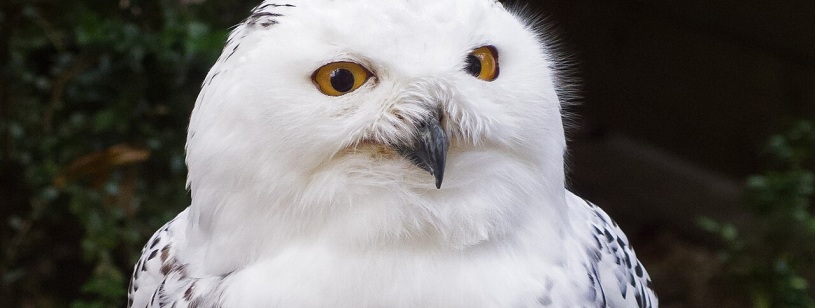
Snowy owl (Bubo scandiacus) with black-flecked white plumage. · Tuxyso / CC BY-SA 3.0 (https://creativecommons.org/licenses/by-sa/3.0). Cropped and resized.
The snowy owl is a large, almost white owl of the Arctic tundra. Because the Arctic summer has light almost all the time, it also hunts by day. Its favourite food is lemmings, and the number of chicks it raises depends on how many lemmings it finds that year.
Quick facts
| Common name | Snowy owl |
| Scientific name | Bubo scandiacus |
| Lifespan | About 10 years in the wild; over 25 in captivity |
| Length | About 52–71 cm |
| Weight | About 1.6–3 kg; females are heavier |
| Diet | Carnivore: lemmings, other rodents, hares, birds |
| Predators | Arctic foxes and wolves at nests; adults have few enemies |
| Conservation status | Vulnerable (VU) |
| Distribution | The Arctic: northern North America, Europe and Asia |
| Habitat | Open tundra; in winter plains, coasts, airports |
| Family | Strigidae |
| Wingspan | About 125–150 cm |
Interesting facts
- Old males are almost completely white, while females have many black markings.
- A snowy owl can eat more than a thousand lemmings in a year.
- Its feet are feathered down to the claws, like slippers.
- Hedwig, Harry Potter’s owl, is a snowy owl.
Characteristics
The snowy owl is one of the largest owls. It has a round head without ear tufts, yellow eyes and a black bill almost hidden in feathers.
Males become whiter with age. Females and young have dark bars and spots that hide them on their ground nests among stones and snow. Dense feathers, including on the feet, protect against cold.
Behaviour
Unlike most owls, it hunts by day, especially at dusk and dawn. It watches motionless from a mound or post, then flies low over the ground.
In winter, some snowy owls stay north while others move south. In some years many reach southern Canada and the northern United States, even airports that resemble tundra.
Habitat and distribution
The species breeds in the Arctic tundra of Alaska, Canada, Greenland, Scandinavia and Russia, partly moving south to plains and coasts in winter.
In Romania it is a very rare visitor, with occasional records in exceptional winters.
Diet and feeding
Its main prey is lemmings. It also catches voles, Arctic hares, waterbirds and fish.
Small prey is swallowed whole. In years with many lemmings, snowy owls raise many chicks; in poor years, some pairs do not nest at all.
Reproduction and life cycle
The nest is a simple scrape on a tundra mound with a good view. The female lays 3–11 eggs two days apart and incubates them for about a month.
Chicks hatch one after another, so they differ in age. The male brings food and the female shares it out. Parents attack foxes and even people approaching the nest.
Name and history
The scientific name Bubo scandiacus means “owl of Scandinavia”. It was long placed in a separate genus, Nyctea, but genetic studies showed it is a close relative of the eagle owls.
The snowy owl is the official bird of the Canadian province of Quebec.
Conservation and threats
Since 2017 the species has been assessed as Vulnerable, because studies showed a smaller and declining population than thought.
Threats include climate change, which disrupts lemming cycles and snow cover, and collisions with vehicles, aircraft and power lines.
Frequently asked questions
Why is the snowy owl white?
White plumage hides it in snowy Arctic landscapes. Females and young also have black markings.
Does the snowy owl hunt by day?
Yes. In the Arctic summer there is light almost all the time, so it hunts by day too.
What does the snowy owl eat?
Mostly lemmings, plus other rodents, hares and birds.
Are there snowy owls in Romania?
Very rarely. Only occasional vagrants have been recorded in some winters.