SilkwormBombyx mori — habitat, diet and reproduction
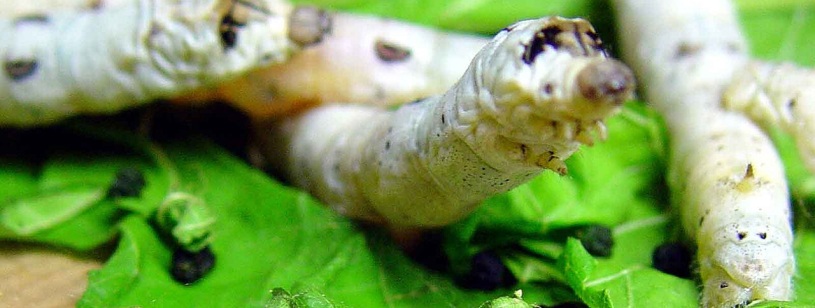
Silkworms (Bombyx mori) feeding on mulberry leaves. · / CC BY-SA 3.0 (http://creativecommons.org/licenses/by-sa/3.0/). Cropped and resized.
The silkworm is the caterpillar of the moth Bombyx mori, an insect domesticated in China more than 5,000 years ago. The caterpillar eats mulberry leaves and, once grown, spins a cocoon from a single long silk thread. This thread is used to make natural silk for clothing and fabrics.
Quick facts
| Common name | Silkworm, domestic silk moth |
| Scientific name | Bombyx mori |
| Lifespan | About 6–8 weeks from egg to moth |
| Length | Mature caterpillar about 7–8 cm; moth 3–5 cm wingspan |
| Diet | Herbivore: mulberry leaves |
| Predators | Does not live in the wild; in farms, birds, mice and disease |
| Conservation status | Domestic species, not assessed |
| Distribution | Raised in China, India, Japan and other countries |
| Habitat | Farms, on trays of mulberry leaves |
| Family | Bombycidae |
| Product | Natural silk |
- Primary category:Insects
- Explore this animal's categories:
Interesting facts
- The silk moth cannot fly and cannot survive in the wild without people.
- The thread from a single cocoon can be hundreds of metres long.
- Over 100 kg of mulberry leaves are needed for one kilogram of silk.
- The Chinese guarded the secret of silk for centuries; the Silk Road was named after this fabric.
Characteristics
The caterpillar has a soft, white or grey, ringed body with a small “horn” near its rear. It grows very fast and moults four times.
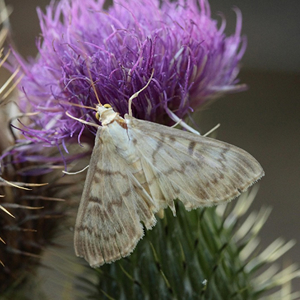
The adult moth is white and hairy with small wings. Its mouth is undeveloped, it does not eat and it lives only a few days, long enough to mate and lay eggs.
Behaviour
Caterpillars eat almost constantly, day and night, increasing their weight thousands of times in a few weeks.
When ready to change, they stop eating and spin a cocoon, moving their heads in a figure-of-eight. Silk comes from two glands near the mouth and hardens in air. Inside the cocoon, the caterpillar becomes a pupa.
Habitat and distribution
The silkworm no longer lives in the wild; its wild ancestor, Bombyx mandarina, lives in China and Korea. The domestic species is raised on farms, mainly in China and India.
In Romania, silkworm rearing had a tradition in the twentieth century, especially in the south, and roadside mulberry plantations recall it.
Diet and feeding
The silkworm eats almost only mulberry leaves, preferably white mulberry, fresh and in large amounts.
This ties silk farming closely to mulberry plantations. Like other caterpillars, the silkworm is the growing stage of a moth.
Reproduction and life cycle
Moths mate after emerging from cocoons. The female lays a few hundred small eggs, which hatch after about 9–14 days.
Tiny caterpillars grow for about a month, spin a cocoon, and about two weeks later the moth emerges. On farms, many cocoons are heated before the moth emerges so the thread stays unbroken.
Name and history
The scientific name Bombyx mori means “silkworm of the mulberry”: “mori” comes from Morus, mulberry.
Legend says a Chinese empress discovered silk when a cocoon fell into her tea. The Silk Road, the network of trade routes between China and Europe, is named after this precious fabric.
Conservation and threats
The silkworm is a domestic species and is not assessed on the Red List. Its wild relatives are moths.
Today silkworms are also used in research, for example to study strong fibres, and are raised in schools to show children an insect’s transformation.
Frequently asked questions
What does the silkworm eat?
Almost only mulberry leaves, especially white mulberry.
How is silk made?
The cocoon is soaked in hot water, and the long thread is unwound, spun and woven.
Can the silk moth fly?
The caterpillar cannot, and the adult has wings but cannot fly after thousands of years of domestication.
How long does a silkworm live?
About 6–8 weeks from egg to moth; the moth lives only a few days.