AxolotlInteresting facts and information
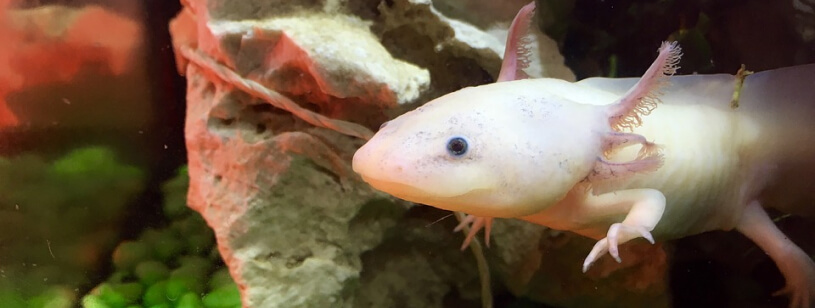
The axolotl (Ambystoma mexicanum) is an aquatic salamander from Mexico. It normally retains larval features, including external gills, as it matures and reproduces. This is called paedomorphosis, often described as neoteny.
Axolotls can regenerate lost limbs and repair several other tissues. Researchers study how this works, but the ability is not a guarantee that every injury heals fully.
Wild axolotls face serious threats from habitat degradation, pollution and introduced fish. Captive axolotls are common in research and animal keeping, but this does not mean the wild population is secure.
Quick facts
| Common name | Axolotl |
| Scientific name | Ambystoma mexicanum |
| Typical lifespan | Often 10-15 years in captivity, sometimes over 20; usually less in the wild |
| Length | Usually about 15-30 cm; size varies with age and condition |
| Weight | About 60-230 g |
| Diet type | Carnivore (worms, insect larvae, crustaceans, molluscs, small fish) |
| Main predators | Introduced fish and waterbirds; habitat destruction is a separate threat |
| Conservation status | Critically Endangered in the wild |
| Distribution | Surviving wild habitat in the Xochimilco canal system, Mexico City; historically also Lake Chalco |
| Living environment | Freshwater canals and associated wetland habitat |
- Primary category:Amphibians
- Explore this animal's categories:
Interesting facts
- Regeneration – Axolotls are studied for their ability to regrow limbs and repair certain tissues; capabilities depend on the tissue and injury.
- Aquatic adulthood – Axolotls normally retain external gills when sexually mature; metamorphosis can occur under unusual conditions.
- Colour forms – Captive axolotls include wild-type, leucistic, albino and other colour forms. A blue fictional animal is not evidence of a naturally blue axolotl.
- Three ways to breathe - Axolotls take in oxygen through their feathery gills, through their skin and by gulping air into their simple lungs.
- A "smiling" face - The shape of its mouth makes the axolotl look as if it is always smiling, which has helped make it popular around the world.
- On a banknote - Since 2022, the axolotl has appeared on Mexico's 50-peso banknote.
Records and remarkable features
- Body size – Most adults are a few tens of centimetres long; no verified exceptional size record is given here.
- A champion of regeneration - Axolotls can regrow lost legs and tails, and even repair parts of the heart, spinal cord and eyes.
- Long life in captivity - Axolotls often live 10-15 years in captivity, and some have lived more than 20 years.
Physical characteristics and adaptations
The axolotl (Ambystoma mexicanum) normally matures while retaining features associated with the larval stage, including external gills. It is an aquatic salamander, not a permanently immature animal incapable of reproduction.
Key physical adaptations
- Feathery external gills - Three pairs of branched gills stick out from the sides of the head and take oxygen from the water.
- Thin, moist skin - Oxygen can also pass through the skin.
- Simple lungs - Axolotls sometimes swim to the surface to gulp air.
- No eyelids - Axolotls cannot close their small eyes.
- Short legs - Used to walk along the bottom of lakes and canals.
- A long, flattened tail - With a fin along it, it helps the axolotl swim.
- Colours – Wild-type animals have mottled dark colouring. Leucistic and albino forms are familiar in captivity.
Main colors of axolotls
| Colour | Characteristics |
|---|---|
| Wild type (brown / olive / grey) | The natural colour, with dark speckles, good for camouflage |
| Leucistic | Pale pink-white skin with dark eyes, very popular in captivity |
| Albino | White skin with pale or pinkish eyes, sensitive to light |
| Golden albino | Golden colouring; eye appearance differs among colour forms |
| Melanoid | Very dark, almost black, without shiny spots |
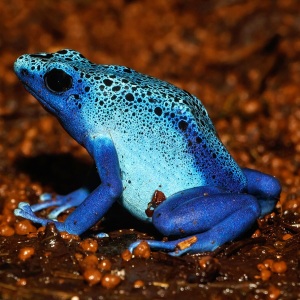
| Purported blue form | A naturally blue variety is not established by the sources cited here; distinguish fictional game designs from real colour forms. |
Habits and behaviour
The axolotl is a mostly solitary predator that spends most of its time on the bottom of the water, among plants and mud.
Daily life
- Fully aquatic - Unlike most salamanders, the axolotl normally never leaves the water.
- Active at dusk and night - It often hunts in dim light.
- Cannibalism - Young axolotls may eat smaller brothers and sisters, especially when food is short.
- Life on the bottom - It mostly walks or rests on the bottom, swimming only short distances.
Social interactions
- Interactions – Axolotls may encounter others while feeding and breeding; crowding can lead to injuries.
- Biting – Axolotls can bite one another, especially during feeding. Apparent calm does not guarantee compatibility.
- Chemical signals - Axolotls use scent signals to find mates in the breeding season.
Defense techniques
- Camouflage - In the wild, their dark, speckled colours help them hide in the mud and among plants.
- Regeneration - If a predator bites off a leg or part of the tail, it can grow back.
- Hiding - Axolotls quickly retreat into plants or mud when disturbed.
Habitat and geographic distribution
The axolotl is native to Mexico City’s lake system. Surviving wild habitat is associated with the Xochimilco canal network; Lake Chalco is part of its historical range.
Distribution context
| Region | Estimated population |
|---|---|
| Xochimilco, Mexico City | Very low: surveys found about 6,000 per km² in 1998, but only about 35 per km² in 2014 |
| Captivity (zoos, laboratories, aquariums, homes) | Very common around the world |
Habitat types
- Lakes - Originally, axolotls lived in the cool, clear lakes of the Valley of Mexico, rich in water plants.
- Canals - Today, wild axolotls survive mainly in the canals of Xochimilco, between the floating gardens called chinampas.
- Cool water - Axolotls prefer water at about 14-20 °C; temperatures above about 24 °C are stressful for them.
Environmental change
- Water pollution - Sewage, fertilisers and pesticides harm the axolotl's water.
- Invasive species - Fish introduced by people, such as tilapia and carp, eat axolotl eggs and young and compete for food.
- Urbanisation - The growth of Mexico City has drained most of the old lakes.
- Climate change - Warmer water could make the remaining habitat less suitable.
Diet and feeding
The axolotl is a carnivore that eats many kinds of small water animals. It finds prey mainly by smell and by sensing movement in the water, because its eyesight is poor.
What does the axolotl eat?
| Food group | Examples and context | Frequency in the diet |
|---|---|---|
| Small crustaceans | Water fleas, small shrimps | Very often |
| Worms and larvae | Worms, mosquito larvae, bloodworms | Often |
| Molluscs | Freshwater snails. Related profile: Snail. | Occasionally |
| Small fish and tadpoles | Small fish, tadpoles | Occasionally |
| Other axolotls | Eggs and young, especially when food is scarce | Sometimes |
Feeding methods
- Suction feeding - The axolotl opens its mouth very quickly, sucking in water and prey together.
- Sensing movement - Special sense organs in the skin detect tiny movements of prey in the water.
- Feeding needs – Feeding requirements depend on age, temperature and condition. Unsupported claims of surviving a year without food should not guide animal care.
Reproduction and life cycle
The axolotl has an interesting way of breeding, with a courtship "dance" and chemical signals. Although it keeps its larval features, it becomes an adult that can breed, like other salamanders.
Breeding season
- In the wild, axolotls breed mainly in late winter and spring; in captivity, they can breed at other times.
- Males become more active and use chemical signals to attract females.
Breeding process
- The male performs a "dance", rubbing against the female and waving his tail.
- If the female is interested, the male leaves small packets of sperm (spermatophores) on the bottom.
- The female takes up the spermatophore through her cloaca, allowing internal fertilisation. The cloaca is a shared opening of the digestive, urinary and reproductive systems.
Development of young axolotls
| Stage | Details |
|---|---|
| Number of eggs laid | About 300-1,000, depending on the size of the female |
| Where eggs are laid | One by one, stuck to water plants and stones |
| Time to hatching | About 10-14 days |
| The larvae | Small larvae initially use nutrients from their yolk reserves |
| Development | The larvae develop limbs and gradually resemble small adults; timing depends on conditions. |
Survival
- Young axolotls face predation, food shortages and other hazards. Survival depends on environmental conditions.
- In captivity, survival is much higher, because there are no predators and conditions are controlled.
Name and history
Origin of the name
- "Axolotl" comes from the Nahuatl (Aztec) language: atl means "water", and xolotl is the name of a god, often translated as "water monster" or "water dog".
- In Aztec legend, the god Xolotl turned himself into an axolotl and hid in the water to escape being sacrificed.
Taxonomic classification
| Classification | Name |
|---|---|
| Kingdom | Animalia |
| Phylum | Chordata |
| Class | Amphibia |
| Order | Urodela (Caudata) |
| Family | Ambystomatidae |
| Genus | Ambystoma |
| Species | Ambystoma mexicanum |
Evolution and history
- The axolotl belongs to the mole salamander genus Ambystoma, which also includes the tiger salamander Ambystoma tigrinum.
- Its relatives usually change into land-living adults, but the axolotl normally stays in the water all its life.
- In 1864, axolotls were brought to Paris, and scientists were amazed when a few of them changed into land salamanders; descendants of these animals spread to laboratories around the world.
Cultural significance and mythology
The axolotl is an important symbol of Aztec mythology and of Mexico, and is famous around the world for its ability to regenerate.
Axolotl in myths and legends
- The god Xolotl - In Aztec mythology, Xolotl was a god of fire, lightning, death and transformation; to avoid being sacrificed, he turned into an axolotl and hid in the lakes of Mexico.
- Food and medicine - The Aztecs ate axolotls, and they were long used in traditional medicine in Mexico.
Axolotl in modern symbolism
- Regeneration - The axolotl is a symbol of healing and is one of the most important animals in research on regeneration.
- A symbol of Mexico City - The axolotl has become a popular symbol of Mexico City and of efforts to save its wetlands.
Conservation status and threats
The axolotl is Critically Endangered in the wild. Habitat loss, pollution and introduced species threaten its remaining native population.
Conservation status
| Region | Assessment scope | Population trend |
|---|---|---|
| Xochimilco, Mexico City | Critically Endangered in the wild | Sharp decline in recent decades |
| Captivity (zoos, laboratories, aquariums) | Common | Many thousands kept around the world |
Main pressures
- Habitat destruction - The growth of Mexico City has drained most of the lakes and polluted the remaining canals.
- Introduced fish – Fish such as tilapia and carp can consume axolotl eggs and young.
- Water pollution - Sewage, fertilisers and pesticides harm axolotls.
- Capture - Although protected, wild axolotls are sometimes caught for food or sale.
Protection measures
- Habitat recovery - In Xochimilco, farmers and scientists create "refuges" in canals next to traditional chinampas, with filtered water and barriers to keep out invasive fish.
- Conservation breeding – Captive breeding alone does not restore wild populations; habitat quality and carefully assessed conservation plans are essential.
- Trade and conservation – Trade and collection are regulated; captive availability does not remove the need to protect wild habitat.
- Education and awareness - Campaigns in Mexico and abroad teach people about the axolotl and its wetland home.
In popular culture
With its unusual looks and "smiling" face, the axolotl has become a popular character in games, books and art.
Games and books
- Minecraft - Axolotls were added to the game in 2021, including a very rare blue variety that does not exist in nature.
- Pokémon - The Pokémon Wooper is inspired by the axolotl.
- "Axolotl" (Julio Cortázar, 1952) - A famous short story by the Argentine writer about a man who becomes fascinated by axolotls in a Paris aquarium.
Mascots and symbols
- A symbol of Mexico - The axolotl appears on Mexico's 50-peso banknote and in many conservation campaigns.