DuckInteresting facts and information
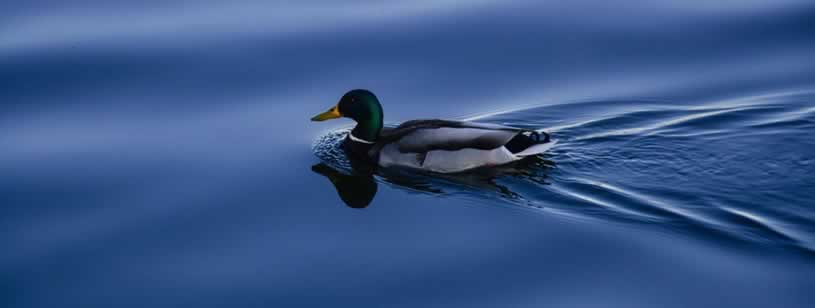
Ducks are waterbirds in the family Anatidae. They have webbed feet, but their bills, feeding methods and habitats vary between species. Some feed near the surface, while others dive for food. Domestic ducks also differ from their wild relatives.
Wild ducks include migratory species such as the mallard (Anas platyrhynchos). Domestic breeds are raised for eggs, meat and other uses; their traits can differ from those of wild ducks.
Quick facts
| Common name | Duck |
| Scientific name | Anatidae (ducks in several genera) |
| Typical lifespan | 5-10 years in the wild, up to about 20 years in captivity |
| Maximum speed | Varies by species; many ducks fly at about 60-90 km/h |
| Wingspan | Varies by species; for example, about 81–98 cm in the mallard |
| Length | 40-65 cm |
| Weight | 0.5 - 2 kg |
| Diet type | Omnivore (water plants, seeds, insects, crustaceans) |
| Main predators | Hawks, falcons, foxes, snakes, raccoons, large fish, humans (hunting) |
| Conservation status | Varies by species; most are Least Concern, some are Endangered |
| Geographical distribution | Every continent except Antarctica |
| Habitat | Lakes, rivers, marshes, coasts |
| Social behaviour | Often gather in large flocks and migrate together |
| Special adaptations | Webbed feet for swimming, filtering bill, waterproof feathers |
Interesting facts
- Ducks can sleep with one eye open - Called unihemispheric sleep, this lets half the brain rest while the other half watches for predators.
- Their feathers are waterproof - An oil produced by the preen gland, near the tail, keeps them dry and helps protect them from the cold.
- Males lose their bright feathers after the breeding season - During this moult, called the eclipse plumage, they look much like females and are better camouflaged.
- Migratory fliers - Redheads (Aythya americana) move between breeding and wintering areas, often gathering in large flocks during migration.
- Some ducks dive deep - Diving ducks such as the common goldeneye (Bucephala clangula) can go down more than 5 metres to find food.
- They have an almost all-round view - Their eyes are on the sides of the head, so ducks can spot danger without turning their heads.
- Their feet stay cold but don't freeze - A special arrangement of blood vessels in the legs means ducks lose very little heat when standing on ice.
Records and remarkable features
- Ducks are waterbirds in the family Anatidae. They have webbed feet, but their bills, feeding methods and habitats vary between species. Some feed near the surface, while others dive for food. Domestic ducks also differ from their wild relatives.
Characteristics
Ducks are sturdy waterbirds adapted to life on water, on land and in the air, with features that help them move efficiently in all three.
Appearance
- Compact, light body - Allows fast flight and efficient swimming.
- Strong wings - Allow long flights, so many ducks can migrate long distances.
- Webbed feet - Make swimming fast and easy; their position near the back of the body helps ducks paddle well.
- A flat, broad bill - Adapted for filtering food from water, with sensitive tips that help ducks find food.
- Waterproof feathers - Oil from the preen gland makes water run off the feathers, keeping the duck dry and warm.
- Different colours - In many species, males are brightly coloured in the breeding season, while females are duller, which helps them hide.
Special adaptations
- Efficient flying - Some ducks fly long distances during migration, using favourable winds to save energy.
- Cold feet, warm body - A countercurrent system of blood vessels lets ducks stand on ice without losing much body heat.
- Built for diving - Diving ducks have larger feet placed further back, which helps them swim underwater.
- Good navigation - Many ducks return to the same breeding and wintering areas year after year.
Habits and behaviour
Ducks are social birds whose behaviour varies with the species and habitat.
Social behaviour
- They form large flocks - Outside the breeding season, ducks often gather in flocks of hundreds or thousands.
- Seasonal pairs - Most ducks pair up for one season; in many species, the male leaves once the female starts incubating.
- Communication by sound and movement - Ducks use different calls to warn of danger and to stay together.
Defence and survival techniques
- Camouflage - Females usually have mottled brown feathers that help them hide among reeds.
- Diving to escape - Diving ducks such as the common pochard (Aythya ferina) dive to escape predators.
- Fast take-off - Dabbling ducks can spring almost straight up into the air and fly with great agility.
- Swimming away - When attacked, some species swim away underwater.
Habitat and geographic distribution
Ducks are highly adaptable and live on every continent except Antarctica, in many kinds of watery habitat.
| Region | Example species | Preferred habitat |
|---|---|---|
| Europe | Mallard (Anas platyrhynchos), common pochard (Aythya ferina) | Lakes, rivers, marshes |
| North America | Northern pintail (Anas acuta), redhead (Aythya americana) | Wetlands, deltas, coasts |
| Asia | Indian spot-billed duck (Anas poecilorhyncha), red-crested pochard (Netta rufina) | Rivers, lakes |
| Africa | Hottentot teal (Spatula hottentota), white-faced whistling duck (Dendrocygna viduata) | Savanna lakes, deltas |
| Australia | Pacific black duck (Anas superciliosa), Australian shelduck (Tadorna tadornoides) | Coasts, rivers, lakes |
| South America | Brazilian teal (Amazonetta brasiliensis), crested duck (Lophonetta specularioides) | Tropical wetlands, mountain lakes |
Types of habitat
- Lakes and rivers with plenty of plants - Offer shelter and food.
- Marshes and deltas - Ideal for migrating ducks, thanks to plentiful food and cover.
- Coasts - Some species, such as sea ducks, live mostly on salt water.
- Man-made habitats - Many ducks have adapted well to parks, ponds and canals.
Human impact and threats
- Habitat loss - Draining wetlands reduces breeding and feeding areas.
- Water pollution - Chemicals and industrial waste harm ducks' health.
- Overhunting - Where hunting is poorly regulated, some populations decline.
- Climate change - Changes in temperature affect migration and food supplies.
Diet and feeding
Ducks are opportunistic omnivores with a varied diet, which helps them adapt to different watery environments. They eat plants, seeds, insects, crustaceans and small fish.
What do ducks eat?
| Type of food | Examples |
|---|---|
| Water plants | Algae, pondweeds, other submerged plants |
| Seeds and grain | Wheat, maize, rice, millet |
| Insects and larvae | Mosquito larvae, flies, beetles |
| Crustaceans and molluscs | Snails, freshwater shrimps |
| Small fish and amphibians | Small fry, tadpoles |
| Food in captivity | Poultry pellets; bread is not recommended |
Feeding techniques
- Filtering with the bill - Dabbling ducks such as the mallard (Anas platyrhynchos) sieve water through their bills, keeping the edible particles.
- Dabbling - Surface-feeding ducks tip forward with their tail in the air to reach plants and invertebrates below the surface.
- Diving - Diving ducks such as the common goldeneye (Bucephala clangula) go down several metres to feed.
- Feeding on land - Ducks also eat seeds and insects in fields and meadows.
- Swallowing grit - Ducks swallow sand and small stones, which help grind food in the gizzard.
Adapting to food supply
- In warm seasons, they eat more insects and fresh plants.
- In the cold season, they eat more seeds and grain, because insects are scarce.
- In towns, they also eat food given by people.
Reproduction and life cycle
Ducks breed quickly, which helps keep their populations stable even in difficult conditions.
| Feature | Details |
|---|---|
| Age at maturity | About 1 year |
| Breeding season | Spring and early summer |
| Eggs per nest | 5 - 15 |
| Incubation | 24-30 days |
| Time until the young can fly | 6-8 weeks |
| Broods per year | 1-2, depending on the species |
| Lifespan | 5-10 years in the wild, up to about 20 years in captivity |
Breeding
- Courtship displays - Males attract females with special movements and calls, including head-bobbing, neck-stretching and splashing.
- The female builds the nest - Usually on the ground, hidden in thick grass near water.
- Only the female incubates the eggs - Meanwhile, males of many species moult into their dull eclipse plumage.
- Ducklings leave the nest early - Within hours of hatching, they can swim and feed themselves, but they stay with their mother for several weeks.
- After about 6-8 weeks, the young can fly and become independent.
Survival strategies
- The female covers her eggs with down feathers to keep them warm and hidden.
- If a nest is destroyed, the female can lay a second clutch of eggs.
- Ducklings grow fast and can fly at about 6-8 weeks, which reduces the time they are most at risk.
Name and history
People have lived alongside ducks for a very long time; ducks were domesticated thousands of years ago.
Origin of the name
- The English word "duck" comes from Old English and is related to the verb "to duck", meaning to dip or dive, describing how many ducks feed.
- The scientific family name Anatidae comes from anas, the Latin word for duck.
Ducks in human history
- Ancient Egypt - Ducks were kept and hunted, and they often appear in Egyptian art and hieroglyphs.
- Ancient China - Ducks were domesticated in China, and mandarin ducks became symbols of a happy marriage in art and poetry.
- The Roman Empire - The Romans kept ducks in special enclosures and ate them as a delicacy.
- The Middle Ages - Ducks became widely kept in Europe for meat and eggs.
- 20th–21st centuries - Researchers have studied how ducks find their way during migration. In some rice-growing systems, domestic ducks also help reduce insect pests and weeds.
Ducks in folklore and superstition
Cultural significance and mythology
- Love and loyalty - In China and other parts of East Asia, a pair of mandarin ducks is a traditional symbol of a happy, faithful couple and often appears in wedding decorations.
- Fairy tales - In Hans Christian Andersen's "The Ugly Duckling" (1843), a bird teased by the ducks grows up to be a beautiful swan.
Conservation status and threats
Ducks are among the most common waterbirds in the world, but some species are threatened by overhunting, pollution and the destruction of wetlands.
| Species | IUCN status | Approximate population | Range |
|---|---|---|---|
| Mallard (Anas platyrhynchos) | Least Concern | Around 20 million | Worldwide (native to the Northern Hemisphere) |
| Mandarin duck (Aix galericulata) | Least Concern | Tens of thousands | East Asia; introduced to Europe |
| Wood duck (Aix sponsa) | Least Concern | Several million | North America |
| White-headed duck (Oxyura leucocephala) | Endangered | Fewer than about 10,000 | Southern Europe, North Africa, Central Asia |
| Common goldeneye (Bucephala clangula) | Least Concern | More than a million | North America, Europe, northern Asia |
Main threats
- Habitat destruction - Wetlands are drained for farming, which reduces breeding areas.
- Overhunting - Some species are hunted too heavily for meat or sport.
- Water pollution - Oil spills, plastics and pesticides harm duck populations.
- Climate change - Affects migration timing and food supplies.
- Hybridisation - Introduced species can breed with native ducks; for example, the North American ruddy duck has threatened the white-headed duck in Europe.
Conservation efforts
- National parks and reserves - Protected wetlands for migrating birds, such as the Danube Delta or the Everglades.
- Hunting rules - In many countries, wild duck hunting is allowed only in certain seasons and in limited numbers.
- Captive breeding - Some threatened species are bred in captivity to support wild populations.
- Wetland protection - Organisations such as WWF and agreements such as the Ramsar Convention work to protect duck habitats.
In popular culture
- Donald Duck (Disney, 1934) and Daffy Duck (Warner Bros., 1937) - Two of the most famous cartoon ducks.
- Make Way for Ducklings (Robert McCloskey, 1941) - A classic children's book about a mallard family in Boston, remembered with a statue in the Boston Public Garden.
- The rubber duck - A popular bath toy and a well-known symbol of childhood.