CrowInteresting facts and information
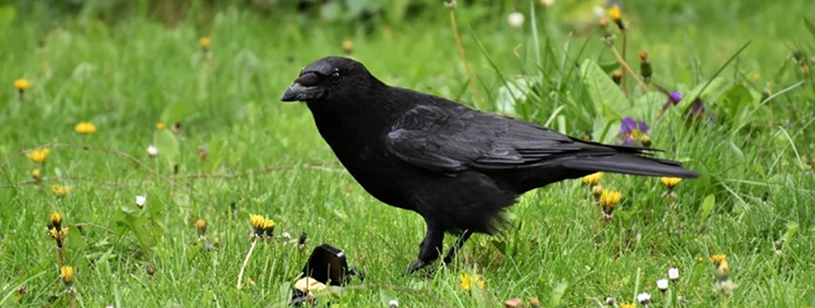
Crows are birds in the genus Corvus, within the family Corvidae. Different species live in different regions and use a wide variety of foods. Some crows show remarkable learning and problem-solving abilities, but a result for one species should not automatically be assigned to every crow.
Different crow species occupy different regions. Some use towns and farmland as well as more natural habitats; their food and social behaviour vary.
Quick facts
| Common name | Crow |
| Scientific name | Corvus |
| Typical lifespan | Often about 7-15 years in the wild; longer in captivity |
| Maximum speed | Varies with species or individual, distance and conditions |
| Height | About 40 - 55 cm long (larger in ravens) |
| Weight | About 300 - 700 g (ravens up to about 1,500 g) |
| Diet type | Omnivore (fruits, seeds, insects, carrion, small vertebrates) |
| Main predators | Owls, hawks, falcons, raccoons and martens (eggs and chicks), humans |
| Conservation status | Assess separately by species and population; different taxa and regions have different needs |
| Habitat | Forests, farmland, cities, mountains, coasts |
- Primary category:Birds
- Explore this animal's categories:
Interesting facts
- Tool users - Some crows make and use tools; New Caledonian crows shape twigs and leaves into hooks to pull insects out of holes.
- They remember faces - Studies have shown that American crows remember the faces of people who threatened them and can teach other crows to recognise them.
- Learning by watching - Crows can learn new ways to find food by watching other crows.
- "Funerals" - American crows often gather noisily around a dead crow, possibly to learn about dangers in that place.
- Mimicry - Crows and ravens can imitate many sounds, and some captive birds have learned to copy human words.
- Clever hiding - Some members of the crow family hide food, and if they notice another bird watching, they may move it later.
- Local calls - Crow calls can differ from one area to another.
Records and remarkable features
- Some members of the crow family use tools and learn complex tasks. The ability depends on the species and the task.
Physical characteristics and adaptations
Crows are sturdy, medium-sized to large birds, many of them black with glossy plumage. Although they may look plain, they have many adaptations that make them very successful birds.
Body structure and appearance
- Glossy feathers - Many crows are black with a blue or purple sheen in bright light; others, such as hooded and pied crows, are black and grey or black and white.
- A strong bill - A multi-purpose tool used for feeding, digging, carrying and handling objects.
- Strong legs and feet - Help them walk, hop and hold food.
- Sharp eyes - Crows have good eyesight and can recognise individual human faces.
Special adaptations for survival
- A large brain - Crows have large brains for their body size, especially the parts used for learning and problem-solving.
- Many calls - Crows use a wide range of calls, and some can imitate other birds, animals and even human voices.
- Excellent memory - Crows remember faces, dangers and places where they have hidden food.
- Problem-solving - In some tests, crows solve puzzles at a level that researchers have compared with young children.
Habits and behaviour
Crows are social birds. Many species live in family groups and gather in large flocks to roost, and they show complex communication and learning.
Social behaviour
- Roosts and flocks - Outside the breeding season, crows often gather in large night roosts, sometimes of thousands of birds.
- Family groups - In some species, such as the American crow, young birds stay with their parents and help raise their younger siblings.
- Mobbing - Crows join together to chase away owls, hawks and other predators.
Methods of obtaining food
| Technique | Description |
|---|---|
| Using tools | New Caledonian crows use sticks and leaf tools to get insects from holes. |
| Dropping nuts and shells | Some crows drop nuts or shellfish from a height onto hard ground to break them. |
| Cooperation | Crows sometimes work together to distract other animals and take their food. |
| Stealing food | Crows often take food from other birds and from people. |
Communication and language
- Crows use different calls to warn of danger, call family members and defend their territory.
- They can imitate sounds from their surroundings, such as other birds, dogs or human voices.
- Information about dangerous people or places can spread among crows and be passed on to young birds.
Habitat and geographic distribution
Crows are among the most widespread and adaptable birds in the world and live on every continent except Antarctica and South America.
Geographical distribution
| Region | Notable species |
|---|---|
| North America | Corvus brachyrhynchos (American crow) |
| Europe and Asia | Corvus corone (carrion crow), Corvus cornix (hooded crow), Corvus frugilegus (rook) |
| Australia | Corvus orru (Torresian crow) |
| Africa | Corvus albus (pied crow) |
| Pacific islands | Corvus moneduloides (New Caledonian crow) |
Habitats
- Woodland and forest edges - Many crows nest high in trees.
- Farmland - Crows are common in fields, where they feed on seeds, insects and worms.
- Towns and cities - Crows have adapted very well to cities, where they find plenty of food.
Adaptation to urban life
- In Japan, crows have been filmed dropping walnuts onto roads so that cars crack them.
- Some city crows seem to wait for traffic lights to change before collecting the opened nuts.
- Crows learn which places and people are safe and which are dangerous.
Diet and feeding
Crows are opportunistic omnivores with a very varied diet. They eat both plant and animal food, including food left by people.
What do crows eat?
| Food type | Examples |
|---|---|
| Fruits and seeds | Grain, acorns, nuts, berries, fruit |
| Insects and invertebrates | Beetles, grasshoppers, caterpillars, snails, earthworms |
| Carrion | Dead animals, including roadkill |
| Eggs and small animals | Birds' eggs and chicks, mice, frogs |
| Human food waste | Bread, chips and other leftovers |
Clever ways of getting food
- Tools - New Caledonian crows make hooked tools from twigs and cut tools from leaves.
- Hiding food - Crows hide pieces of food in the ground or under leaves and come back for them later.
- Teamwork - Several crows may work together to steal food from other animals.
- Using traffic - Some city crows use passing cars to crack nuts.
Reproduction and life cycle
Crows usually form long-lasting pairs. They build large stick nests and defend their young boldly.
Breeding and parental behaviour
- The breeding season begins in spring, and the pair build a nest of sticks lined with softer materials.
- Some crows form lasting pairs, but pair duration and mating behaviour differ between species and individuals.
- In some species, young crows stay with their parents and help care for the next year's chicks.
Eggs and hatching
| Characteristic | Details |
|---|---|
| Eggs | Usually 3-6 per clutch |
| Incubation | About 17-20 days |
| Who incubates the eggs? | Mainly the female, while the male brings her food |
| Leaving the nest | At about 4-5 weeks old |
- The chicks depend completely on their parents for the first weeks.
- After leaving the nest, young crows stay near their parents for some time and learn how to find food.
Longevity and Survival
- In the wild, many crows live about 7-15 years, and some much longer; captive crows have lived for several decades.
- The main causes of death are predators, disease, accidents and persecution by people.
Name and history
Crows have been known and written about since ancient times because they live close to people and behave in complex ways.
Origin of name
- The English word "crow" comes from Old English crāwe and imitates the bird's call.
- The scientific name Corvus is the Latin word for "raven".
Taxonomic Classification
| Kingdom | Animalia |
|---|---|
| Phylum | Chordata |
| Class | Aves |
| Order | Passeriformes |
| Family | Corvidae |
| Genus | Corvus |
History and documentation
- Ancient writers - Aristotle and Pliny the Elder wrote about crows and ravens.
- Aesop's fable - In "The Crow and the Pitcher", a thirsty crow drops stones into a jug to raise the water; modern experiments have shown that crows and rooks can really solve this kind of problem.
- Crows and ravens - Ravens are larger members of the same genus, Corvus, and appear in many of the same myths.
Cultural significance and mythology
Crows and their relatives, the ravens, have been part of human myths and culture for thousands of years, as messengers of the gods, symbols of wisdom or signs of death.
Crows in mythology and religion
- Norse mythology - The god Odin had two ravens, Huginn and Muninn ("thought" and "memory"), which flew around the world and brought him news.
- Celtic mythology - Crows and ravens were linked with the war goddess Morrígan and with battlefields.
- Greek mythology - According to a myth, Apollo's crow was once white but was turned black for bringing him bad news.
- Japan - The three-legged crow Yatagarasu is a symbol of divine guidance and appears on the emblem of the Japan Football Association.
- The Bible - In the story of Noah, a raven is the first bird sent out to look for land after the flood.
Superstition and symbolism
- Omens of death - In many European cultures, crows were linked with death and bad luck, because they feed on carrion and are often seen near battlefields and graveyards.
- Intelligence - In other traditions, crows are symbols of cleverness and wisdom.
- Romanian folklore - The crow is seen as a cunning bird, sometimes a bringer of bad news, but also a symbol of survival in hard times.
Conservation status and threats
Most crow species are common and not threatened, but some island species are critically endangered.
Main threats
- Habitat loss - Island species are threatened by the loss of their forests.
- Persecution - In some places, crows are shot or poisoned as pests.
- Disease - West Nile virus killed many American crows in the early 2000s.
- Introduced predators - On islands, introduced animals such as rats and snakes attack eggs and chicks.
Conservation status
| Species | IUCN Status |
|---|---|
| Corvus brachyrhynchos (American crow) | Least Concern |
| Corvus corone (carrion crow) | Least Concern |
| Corvus kubaryi (Mariana crow) | Critically Endangered |
| Corvus hawaiiensis (Hawaiian crow, or ʻalalā) | Extinct in the Wild |
Conservation efforts
- Captive breeding - The Hawaiian crow survives in captivity, and attempts have been made to return it to the wild.
- Protecting habitats - Island forests are protected to help rare crows.
- Education - Changing people's view of crows helps reduce persecution.
In popular culture
Crows and ravens often appear in literature, films, music and art because of their striking look and rich symbolism.
Crows in literature
- "The Raven" (1845) by Edgar Allan Poe - One of the most famous poems in English, in which a raven repeats the word "Nevermore".
- "A Song of Ice and Fire" / "Game of Thrones" - Ravens carry messages, the men of the Night's Watch are nicknamed "crows", and a mysterious figure is called the Three-Eyed Raven.
- Folk tales - In Romanian and other folk tales, the crow often appears as a cunning bird.
Crows in films and animation
- "The Crow" (1994) - A cult film about a man who returns from the dead, guided by a crow.
- "Dumbo" (1941, Disney) - A group of crows help Dumbo believe that he can fly.
- "Maleficent" (2014) - Maleficent's loyal servant Diaval is a raven who can be turned into a man.
Crows in music and sport
- Counting Crows - An American rock band whose name comes from an old rhyme about counting crows or magpies.
- Baltimore Ravens - The American football team is named after Poe's poem.