European rhinoceros beetleOryctes nasicornis — habitat, diet and reproduction
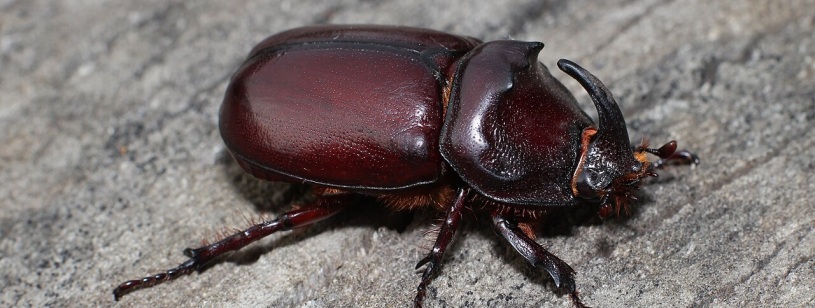
Male European rhinoceros beetle (Oryctes nasicornis). · George Chernilevsky / Public domain ().
The European rhinoceros beetle is one of the largest beetles in Europe. The male carries a curved horn on its head like a rhino, while the female has only a small bump. Its large white larvae grow for several years in rotting wood, sawdust and compost, and adults fly on warm summer evenings.
Quick facts
| Common name | European rhinoceros beetle |
| Scientific name | Oryctes nasicornis |
| Lifespan | Development takes 2–4 years; the adult lives a few weeks |
| Length | Usually 2–4 cm as an adult; larvae can exceed 10 cm |
| Diet | Larvae: rotting wood and plant debris; adults eat very little |
| Predators | Birds, wild boar, badgers, hedgehogs |
| Conservation status | Not evaluated globally; protected in some European countries |
| Distribution | Europe, North Africa, western and central Asia |
| Habitat | Woods, parks, gardens with compost, sawdust and rotting wood |
| Family | Scarabaeidae |
| Activity | Nocturnal, mainly in summer |
- Primary category:Insects
- Explore this animal's categories:
Interesting facts
- The male’s horn is used in fights with other males, not for defence against people.
- A rhinoceros beetle larva can live up to four years before becoming an adult.
- The adult barely eats and lives on reserves built up as a larva.
- When handled, the beetle makes a squeaking sound by rubbing body parts together.
Characteristics
The adult has a robust, glossy, reddish-brown body. The male has a long, backward-curving horn on its head and a ridge on the pronotum behind the head. The female has only a small bump instead of a horn.
The larva is large and creamy white, curled into a C-shape, with a brown head and three pairs of legs. It can grow larger than a finger.
Behaviour
Adults appear in summer, usually in June and July, flying mainly in the evening and at night and attracted to light.
They are completely harmless to people: they do not bite or sting. When alarmed they squeak. Larvae stay hidden in decaying material and are seen only when compost or a rotten log is disturbed.
Habitat and distribution
The species lives across much of Europe, North Africa and western and central Asia. Originally it lived in forests, in the rotting wood of old trees.
In Romania it is fairly common in woods, parks and gardens, especially where there are compost heaps, sawdust or manure.
Diet and feeding
Larvae feed on rotting wood, sawdust, leaves and other decaying plant matter, helping turn them into fertile soil.
Adults eat little or nothing, using reserves built up as larvae.
Reproduction and life cycle
After mating, the female lays eggs in decaying material: compost, sawdust or rotting wood.
Larvae grow slowly, for two to four years depending on temperature and food. They then build a chamber of soil and debris, pupate and emerge as adults a few weeks later.
Name and history
The scientific name Oryctes nasicornis roughly means “digger with a horn on its nose”. The common name comes from the male’s rhino-like horn.
The rhinoceros beetle belongs to the scarab family, which also includes the sacred beetles of ancient Egypt.
Conservation and threats
The rhinoceros beetle is not assessed globally, but some European countries, such as Germany, protect it. Fewer old trees and excessive removal of dead wood reduce its habitat.
In gardens, larvae found in compost do not harm living plants and can be left alone. Log piles and compost help the species.
Frequently asked questions
Is the rhinoceros beetle dangerous?
No. It does not bite or sting; it only squeaks when handled.
Where do its larvae live?
In rotting wood, sawdust, compost and manure, where they grow for two to four years.
Do larvae in compost harm plants?
No. They eat dead plant matter and help form fertile soil.
Why does it have a horn?
Only males have a horn, used in fights with other males.