Andean condorVultur gryphus — habitat, diet and reproduction
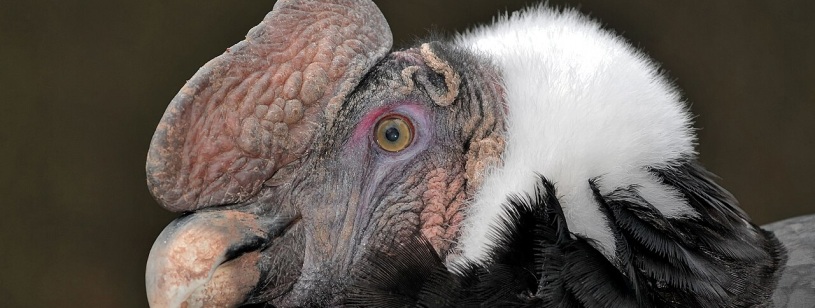
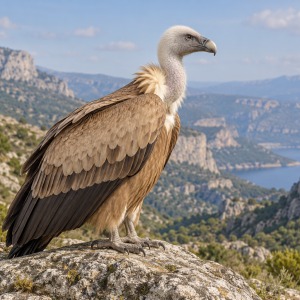
Male Andean condor (Vultur gryphus) showing its comb. · Michael Gäbler / CC BY 3.0 (https://creativecommons.org/licenses/by/3.0). Cropped and resized.
The Andean condor is one of the largest flying birds in the world, with wings spanning more than three metres. It lives in the Andes and along the coasts of South America, soaring on air currents in search of dead animals. It is a national symbol in several South American countries.
Quick facts
| Common name | Andean condor |
| Scientific name | Vultur gryphus |
| Lifespan | Over 50 years; over 70 in captivity |
| Length | About 100–130 cm |
| Weight | Males about 11–15 kg; females about 8–11 kg |
| Diet | Scavenger: carcasses, mainly of large mammals |
| Predators | Adults have no natural predators |
| Conservation status | Vulnerable (VU) |
| Distribution | The Andes and Pacific coast, from Venezuela to Tierra del Fuego |
| Habitat | High mountains, alpine grassland, rocky coasts |
| Family | Cathartidae |
| Wingspan | Up to about 3.3 m |
Interesting facts
- Charles Darwin watched condors for half an hour without seeing a single wingbeat.
- Condors flap for only about 1% of their flight time.
- Males have a fleshy comb on the head, which females lack.
- The condor appears on the coats of arms of Bolivia, Chile, Colombia and Ecuador.
Characteristics
The Andean condor has black plumage with a white ruff of soft feathers at the base of the neck and large white wing patches. The head and neck are bare, reddish or grey, which helps it stay clean when feeding on carcasses.
Males have a fleshy comb and neck wattles. Unlike most birds of prey, males are larger than females.
Behaviour
The condor is a master glider, using rising warm air and wind deflected by mountain slopes to climb effortlessly. It may travel hundreds of kilometres a day searching for food.
It lives alone or in pairs, but several may gather at a large carcass. Condors roost on high, inaccessible cliffs.
Habitat and distribution
The species lives along the Andes, from Venezuela and Colombia to Tierra del Fuego, and on the Pacific coasts of Peru and Chile.
It uses open areas where it can spot food from above: alpine grassland, mountain deserts and coasts.
Diet and feeding
The condor feeds mainly on dead animals: llamas, guanacos, cattle, sheep, deer and, on the coast, sea lions and stranded whales.
By eating carcasses, it helps clean the environment and reduce disease. It occasionally attacks small birds or eats eggs in coastal colonies.
Reproduction and life cycle
Condors breed very slowly. The female lays a single egg, usually every other year, on a cliff ledge or in a cave. Both parents incubate it for about 54–58 days.
The chick flies at about six months but stays with its parents another year. Condors mature only at 5–8 years.
Name and history
The scientific name Vultur gryphus combines the Latin word for vulture with “gryphus”, the legendary griffin. “Condor” comes from the Quechua “kuntur”.
In Andean mythology, the condor was linked to the sky and the upper world. It is a national symbol of Bolivia, Chile, Colombia, Ecuador and Peru.
Conservation and threats
The species is assessed as Vulnerable. Because it breeds slowly, every adult lost matters.
Threats include poisoning from baits set for predators, lead poisoning from bullets, shooting and habitat loss. Captive-breeding programmes release young birds into the wild.
Frequently asked questions
How big are a condor’s wings?
The wingspan can reach about 3.3 m, among the largest of any flying bird.
What does the Andean condor eat?
Mostly dead animals, such as llamas, cattle, sheep or sea lions.
How long does a condor live?
Over 50 years in the wild and over 70 in captivity.
Does the condor hunt people or live animals?
No. It is a scavenger feeding mainly on carcasses; it only rarely catches small animals.