PigeonInteresting facts and information
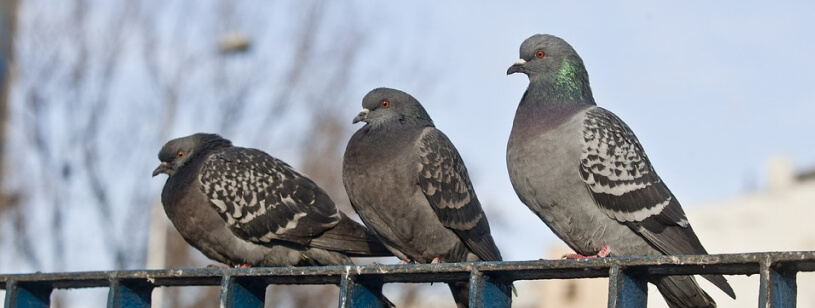
Domestic and feral pigeons descend from the rock dove (Columba livia). They use varied foods and nesting places and are familiar in towns. Pigeons can produce crop milk to feed their young.
Thanks to their amazing ability to find their way home over long distances, pigeons have carried messages for armies and postal services for thousands of years. The dove is also a worldwide symbol of peace, love and hope, and appears in mythology, religion and popular culture.
In cities, pigeons are often seen as pests, but they are also intelligent birds with a long history alongside people.
Quick facts
| Common name | Pigeon |
| Scientific name | Columba livia (domestic and feral forms) |
| Typical lifespan | Usually 3-5 years in cities; 15 years or more in captivity |
| Maximum speed | Racing pigeons average 70-90 km/h and can exceed 150 km/h with a tailwind |
| Wingspan | About 60-70 cm |
| Length | About 30-35 cm |
| Weight | About 250-400 g |
| Diet type | Mainly seeds and grain, plus fruit, occasional insects and food scraps |
| Main predators | Peregrine falcons, hawks, cats, rats (eggs and chicks), people |
| Conservation status | Rock pigeon: Least Concern; other pigeon species range from common to extinct |
| Geographical distribution | Worldwide, except the driest deserts and polar regions |
| Social behaviour | Lives in flocks; pairs often stay together for life |
| Special adaptations | Excellent navigation, remarkable memory, fast and enduring flight, crop milk |
- Primary category:Birds
- Explore this animal's categories:
Interesting facts
- Pigeons recognise people - Experiments in Paris showed that city pigeons can tell apart individual people and remember who chased them away.
- Expert navigators - Pigeons find their way using the sun, the Earth's magnetic field, smells and familiar landmarks such as roads and rivers.
- Homing champions - Trained homing pigeons can return to their loft from places more than 1,000 km away that they have never seen before.
- Fast flyers - Racing pigeons often average 70-90 km/h, and with a tailwind they can exceed 150 km/h.
- Colourful vision - Pigeons see more colours than people, including ultraviolet light.
- Clever birds - In experiments, pigeons have learned to recognise all the letters of the alphabet and to tell apart paintings by different artists.
- War heroes - Pigeons carried vital messages in both world wars; 32 pigeons received the Dickin Medal, an award for animal bravery.
- Cher Ami - In 1918, this pigeon carried a message that helped save 194 American soldiers of the "Lost Battalion" in France, despite being badly wounded.
Records and remarkable features
- Domestic and feral pigeons descend from the rock dove (Columba livia). They use varied foods and nesting places and are familiar in towns. Pigeons can produce crop milk to feed their young.
- The most expensive pigeon - In 2020, a Belgian racing pigeon called New Kim was sold for €1.6 million.
- Famous relatives - The extinct dodo of Mauritius was a giant flightless pigeon.
- Drinking without lifting the head - Unlike most birds, pigeons can suck up water like through a straw.
Characteristics
The pigeon is a fast, intelligent bird with many physical and behavioural adaptations that make it one of the most successful birds in the world.
Physical aspect
- Compact, streamlined body - Built for fast flight and endurance, with powerful flight muscles.
- Small head and large eyes - Pigeons have a wide field of view and can see ultraviolet light.
- Short beak - Ideal for picking up seeds and grain.
- Short legs - Pigeons walk well on the ground and grip narrow ledges.
- Pointed wings - Allow fast, long-distance flight.
Special adaptations
- Magnetic and visual navigation - Pigeons can sense the Earth's magnetic field and use landmarks to find their way.
- Excellent memory - They remember feeding places, routes and even people for years.
- Speed and agility - They can quickly change direction to escape predators.
- Drinking - Pigeons can suck up water without lifting their heads, unlike most other birds.
Habits and behaviour
Pigeons are social birds that usually live in flocks and form long-lasting pairs.
Social behaviour
- Pairs and flocks - Pigeons live in flocks, and pairs often stay together for life.
- Feeding together - Flocks of 20-30 birds or more often feed together.
- Preening - They clean and arrange their feathers carefully every day.
- Defending the nest - Pigeons defend their nest site, and males chase rivals away.
Defence and Survival Techniques
- Fast, twisting flight - When attacked, pigeons make sudden turns to escape.
- Flying in flocks - A tight flock makes it harder for a falcon to pick out one bird.
- Communication - They use cooing, wing claps and body movements to send messages.
Habitat and geographic distribution
Feral pigeons are among the most widespread birds in the world, living in cities, farmland and on rocky cliffs. There are also more than 300 other species of pigeons and doves.
| Region | Example species | Habitat Preferred |
|---|---|---|
| Europe | Domestic and feral rock pigeons (Columba livia); wood pigeon | Cities, cliffs, farmland, woods |
| Asia | Wood pigeon (Columba palumbus); collared doves are separate species | Woods, farmland, villages |
| North America | Feral rock pigeon (introduced), mourning dove, band-tailed pigeon | Cities, farms, forests |
| Africa | African green pigeon (Treron calvus) — a different pigeon species | Savanna, forests |
| Australia | Native pigeons such as the crested pigeon; feral rock pigeons in cities | Dry country, cities |
Types of Habitat
- Cities - Feral pigeons nest on buildings, bridges and in railway stations, which are like the cliffs of their wild ancestors.
- Cliffs and mountains - Wild rock doves nest on sea cliffs and in rocky gorges.
- Farmland - Pigeons feed on spilled grain and seeds.
Human Impact and Threats
- Habitat loss - Many wild pigeon and dove species, especially on tropical islands, are threatened by deforestation.
- Conflicts with people - City pigeons can damage buildings with their droppings, and some species eat crops.
- Predators - Peregrine falcons, hawks and cats hunt pigeons.
Diet and feeding
The pigeon mainly eats seeds and grain, but it also eats other foods when available. In cities, it easily adapts to a diet of food scraps.
What does the pigeon eat?
| Type of food | Examples |
|---|---|
| Seeds | Wheat, maize, sunflower, millet |
| Cereals | Rice, oats, barley |
| Fruit and berries | Berries, grapes, figs |
| Insects and worms (occasionally) | Larvae, ants, small beetles |
| Food scraps | Bread, biscuits, cooked rice |
Feeding methods
- Pecking on the ground - Pigeons usually feed on the ground, picking up seeds and grain.
- Memory - They remember where they found food and return again and again.
- Feeding in flocks - In cities, pigeons feed in large flocks.
- Storing food in the crop - They can quickly fill their crop and digest the food later in a safe place.
Adaptation to Food Availability
- In the wild, rock doves eat mainly seeds.
- In cities, they eat a lot of human food scraps.
- They also swallow small stones (grit), which help grind seeds in the gizzard.
Reproduction and life cycle
Pigeons usually form long-lasting pairs and can breed many times a year, which explains why there are so many in cities.
| Characteristic | Details |
|---|---|
| Age of sexual maturity | About 6 months |
| Breeding season | All year (where food is plentiful) |
| Number of eggs per nest | Usually 2 eggs |
| Incubation period | About 17-19 days |
| Time in the nest | About 4-5 weeks |
| Life expectancy | Usually 3-5 years in cities; 15 years or more in captivity |
Breeding process
- Courtship - The male puffs up his neck, coos and bows, turning in circles in front of the female.
- Building the nest - The nest is a simple, flimsy platform of twigs and grass, on a ledge or in a sheltered spot.
- Shared incubation - Both parents take turns sitting on the eggs: usually the male by day and the female at night.
- "Pigeon milk" - Both parents feed the chicks with crop milk, a rich food made in their crop.
- Leaving the nest - The young leave the nest after about 4-5 weeks, when they already look almost like adults.
Survival Strategies
- They nest in hard-to-reach places to avoid predators.
- Fast breeding - A pair can raise up to about 6 broods a year in good conditions.
- Living in flocks - Flocks give protection against attacks.
Name and history
The rock pigeon may have been the first bird domesticated by people, at least 5,000 years ago. Pigeons have been kept for food, for carrying messages, for racing and for their beauty.
Origin and etymology of the name
- The word "pigeon" comes from Old French pijon, from the Late Latin pipio, "young chirping bird". "Dove" is an old Germanic word; both names are used for birds of the same family.
- The scientific name Columba livia refers to the rock dove, the wild ancestor of domestic pigeons.
Pigeon in the History of Humanity
- Ancient Middle East and Egypt - Pigeons were kept for food and were among the first domesticated birds.
- The Roman Empire - Romans used pigeons to carry messages and built large pigeon houses.
- The Middle Ages - Pigeons were kept in special buildings called dovecotes, which provided meat and manure.
- The 19th and 20th centuries - Pigeons carried microfilm letters during the Siege of Paris (1870-71) and vital messages in both world wars.
Pigeon in Folklore and Superstition
- The white dove - A universal symbol of peace and hope.
- Good news - In some European traditions, a pigeon at the window is said to bring news.
- Always home - Pigeons' ability to find their way home made them famous as messengers.
Cultural significance and mythology
The dove is one of the most symbolic animals in human history, associated with peace, love, hope and the divine in many cultures and religions.
Pigeon in Mythology and Religion
- The Bible and Christianity - The dove is a symbol of the Holy Spirit. In the story of the Flood, Noah sends out a dove, which returns with an olive leaf as a sign that the waters are going down.
- Greek mythology - Doves were sacred to Aphrodite, the goddess of love.
- Islam - According to tradition, a pair of pigeons nested at the entrance of the cave where the Prophet Muhammad was hiding, helping to protect him from his pursuers.
- China - In Beijing, people traditionally tie small whistles to pigeons' tails, which make music as the flock flies.
- Hinduism - In some Indian traditions, feeding pigeons is considered a good deed.
Pigeon in Folklore and Superstition
- Good fortune - In some places, a pigeon settling on a house is seen as a sign of happy news.
- Weddings - White doves are released at some weddings as a symbol of love and peace.
- Bad luck - In some traditions, killing a dove is believed to bring bad luck.
Conservation status and threats
Domestic pigeons and wild pigeon species require separate conservation descriptions. Abundance of domestic pigeons does not establish the status of other species.
| IUCN status | Species | Regions |
|---|---|---|
| Least Concern (LC) | Domestic and wild forms of the rock pigeon (Columba livia) | Global |
| Near Threatened (NT) | Nicobar pigeon (Caloenas nicobarica) | Islands of South-East Asia and the western Pacific |
| Vulnerable (VU) | Pink pigeon (Nesoenas mayeri), down to about 10 birds in 1990 | Mauritius |
| Extinct (EX) | Passenger pigeon (Ectopistes migratorius); the last one, Martha, died in 1914 | North America |
Main threats
- Habitat loss - Many wild pigeons and doves, especially on tropical islands, are threatened by deforestation.
- Hunting - In some regions, pigeons are hunted heavily for meat.
- Introduced predators - On islands, rats, cats and mongooses kill many pigeons and eat their eggs.
- City problems - Feral pigeons suffer from poor food, diseases and injuries to their feet.
Conservation efforts
- Saving rare species - The pink pigeon of Mauritius was saved from extinction by captive breeding; there are now several hundred in the wild.
- Hunting rules - Many countries protect rare pigeon species from hunting.
- Restoring forests - Replanting native forests and controlling predators help island pigeons.
In popular culture
The pigeon appears in art, literature, films and advertising, thanks to its strong symbolism.
Literature and fables
- The Bible - Noah's dove is one of the most famous symbols of hope and renewal.
- Colomba (Prosper Mérimée, 1840) - A French novel about a Corsican family feud; the heroine's name means "dove".
- Aesop's Fables - In "The Ant and the Dove", a dove saves an ant, which later saves the dove.
- Don't Let the Pigeon Drive the Bus! (Mo Willems, 2003) - A popular children's picture book about a stubborn pigeon.
Films and animation
- Valiant (2005) - An animated film about a small pigeon in the Royal Air Force's pigeon service during the Second World War.
- Home Alone 2: Lost in New York (1992) - Kevin befriends a lonely woman who feeds the pigeons in Central Park.
- Mary Poppins (1964) - The song "Feed the Birds" is about an old woman who sells bird food to feed the pigeons outside St Paul's Cathedral.
- Spies in Disguise (2019) - An animated film in which a super-spy is accidentally turned into a pigeon.
Video Games
- Assassin's Creed - In several games, pigeon coops are used to send and receive messages and contracts.
- Grand Theft Auto IV - Players can hunt for 200 hidden "flying rats" (pigeons) around the city.
- Hatoful Boyfriend (2011) - A comic dating game in which almost all the characters are pigeons and other birds.
Pigeon as Commercial Symbol
- The dove of peace - Pablo Picasso's drawing of a dove (1949) became a famous symbol of the peace movement.
- Dove - The personal-care brand uses a dove as its logo, as a symbol of gentleness.
- Pigeon racing - Racing pigeons are especially popular in Belgium, the Netherlands, the United Kingdom and China.