AlbatrossInteresting facts and information
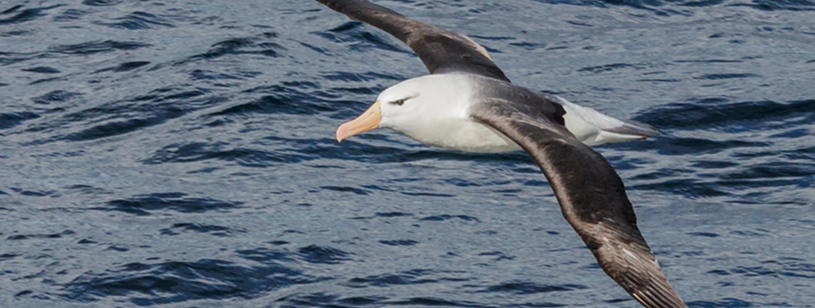
Albatrosses are seabirds in the family Diomedeidae, known for long, narrow wings and efficient soaring flight. Different species range across the Southern Ocean or the North Pacific.
They spend much of their lives at sea but return to land to breed. Many nest on remote islands and have a slow breeding cycle, so losses of adults can have serious effects on populations.
Albatrosses appear in maritime literature, including Coleridge’s poem. Several species face threats from fishing bycatch, introduced predators at nesting sites and pollution.
Quick facts
| Common name | Albatross |
| Scientific name | Diomedeidae (family) |
| Typical lifespan | Often 40-50 years; some individuals over 70 years |
| Length | About 70-135 cm (depending on species) |
| Wingspan | About 2-3.5 metres (the wandering albatross has the largest of all living birds) |
| Weight | About 2-12 kg (depending on species) |
| Diet type | Carnivorous (squid, fish, crustaceans, carrion) |
| Main predators | Sharks (fledglings at sea); skuas and giant petrels (chicks); introduced rats, mice and cats (eggs and chicks) |
| Conservation status | Varies by species; several albatrosses face serious conservation threats |
| Distribution | Southern Ocean and North Pacific |
| Living environment | Open ocean; remote islands for breeding |
- Primary category:Birds
- Explore this animal's categories:
Interesting facts
- The wandering albatross (Diomedea exulans) has the largest wingspan of any living bird, usually 2.5-3.5 metres.
- Gliding without flapping - Using the wind over the waves, albatrosses can glide for hours with hardly a wingbeat.
- Huge distances - A wandering albatross can fly more than 100,000 kilometres in a year, and some albatrosses fly right around the Southern Ocean.
- Long lives – Albatrosses can live for decades. Individual longevity records need a dated and identified bird.
- Drinking seawater - Special salt glands above the eyes remove excess salt, so albatrosses can drink seawater.
Records and remarkable features
- Broad wingspans – Great albatrosses are among the living birds with the greatest wingspans.
- Long-distance flyers - They can travel thousands of kilometres on a single foraging trip, using the wind to soar.
- Around the world - A grey-headed albatross has been tracked flying around the globe in 46 days.
- One of the longest-lived wild birds - Wisdom, a Laysan albatross first ringed as an adult in 1956, was still breeding when she was over 70 years old.
See the list of all the birds.
Physical characteristics and adaptations
Albatrosses are among the largest seabirds, with bodies built for flying huge distances over the open ocean.
Key physical adaptations
- Long, narrow wings - Ideal for gliding long distances with very few wingbeats.
- A streamlined body - Despite its size, the albatross is built for efficient flight.
- A shoulder lock - A special tendon lets albatrosses hold their wings out straight without using muscle power.
- A strong, hooked bill - Suited to catching squid and fish; tube-shaped nostrils on the bill help it smell food from far away.
- Salt glands - Glands above the eyes remove excess salt from the blood.
- Webbed feet - Help with swimming, landing and taking off from the water; on land, albatrosses walk rather clumsily.
Dimensions and variations between species
| Characteristic | Wandering albatross (Diomedea exulans) | Grey-headed albatross (Thalassarche chrysostoma) |
|---|---|---|
| Body length | About 110-135 cm | About 70-85 cm |
| Weight | About 6-12 kg | About 3-4.5 kg |
| Wingspan | About 2.5-3.5 metres | About 2-2.2 metres |
| Plumage | Mostly white, with dark wing tips; young birds are browner | Grey head, white body and dark upper wings |
Habits and behaviour
Albatrosses spend most of their lives alone at sea, but they nest in colonies and form strong pair bonds.
Daily life
- They spend most of their lives over the ocean and come to land only to breed.
- They can fly thousands of kilometres on a single trip, using the winds over the sea.
- Most pairs stay together for life.
- Young albatrosses may spend several years at sea before they first return to land.
Communication
- Courtship dances - Pairs perform dances with bill clapping, bowing, sky-pointing and calls.
- Calls - They make whistles, groans and clattering sounds with the bill at the colony.
- Postures - Wing and body positions show aggression or calm.
Defense techniques
- Remote nesting sites - Albatrosses breed on isolated islands with few or no natural land predators.
- Defending the nest - Adults clatter their bills at intruders, and chicks of some species spit oil at them.
- Dangers at sea - Fledglings resting on the water can be caught by sharks, especially tiger sharks off Hawaii; albatrosses share the open ocean with other large predators such as the orca.
Habitat and geographic distribution
Albatrosses are ocean birds; most species live in the Southern Hemisphere, and a few in the North Pacific.
Distribution context
| Region | Population information |
|---|---|
| Southern Ocean and South Pacific | Most species; many affected by fishing |
| South Atlantic Ocean | Important colonies on South Georgia, Gough Island and the Falklands; several species declining |
| Indian Ocean | Colonies on the Crozet, Kerguelen and Prince Edward Islands |
| North Pacific | Laysan, black-footed and short-tailed albatrosses |
Habitat types
- Open ocean - Albatrosses spend most of their lives far out at sea.
- Remote islands - They nest on isolated islands, far from the mainland.
- From cold to warm seas - Different species live in cold subantarctic waters or in the warmer North Pacific.
See about the seagulls, too. Gull.
Environmental change
- Longline fishing - Many thousands of albatrosses die each year after grabbing baited hooks.
- Plastic pollution - Albatross chicks are often fed pieces of plastic by their parents, mistaken for food.
- Climate change - Changes in winds and ocean conditions can affect where albatrosses find food.
- Introduced predators - Rats, mice and cats brought to nesting islands by people eat albatross eggs and chicks.
Diet and feeding
Albatrosses feed mainly on squid, fish and crustaceans, and also scavenge dead animals floating on the surface.
What does the albatross eat?
| Food group | Examples and context |
|---|---|
| Fish | Various ocean fish caught near the surface |
| Squid and other cephalopods | Squid are a main food for many species; also small octopus |
| Crustaceans | Krill and other small crustaceans |
| Carrion | Dead squid, fish and other animals floating at sea |
| Human waste (by mistake) | Plastic, pieces of rope and nets |
Feeding methods
- Surface feeding - Albatrosses usually catch food at or just below the surface; some smaller species dive a few metres.
- Following fishing boats - Albatrosses often follow boats to feed on discarded fish, which also puts them at risk from hooks.
- Searching by smell - They use their keen sense of smell to find food over long distances.
- Night feeding - Some squid rise to the surface at night, where albatrosses can catch them.
See other animals with the letter "P." Animals beginning with P.
Reproduction and life cycle
Albatrosses usually pair for life and breed very slowly: they lay a single egg, and the largest species breed only every two years.
Breeding season
- Albatrosses breed in colonies on remote islands; great albatrosses breed every two years, while many smaller species breed every year.
- Young birds spend several seasons dancing with possible partners before they form a pair.
- Nests are mounds of mud and plants, or simple hollows on the ground, depending on the species.
Nest and chick
| Characteristic | Details |
|---|---|
| Place of the nest | On remote islands, often in large colonies |
| Eggs | 1 egg per breeding attempt |
| Incubation | About 60-80 days (by both parents) |
| Feeding the chick | Regurgitated food and energy-rich stomach oil |
| Maturity | First breeding usually at about 5-10 years or later |
Raising young
- Chicks depend completely on their parents for many months.
- They are fed with partly digested food and stomach oil, which is very rich in energy.
- Chicks of the largest species leave the nest after about 9 months; those of smaller species after about 4-5 months.
- Young albatrosses spend several years at sea before returning to their colony to breed.
Name and history
Origin of the name
- The word "albatross" probably comes from the Portuguese and Spanish alcatraz, a name for large seabirds, later changed under the influence of the Latin albus, "white".
- The family name Diomedeidae comes from the Greek hero Diomedes, whose companions, according to legend, were turned into seabirds.
Taxonomic classification
| Classification | Name |
|---|---|
| Kingdom | Animalia |
| Phylum | Chordata |
| Class | Aves |
| Order | Procellariiformes |
| Family | Diomedeidae |
| Main genera | Diomedea, Thalassarche, Phoebastria, Phoebetria |
Evolution and fossils
- Albatross fossils help reconstruct the family’s evolutionary history; an exact origin date should not be inferred from a single fossil.
- Albatrosses are related to other tube-nosed seabirds, such as petrels, shearwaters and storm petrels.
- Fossils show that albatrosses once nested in the North Atlantic too, for example on Bermuda, where they are no longer found.
Cultural significance and mythology
The albatross is one of the most famous seabirds and has an important place in sailors' folklore and in literature.
Albatross in literature
- “The Rime of the Ancient Mariner” (Samuel Taylor Coleridge, 1798) – Killing an albatross brings misfortune in the poem; this is a literary story.
- "The Albatross" - Charles Baudelaire - A poem comparing the poet to the albatross, majestic in the air but clumsy on deck.
- "An albatross around one's neck" - This English expression, meaning a heavy burden, comes from Coleridge's poem.
Albatross in modern symbolism
- Sailors' beliefs - Some sailors believed that albatrosses carried the souls of sailors lost at sea.
- New Zealand - Māori used albatross (toroa) feathers for decoration and its bones to make flutes and other objects.
- Ocean conservation - The albatross has become a symbol of the fight against bycatch and plastic pollution.
Conservation status and threats
Many albatross species are threatened, mainly because of fishing, introduced predators and pollution.
Conservation status
| Species | Assessment scope | Population information |
|---|---|---|
| Wandering albatross (Diomedea exulans) | Vulnerable | About 20,000 mature birds |
| Laysan albatross (Phoebastria immutabilis) | Near Threatened | Population size depends on the particular species, region and assessment year |
| Grey-headed albatross (Thalassarche chrysostoma) | Endangered | Declining at several colonies |
| Southern royal albatross (Diomedea epomophora) | Vulnerable | Breeds mainly on Campbell Island, New Zealand |
Main pressures
- Longline and trawl fishing - Many thousands of albatrosses are killed each year by hooks and fishing cables.
- Plastic pollution - Birds mistake plastic for food and feed it to their chicks.
- Invasive species on nesting islands - Rats, mice and cats introduced by people attack chicks and eggs.
- Climate change - Changes in winds and sea temperatures affect food and breeding.
- Diseases - Outbreaks such as avian cholera have killed chicks at some colonies.
Protection measures
- Safer fishing gear - Weighted lines, bird-scaring lines and night setting reduce the number of birds caught.
- Protected areas - Nesting islands and important feeding areas are protected.
- Reducing plastic waste - Campaigns aim to reduce marine litter.
- Removing invasive species - Rats, mice and cats have been removed from several breeding islands.
In popular culture
The albatross appears in films, music and literature, often as a symbol of the open ocean.
Albatross in movies and animations
- "The Rescuers" (1977) and "The Rescuers Down Under" (1990) - Disney's comic albatrosses Orville and his brother Wilbur fly the mouse heroes to their adventures.
- Monty Python - In a famous sketch, an ice-cream seller tries to sell an albatross at the cinema, shouting "Albatross!"
Albatross in music
- "Albatross" - Fleetwood Mac (1968) - A gentle instrumental piece that reached number one in the UK.
- "Rime of the Ancient Mariner" - Iron Maiden (1984) - A long song based on Coleridge's poem.
Albatross as mascot and symbol
- Golf - An "albatross" is a score of three under par on a single hole.
- Conservation - The albatross is a symbol of seabird and ocean protection.
Did you know? About albatross
- The wandering albatross has the largest wingspan of any living bird.
- A special tendon lets albatrosses lock their wings open while gliding.
- Albatrosses can smell food from far away thanks to tube-shaped nostrils.
- Most albatross pairs stay together for life.
- An albatross lays only one egg per breeding attempt.
- Wandering albatross chicks stay in the nest for about nine months.
- Wisdom, a Laysan albatross, was still raising chicks when she was over 70 years old.
- The phrase "an albatross around one's neck" comes from Coleridge's poem "The Rime of the Ancient Mariner".
- Many thousands of albatrosses die each year on fishing hooks.