BaboonInteresting facts and information
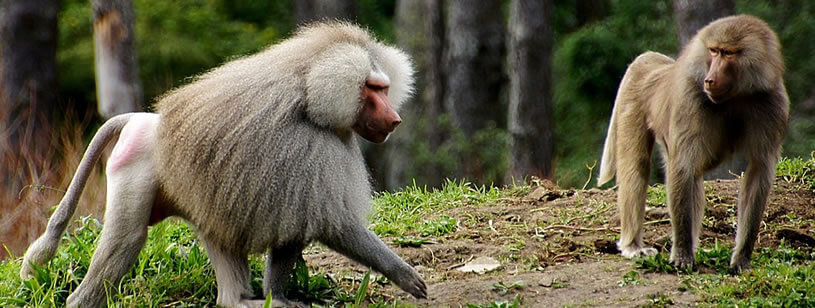
Baboons (Papio) are Old World monkeys in the family Cercopithecidae. They spend much of their time on the ground, but also climb and use different habitats. Social organisation varies among species.
Scientists usually recognise six species of baboons:
- Olive baboon (Papio anubis) – Lives in a broad belt across sub-Saharan Africa.
- Hamadryas baboon (Papio hamadryas) – Lives in northeastern Africa and southwestern Arabia; its society is built from one-male units within larger groups.
- Yellow baboon (Papio cynocephalus) – An eastern African species with yellowish-brown fur.
- Chacma baboon (Papio ursinus) – A large baboon of southern Africa.
- Guinea baboon (Papio papio) – A western African species.
- Kinda baboon (Papio kindae) – The smallest species, from south-central Africa.
Baboons are intelligent and very social and live in groups called troops, which can have more than 100 members.
Baboons can defend themselves with group responses and strong canine teeth, but they still face predators and human-related threats.
Quick facts
| Common name | Baboon |
| Scientific name | Papio (genus; commonly six living species) |
| Typical lifespan | About 20-30 years in the wild, up to about 45 years in captivity |
| Length | About 50-110 cm (without tail) |
| Tail length | About 40-85 cm |
| Weight | About 15-45 kg (males), 10-20 kg (females) |
| Diet type | Omnivore (fruit, seeds, grass, roots, insects, small animals) |
| Main predators | Leopards, lions, hyenas, crocodiles; eagles and pythons may take young |
| Conservation status | Most species Least Concern; the Guinea baboon is Near Threatened (IUCN) |
| Distribution | Africa and southwestern Arabia |
| Living environment | Savannas, woodland, semi-arid areas and mountains, depending on species |
- Primary category:Mammals
- Explore this animal's categories:
Interesting facts
- Very talkative primates - Baboons use many calls, gestures and facial expressions to communicate, and scientists have studied their "language" for decades.
- Friendships and alliances - Male baboons form alliances to gain status, and many males have special friendships with particular females and their young.
- Occasional hunters - Although they eat mainly plants, baboons sometimes catch and eat young antelopes, hares and birds.
- Desert survivors - Hamadryas baboons live in dry, rocky areas of Ethiopia, Somalia and the Arabian Peninsula.
- Living alongside other animals - Baboons often feed near impalas and other antelopes; each species benefits from the other's warnings of danger.
- Complex hierarchies - Baboon groups have clear ranks, and individuals keep their status through displays, fights and alliances.
Records and remarkable features
- The largest baboon - Big male chacma baboons (Papio ursinus) can weigh up to about 40-45 kg.
- Huge gatherings - Hamadryas baboons may gather in groups of several hundred animals at their sleeping cliffs.
- Lifespan – Baboons can live for several decades, particularly in managed care; no exact record is assigned here.
- The widest range - The olive baboon (Papio anubis) lives in more than 25 African countries, the largest range of any baboon.
- The smallest baboon - The Kinda baboon (Papio kindae) of Zambia, Angola and the Democratic Republic of the Congo is the smallest species.
Physical characteristics and adaptations
Baboons are among the largest monkeys. They have strong bodies, long, dog-like muzzles and expressive faces. Their adaptations let them live in many habitats, from savannas to mountains and deserts.
Key physical adaptations
- A long muzzle - Baboons have a long, dog-like face and powerful jaws.
- Canine teeth – Adult males have large canine teeth used in displays and fighting; no cross-species tooth-length record is claimed.
- A muscular body for life on the ground - Baboons can climb trees and cliffs, but they spend most of their time on the ground, walking on all fours.
- Strong hands - Used to dig up roots, pick up food and handle objects.
- A long tail - Not prehensile; it is often held in an arch, with the first part pointing up and the rest hanging down.
- Thick fur - Colours vary from grey and olive to yellowish-brown, depending on the species.
- Large differences between the sexes - Males are much bigger than females, and male hamadryas baboons have a large silvery mane and cape.
Sizes of different species
| Species | Body length | Tail length | Weight (males) | Weight (females) |
|---|---|---|---|---|
| Chacma baboon (Papio ursinus) | About 70-110 cm | 50-85 cm | About 30-45 kg | About 12-20 kg |
| Olive baboon (Papio anubis) | About 60-90 cm | 40-60 cm | About 24-37 kg | About 13-18 kg |
| Yellow baboon (Papio cynocephalus) | About 50-85 cm | 45-65 cm | About 20-30 kg | About 10-15 kg |
| Hamadryas baboon (Papio hamadryas) | About 60-80 cm | 40-60 cm | About 20-30 kg | About 10-15 kg |
| Guinea baboon (Papio papio) | About 50-80 cm | 40-55 cm | About 18-26 kg | About 10-14 kg |
| Kinda baboon (Papio kindae) | About 50-70 cm | 40-55 cm | About 15-16 kg | About 10 kg |
Habits and behaviour
Baboons are among the most social primates. They live in large groups, called troops, where life is governed by complex social rules.
Daily life
- Active by day - They feed and travel during the day and sleep in tall trees or on cliffs at night, out of reach of predators.
- Busy days - They spend the day feeding, travelling and socialising.
- Grooming - Baboons pick through each other's fur, which keeps them clean and strengthens friendships.
- Home ranges - Each troop has a home range that it travels through, sometimes walking many kilometres a day in search of food and water.
Social organisation
- Troops - Most baboons live in troops of about 20 to over 100 animals, with clear hierarchies.
- Dominant males - High-ranking males get priority access to food and females.
- Inherited rank - In savanna baboons, females usually stay in the troop where they were born and inherit their mother's rank.
- Moving males - Males usually leave their birth troop and must win their status in a new troop through fights or alliances.
- Hamadryas families - Hamadryas baboons live in small one-male units, which join together in larger bands and herds.
Communication
Baboons use many visual, vocal and touch signals.
- Facial expressions - Raising the eyebrows to flash pale eyelids, or yawning to show the canines, are threats; lip-smacking is a friendly signal.
- Calls - Soft grunts for friendly contact, screams in fights and loud "wahoo" barks to warn of danger or to challenge rivals.
- Grooming - Used to build friendships and reduce stress.
Defence techniques
- Escaping together - When danger appears, the troop runs off together, often to trees or cliffs.
- Fighting back - Adult males can confront predators, sometimes in groups, and have even driven off leopards.
- Alarm calls - A baboon that spots a predator gives a loud bark, warning the whole troop.
Habitat and geographic distribution
Baboons are very adaptable and live in many habitats in Africa and southwestern Arabia, from open savannas and woodland to mountains and semi-deserts.
Distribution context
| Region | Species present |
|---|---|
| East Africa (Kenya, Tanzania, Ethiopia, Somalia) | Papio anubis, Papio cynocephalus, Papio hamadryas |
| Central Africa (Central African Republic, Cameroon, Chad) | Papio anubis |
| South-Central Africa (Zambia, Angola, DR Congo) | Papio kindae, Papio cynocephalus |
| Southern Africa (Botswana, South Africa, Namibia) | Papio ursinus |
| West Africa (Senegal, Guinea, Mali) | Papio papio, Papio anubis |
| Arabian Peninsula (Yemen, Saudi Arabia) | Papio hamadryas |
Habitat types
- Savannas and open woodland - Ideal for baboons, offering varied food and a good view of approaching predators.
- Forest edges - Baboons live at the edges of forests and in gallery forests along rivers, but avoid dense jungle.
- Mountains and rocky areas - Hamadryas baboons prefer dry, rocky regions of Ethiopia and Arabia, and chacma baboons also live in mountains.
- Near water - Baboons need to drink regularly and usually stay within reach of water.
Environmental change
- Spreading towns and farms - As people move into their habitats, baboons raid crops and enter villages, which leads to conflict.
- Habitat loss - Clearing land affects many baboon populations, especially Guinea baboons.
- Persecution - In some regions, baboons are killed to protect crops and livestock.
Diet and feeding
Baboons are opportunistic omnivores with a very varied diet that helps them survive in many environments. They eat mainly plants, but also insects and sometimes small animals.
What do baboons eat?
| Food group | Examples and context |
|---|---|
| Fruit and seeds | Figs, berries, acacia seeds and pods |
| Leaves and grasses | Savanna grasses, young leaves, flowers |
| Roots and tubers | Grass corms, bulbs and roots dug from the ground |
| Insects and larvae | Grasshoppers, termites, beetle grubs |
| Eggs and small birds | Birds' eggs and chicks |
| Small mammals | Hares, young antelopes, rodents |
| Reptiles | Lizards |
| Human food | Crops and scraps near villages, farms and campsites |
Feeding methods
- Foraging - Baboons spend much of the day searching for fruit, seeds, leaves and grass.
- Hunting - In some troops, males in particular catch hares, birds or young antelopes.
- Digging - They dig up roots and bulbs with their hands, especially in the dry season.
- Raiding - In some areas, baboons have learned to steal food from farms, houses and cars.
Reproduction and life cycle
Baboon reproduction is closely linked to social life: high-ranking males have more chances to mate, but other males can succeed through friendships and alliances.
Breeding season
- Baboons have no fixed breeding season, and young can be born at any time of year.
- Males win access to females by competing with rivals or by forming close friendships with them.
- When a female is fertile, the skin around her bottom swells and turns pink, a clear signal to males.
Pregnancy and birth
| Feature | Details |
|---|---|
| Pregnancy | About 6 months |
| Young per birth | 1 (twins are rare) |
| Nursing | About 6-12 months, sometimes longer |
| Independence | About 2-3 years |
| Maturity | About 4-6 years for females, 6-8 years for males |
Raising the young
- Babies have black fur and pink faces, and other females in the troop are often keen to hold and groom them.
- For the first weeks, mothers carry their babies clinging to their belly; later the young ride on their mother's back like jockeys.
- Adult males often protect and play with infants, especially if they are their fathers or friends of the mother.
Survival
- Many young baboons die in their first years because of predators, disease and hunger.
- In captivity, where there are no predators, more young survive and adults live longer.
Name and history
Origin of the name
- The English word "baboon" comes from the Old French babouin, probably related to babine, "lip", or to a word meaning "fool" or "grimace".
- The genus name Papio comes from an old French word for baboon.
- The olive baboon's scientific name, Papio anubis, refers to the Egyptian god Anubis.
Taxonomic classification
| Classification | Name |
|---|---|
| Kingdom | Animalia |
| Phylum | Chordata |
| Class | Mammalia |
| Order | Primates |
| Family | Cercopithecidae |
| Genus | Papio |
| Species | Papio anubis, Papio hamadryas, Papio cynocephalus, Papio ursinus, Papio papio, Papio kindae |
Evolution and fossils
- Baboons of the genus Papio appeared about 2 million years ago and are among the primates best adapted to life on the ground.
- Fossils show that baboons have been widespread in Africa for a long time.
- Some extinct relatives of baboons, such as Dinopithecus, were much larger than today's species.
Cultural significance and mythology
People have lived alongside baboons for thousands of years; some societies honoured them, while others saw them as pests.
Baboons in myths and symbolism
- Ancient Egypt - Hamadryas baboons were sacred to Thoth, god of wisdom and writing, and were often shown greeting the rising sun. Many baboon mummies have been found in Egyptian temples and tombs.
- Imported from Punt - Studies of mummified baboons suggest that the Egyptians brought baboons from the land of Punt, somewhere in the Horn of Africa or Arabia.
- Pests and thieves - In many places today, baboons are seen as crop raiders and troublemakers, because they steal food and can be aggressive.
Baboons in modern symbolism
- Intelligence and adaptability - Baboons stand for cleverness and the ability to survive in difficult places.
- Jack the signalman - In 19th-century South Africa, a chacma baboon called Jack helped a disabled railway worker operate signals, and he is said never to have made a mistake.
Conservation status and threats
Most baboon species are not threatened, but some populations are affected by habitat loss and conflict with people.
Conservation status
| Species | IUCN status | Trend |
|---|---|---|
| Olive baboon | Least Concern | Stable |
| Hamadryas baboon | Least Concern | Stable in many areas, declining in some |
| Yellow baboon | Least Concern | Stable |
| Chacma baboon | Least Concern | Stable |
| Guinea baboon | Near Threatened | Declining |
| Kinda baboon | Least Concern | Little known |
Main pressures
- Conflict with farmers - Baboons raid crops, which leads to them being killed.
- Habitat loss - Land clearing affects many populations, especially Guinea baboons.
- Hunting - In some regions, baboons are hunted for meat or to protect farms.
- Towns and tourism - In places such as the Cape Peninsula in South Africa, baboons that learn to steal food from homes and tourists can become a problem.
Protection measures
- Wildlife corridors - Help baboon troops move between habitats without passing through farmland.
- Community programmes - Farmers are encouraged to use non-lethal methods, such as guards and fences, to keep baboons away.
- Protected areas - Baboons are protected and studied in many African national parks.
- Research - Long-term studies, such as those in Kenya's Amboseli, help find solutions to human-baboon conflict.
In popular culture
Baboons appear in films, cartoons and books, often as clever, cheeky or wise characters.
Characters and symbols
- Rafiki (The Lion King, 1994) - The wise old monkey who presents Simba to the animals is often described as a baboon, although he also has features of a mandrill.
- Science - Baboons are among the most studied primates, helping researchers understand stress, friendship and social life.
- Tourism - In many parts of Africa, baboons are among the most familiar animals for visitors, and they appear on souvenirs and postcards.