GuineafowlInteresting facts and information
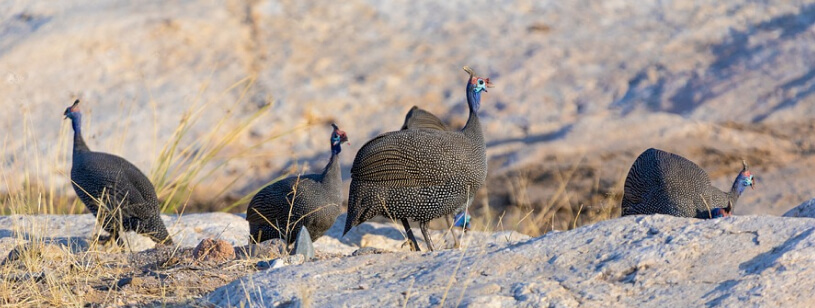
Guineafowl are African birds in the family Numididae. This profile focuses mainly on the helmeted guineafowl (Numida meleagris), the species from which domestic guineafowl were developed. It has spotted plumage and is known for loud calls.
Helmeted guineafowl live in flocks and often forage on the ground for plant material and small animals. They can fly, although much of their activity takes place on foot.
Domestic guineafowl are kept for products such as meat and eggs. Their alarm calls can alert people to disturbance, but this does not guarantee pest control or farm protection.
Quick facts
| Common name | Guineafowl |
| Scientific name | Numida meleagris |
| Typical lifespan | About 10-15 years in captivity; usually shorter in the wild |
| Height | About 40-58 cm |
| Length | About 50-60 cm |
| Weight | About 1–2 kg; individuals vary |
| Diet type | Omnivorous (seeds, insects, greens, roots, fruit) |
| Main predators | Jackals, wild cats, mongooses, snakes, birds of prey |
| Conservation status | Helmeted guineafowl: Least Concern (IUCN); domestic stock and wild populations are different |
| Distribution | Wild in Africa; domestic birds worldwide |
| Living environment | Savannas, grassland and, for domestic birds, farms and agricultural land |
- Primary category:Birds
- Explore this animal's categories:
Interesting facts
- Very noisy birds - Guineafowl give loud, harsh alarm calls when they see anything unusual, so farmers sometimes keep them as "watchdogs".
- Insect eaters - They eat grasshoppers, ticks, termites and other insects, as well as seeds and plants.
- Group living - Outside the breeding season, they live in flocks that can number dozens of birds and keep together closely.
- Guineafowl can fly, although they spend much of their time on the ground and may run away from disturbance.
- Faithful pairs - Helmeted guineafowl usually live in monogamous pairs during the breeding season.
- A bony helmet - The helmeted guineafowl gets its name from the hard, bony casque on top of its bare head.
Records and remarkable features
- Guineafowl often run to escape disturbance, but they can also fly.
- Very hard eggs - Guineafowl eggs have thick, very strong shells, much harder than chicken eggs.
- Long-lived poultry - Domestic guineafowl can live 10-15 years, longer than many other poultry.
Physical characteristics and adaptations
The helmeted guineafowl (Numida meleagris) is a sturdy, ground-dwelling bird with a rounded body, spotted plumage and a bare, colourful head.
Key physical adaptations
- Compact, strong body - Built for walking long distances and running fast.
- Spotted plumage - Dark grey feathers covered with small white spots help them blend into the dappled light of grass and bushes.
- A short, strong beak - Good for picking up seeds, insects and plants.
- A bare head with a bony helmet - The bare blue and red skin of the head may help them lose heat in hot weather.
- Strong legs - Good for walking, running and scratching the ground for food.
- Short, rounded wings - Allow fast, short flights, used mainly to escape danger and to fly up into trees to roost.
What do guineafowl look like?
| Characteristic | Details |
|---|---|
| Colour | Dark grey to black, with many small white spots |
| Length | About 50-60 cm |
| Weight | About 1–2 kg |
| Beak | Short, slightly curved, pale horn-coloured |
| Feet | Strong, dark grey |
| Head | Bare blue skin, red wattles and a bony helmet (casque) |
Habits and behaviour
Guineafowl are active, social birds that live in flocks and are always on the lookout for danger.
Daily life
- Flock birds - Outside the breeding season, wild guineafowl live in flocks of about 10-30 birds or more; domestic birds also like to stay together.
- Loud communication - They call loudly to warn the flock of danger and to keep in contact.
- Always alert - Any unusual movement makes the whole flock call or run away.
- Running rather than flying - When threatened, they usually run; they fly when danger is very close.
- Breeding territories - In the breeding season, pairs leave the flock and males defend the area around the nest.
Specific behaviours
- Lookouts - While the flock feeds, some birds watch for danger and raise the alarm.
- Pairs - Helmeted guineafowl usually form monogamous pairs for the breeding season.
- Guineafowl forage on the ground and may roost above ground; roosting habits depend on their surroundings.
- Mobbing - Guineafowl may gang up on a small predator, such as a snake, calling loudly and rushing at it.
Survival strategies
- Camouflage - Their spotted plumage helps them hide among grass and bushes.
- Fast running - They can run quickly and escape many predators on foot.
- Alarm calls - Their loud calls warn the whole flock, and other animals nearby too.
- Hidden nests - Nests are made on the ground, well hidden in thick vegetation.
Habitat and geographic distribution
Guineafowl are native to Africa, mainly south of the Sahara. Domestic guineafowl have been taken to farms all over the world.
Distribution context
| Region | Population information | Habitat examples |
|---|---|---|
| Sub-Saharan Africa | Wild and domestic | Savannas, grasslands, open woodland, farmland |
| Europe and North America | Domestic | Farms and smallholdings |
| Caribbean and South America | Domestic; feral in some places | Rural grassland and farms |
| Asia and Australia | Domestic | Farms, large gardens |
Habitat types
- Savannas and open grasslands - The natural home of wild guineafowl, with plenty of varied food.
- Farmland - Wild guineafowl feed in fields, and domestic birds are raised for meat and eggs.
- Dry areas - In Africa, guineafowl live in fairly dry places, as long as there is water nearby.
- Open woodland and bush - They nest in thick, low vegetation and roost in trees.
Environmental change
- Farming can help them - In many areas, crops and farm water supplies give guineafowl food and water.
- Urbanisation - Spreading towns reduce natural habitat in some regions.
- Opening up of forests - In some places, clearing forests has created open areas where guineafowl can spread.
- Heat tolerance - Guineafowl cope well with hot climates.
Diet and feeding
The helmeted guineafowl (Numida meleagris) is an omnivore that feeds mainly on the ground, eating seeds, insects, green plants, roots and fruit.
What do guineafowl eat?
| Food group | Examples |
|---|---|
| Insects and other invertebrates | Grasshoppers, crickets, termites, caterpillars, ticks, snails, ants |
| Seeds and grains | Millet, maize, wheat, sorghum, grass seeds |
| Greens and leaves | Grass, young leaves, flowers |
| Roots and bulbs | Dug up from the ground |
| Small animals (occasionally) | Small lizards, frogs, small snakes, mice |
Feeding methods
- Scratching and pecking - Like chickens, guineafowl scratch the top layer of soil to find food.
- Catching insects - They are quick at catching grasshoppers and other insects.
- Flexible diet - In dry seasons, they eat more seeds, roots and bulbs.
- Free-range birds - Domestic guineafowl do best when they can roam and find much of their own food.
The role of guinea fowl in the ecosystem
- Eating insects - They eat many insects, including ticks, although they cannot be relied on to get rid of pests completely.
- Spreading seeds - They help spread some plants by eating their seeds.
- Food for predators - Guineafowl and their eggs are food for many African predators.
Reproduction and life cycle
Helmeted guineafowl usually form monogamous pairs. In the wild, the female incubates the eggs while the male guards the nest area.
Breeding season
- In Africa, guineafowl breed in the rainy season, when food is plentiful.
- In captivity, they lay mainly in the warmer months, depending on temperature, daylight and food.
- Males become territorial, chasing other guineafowl away from their mate and nest.
Raising young
| Stage | Duration | Characteristics |
|---|---|---|
| Incubation of eggs | About 26-28 days | The female sits on the eggs, and the male stays nearby. |
| Hatching | After about 4 weeks | Newly hatched guineafowl, called keets, have down that helps conceal them. |
| Learning to feed | From the first day | The keets find their own food, guided and protected by both parents. |
| First flights | From about 2 weeks | The keets can flutter up off the ground and soon roost off the ground. |
| Independence | About 3 months | The young become independent and join the flock. |
Adaptations for survival
- Precocial keets - Soon after hatching, they are active and start feeding themselves.
- Hidden nests - Females lay their eggs in well-hidden places on the ground.
- Defensive behaviour - Both parents protect the keets and call loudly to scare off predators.
Name and history
Origin of the name
- "Guineafowl" means "bird from Guinea": Portuguese traders brought the birds to Europe from the Guinea coast of West Africa in the 15th and 16th centuries.
- The scientific name Numida meleagris refers to Numidia, an ancient region of North Africa, and to meleagris, the ancient Greek word for guineafowl, which comes from the myth of Meleager's sisters.
Taxonomic classification
| Classification | Name |
|---|---|
| Kingdom | Animalia |
| Phylum | Chordata |
| Class | Aves |
| Order | Galliformes |
| Family | Numididae |
| Genus | Numida |
| Species | Numida meleagris |
Evolution and domestication
- Guineafowl are an ancient African group of birds, related to pheasants and chickens.
- The helmeted guineafowl was domesticated in West Africa; guineafowl also appear in ancient Egyptian art, and the ancient Greeks and Romans kept them as table birds.
- After the fall of Rome, they almost disappeared from European farms, and were brought back from West Africa by Portuguese traders.
- Today, they are kept on farms around the world for meat and eggs, and as alert, noisy "watch birds".
Cultural significance and mythology
Guineafowl in myths and symbolism
- The sisters of Meleager - In Greek mythology, the goddess Artemis turned the grieving sisters of the hero Meleager into guineafowl; their tears became the white spots on the birds' feathers.
- African folk tales - In a well-known African tale, the guineafowl gets her spots as a reward for helping her friend, the cow, escape from a lion.
- Feathers as decoration - In many parts of Africa, the spotted feathers are used in headdresses, crafts and beadwork.
Conservation status and threats
The helmeted guineafowl is listed as Least Concern by the IUCN, but some wild populations in Africa face local pressures.
Main pressures
- Habitat loss - Clearing land and intensive farming affect wild populations in some areas.
- Hunting - In some parts of Africa, guineafowl are hunted heavily for meat.
- Urbanisation - Growing cities reduce the places where wild guineafowl can live and nest.
- Poisoning - Pesticides and poisoned grain on farms can kill guineafowl.
Protection efforts
| Measure | Organization / Action |
|---|---|
| Habitat conservation | National parks and reserves in Africa protect natural savanna habitats |
| Regulation of hunting | Hunting seasons and bag limits for wild guineafowl in some countries |
| Research | Studies in South Africa and elsewhere follow how guineafowl numbers change on farmland |
Current population
- Wild helmeted guineafowl are still common in much of Africa, although they have declined in some regions.
- Domestic guineafowl are kept in large numbers around the world.
- The species is not considered threatened, but monitoring helps protect its habitat.
Guineafowl in popular culture
Guineafowl are kept as domestic poultry, including for meat and eggs.
Guineafowl in literature and art
- Greek mythology - The legend of Meleager's sisters explains the guineafowl's spots.
- How the Guinea Fowl Got Her Spots (Barbara Knutson, 1990) - A children's picture book retelling the African tale of the guineafowl and the cow.
Guineafowl in gastronomy
- A favourite in France and Italy - Guineafowl (pintade in French, faraona in Italian) is valued for its tasty, slightly gamey meat.
- African cuisine - Guineafowl is cooked in traditional stews and roasted.
- Restaurants - Guineafowl dishes are served in restaurants around the world.
Guineafowl as symbol
- A name from the pharaohs - The Italian name faraona means "pharaoh's hen", linking the bird with Egypt.
- Their loud calls can alert people to disturbance; this is not a guarantee of protection.
Did you know? About guineafowl
- Helmeted guineafowl have been domesticated and are still raised as poultry.
- Guineafowl often forage during cooler parts of the day and may rest when conditions are hot.
- Domestic guineafowl are raised for eggs as well as meat. Related profile: Chicken.
- Guineafowl spend much of their time on the ground, although they can fly.
- The female lays about 8-15 eggs and incubates them for about 26-28 days, while the male guards the nest area.
- In the wild, guineafowl often follow herds of large animals and troops of monkeys, picking up food they disturb or drop. Related profile: Monkey.
- Guineafowl eat insects and other small animals, but their presence does not guarantee pest control. Related profile: Fly. Related profile: Scorpion.
- Guineafowl are social birds and commonly move and forage in flocks.
- Helmeted guineafowl usually form monogamous pairs in the breeding season.
- Although they live on the ground, guineafowl are strong fliers over short distances; still, they usually run when threatened.
- The name "guineafowl" comes from the Guinea coast of West Africa, where Portuguese traders obtained the birds.