Nose-horned viperVipera ammodytes — habitat, diet and reproduction
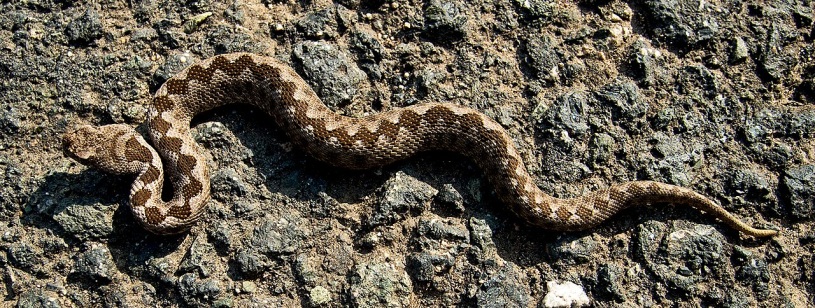
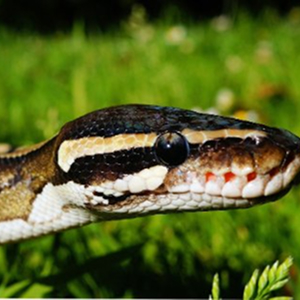
Nose-horned viper, Vipera ammodytes, on rock, showing the dark zigzag along its back. · katunchik / CC BY 4.0 (https://creativecommons.org/licenses/by/4.0). Cropped and resized.
The nose-horned viper is a venomous snake also found in Romania, recognised by the small projection on its snout and dark back pattern. Vipera ammodytes often uses sunny rocky places with shrubs and nearby cover. This discreet animal should be observed from a distance. Its horn gives it its name, but venom is delivered through fangs in the mouth, not through the projection.
Quick facts
| Common name | Nose-horned viper |
| Scientific name | Vipera ammodytes |
| Diet | Carnivore: lizards, small mammals and occasionally birds |
| Main predators | Birds of prey and some carnivorous mammals |
| Conservation status | Least Concern (LC) in the IUCN European assessment |
| Distribution | Mainly southeastern Europe; in Romania, Dobrogea and the southwest |
| Habitat | Rocky slopes, scrub and woodland edges |
| Length | Adults approximately 50–90 cm |
| Family | Viperidae |
| Reproduction | Live young |
| Distinctive feature | A soft, scale-covered horn on the snout |
| Venom | Dangerous to humans; a bite is a medical emergency |
- Primary category:Types of snakes
- Explore this animal's categories:
Interesting facts
- The snout horn is soft and covered in scales.
- The back often shows a zigzag or connected dark diamonds.
- Females produce live young rather than laying an external clutch.
- The species is a natural member of Romania’s fauna.
Characteristics
The body is relatively robust and the tail short. A distinct head carries the characteristic small snout projection, while overall colour ranges from grey to brown.
A darker zigzag or chain of diamonds usually runs along the back. The tail tip can differ in colour, with individual variation. The horn is a scaled structure, not a sting. Identification does not justify approaching or handling the snake: observation should leave its escape route open.
Behaviour
The viper regulates body temperature by moving between sunny places and shelter. Activity varies with temperature and season, including daylight, dusk or night.
During cold periods it retreats into suitable refuges. Rocky crevices and woodland-edge vegetation offer protection and resting sites. A threatened animal may hiss and adopt a defensive posture. Bites can occur when it is stepped on, captured or handled, so distance is essential.
Habitat and distribution
The range lies mainly in southeastern Europe, including the Balkans and nearby regions. Romanian populations occur in Dobrogea and the southwest.
Rocky slopes with shrubs, scree and woodland edges are frequently used. Sparse woodland can also provide sunlight at ground level and shelter among stones. Not every dry site or sunny path holds the species: local conditions determine a patchy distribution that should not be extended to an entire country.
Diet and feeding
Lizards and small mammals are important prey. Birds and other animals are taken occasionally, with proportions changing between populations and age groups.
A Balkan study found sex-related differences and dietary changes during growth, showing why describing it as a mouse-only hunter would be misleading. Venom helps immobilise prey, which is swallowed whole. The viper participates in the food web linking the other vertebrates of its habitat.
Reproduction and life cycle
Mating takes place during favourable conditions and young develop inside the female. They are born alive, emerging from their surrounding membranes.
Litter size varies, partly with maternal size. Research indicates that females do not necessarily reproduce every year because breeding requires substantial resources. The young are independent and venomous. Like adults, they should not be captured for relocation or display to other people.
Name and history
The common name describes the snout’s distinctive feature. Vipera ammodytes identifies the species scientifically and separates it from other vipers or superficially similar snakes.
Stories attributing special powers to the horn do not explain its anatomy. It does not inject venom and should never be removed or collected. This member of Viperidae belongs to the natural heritage of the regions where it lives.
Conservation and threats
The European IUCN assessment lists Least Concern but reports a decreasing population trend. Habitat destruction, collection and deliberate killing can cause local problems.
Watching where hands and feet are placed reduces close encounters. Do not provoke or pursue a snake for a better photograph. A suspected bite requires immediate emergency assistance and minimal movement. In Romania, call 112. Do not cut the wound, attempt suction or apply a tourniquet.
Frequently asked questions
Does it live in Romania?
Yes, particularly in Dobrogea and the southwest.
Does the horn inject venom?
No. Venom is delivered through mouth fangs; the horn is a scale-covered projection.
Does it lay eggs in a nest?
No. Young develop inside the female and are born alive.
What if I see one on a path?
Keep your distance, leave an escape route and do not touch or capture it.