Common deguOctodon degus — habitat, diet and reproduction
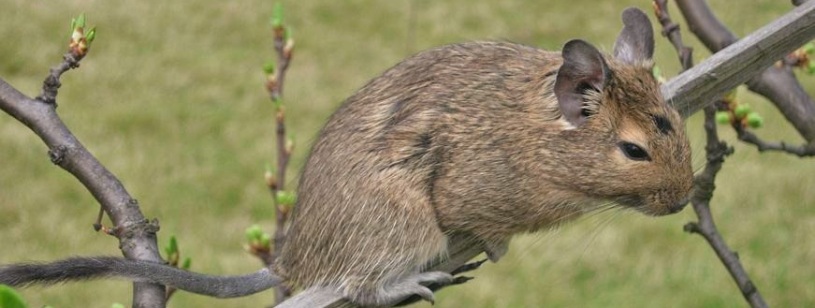
Common degu (Octodon degus) climbing on a branch. · Jacek555 / CC BY-SA 4.0 (https://creativecommons.org/licenses/by-sa/4.0). Cropped and resized.
The common degu is a Chilean rodent with brown fur, rounded ears and a tuft at the end of its tail. It is mainly active by day and lives in groups sharing burrows. Young are born furred with their eyes open. Its natural diet consists of fibre-rich plant material.
Quick facts
| Common name | Common degu |
| Scientific name | Octodon degus |
| Lifespan | Approximately 5–8 years in human care |
| Length | Around 33–44 cm, including the tail |
| Weight | Around 170–300 g |
| Diet | Herbivore: grasses, leaves and other plant material |
| Predators | Birds of prey and carnivorous mammals |
| Conservation status | Least Concern (LC) |
| Distribution | Chile |
| Habitat | Semi-arid scrub and grassland on western Andean slopes |
| Family | Octodontidae |
| Activity | Mainly diurnal |
- Primary category:Rodents
- Explore this animal's categories:
Interesting facts
- Pups are born with fur and open eyes.
- Related females may help care for young within the group.
- The chewing surfaces of the cheek teeth resemble a figure of eight.
- A noticeable hair tuft marks the end of the tail.
Characteristics
The coat is yellow-brown above and paler below. A light area may surround the eye. Relatively large ears and the tufted tail create a distinctive outline.
Degus use their feet to handle food, dig and climb. Their teeth process plant material, making fibrous food and safe chewing materials important in human care. They belong to Octodontidae and have requirements distinct from other superficially similar rodents.
Behaviour
Groups share burrow systems and communicate through sounds, scents and contact. Members may groom each other and rest close together.
Activity is mainly during daylight. Animals emerge to feed and explore, returning to shelter; local heat influences time spent above ground.
Compatible companions or stable groups provide important social interaction in captivity. Space should allow climbing, digging and retreat. An appropriate bathing material helps maintain the coat.
Habitat and distribution
The species is native to Chile on the western side of the Andes. It inhabits semi-arid matorral scrub, a landscape of shrubs and plants adapted to dry summers.
Burrows provide resting and breeding refuges. Surrounding vegetation supplies food and cover. Degus also occur on land influenced by livestock grazing.
Diet and feeding
Degus eat grasses, leaves and other plant foods. Their digestive system is suited to a high-fibre diet. Reingesting certain droppings helps recover nutrients and is a natural behaviour.
Good-quality hay should form the basis of a captive diet. Suitable formulated food and leafy vegetables supplement it in appropriate amounts, with fresh water always available.
Degus are prone to problems with sugar metabolism. Sweetened products and high-sugar treats are unsuitable. Changes in appetite or thirst warrant veterinary advice.
Reproduction and life cycle
Gestation lasts about 90 days, relatively long for a small rodent. Litters commonly contain four to six pups. Newborns are well developed and able to move early.
Milk remains important as pups begin exploring solid food. Weaning occurs around four to six weeks. Related females may share care of the group’s young.
Young animals continue learning routes, food choices and social interactions. A stable group provides more than simply a shared shelter.
Name and history
The scientific name is Octodon degus. Octodon refers to the figure-of-eight appearance of the chewing surfaces of the teeth. Molina described the species in 1782.
Degus are known as companion animals and research subjects. Observations of their social behaviour help explain their care requirements.
Conservation and threats
Common degus are globally Least Concern. Their habitats remain part of Chilean ecosystems, linking food plants and natural predators.
Responsible captive care begins with correct identification and a suitable diet. Like chinchillas, degus need fibrous food, although their care requirements are not identical.
Frequently asked questions
Can a degu live alone?
Degus are social. Compatible degu companions are important for their welfare.
Is hamster food suitable?
Degus need a high-fibre, low-sugar diet. Hamster and gerbil mixtures may have an unsuitable composition.
Does a degu sleep all day?
It is mainly diurnal and can be observed active during daylight, with periods of rest.
Why does it eat some of its droppings?
This helps recover nutrients from plant food and is part of normal digestion.