Little egretEgretta garzetta — habitat, diet and reproduction

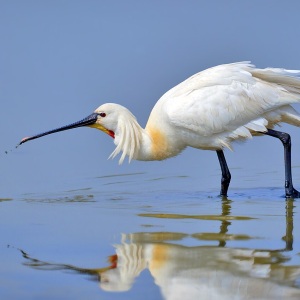
Little egret (Egretta garzetta) with ornamental head plumes. · El Golli Mohamed / CC BY-SA 4.0 (https://creativecommons.org/licenses/by-sa/4.0). Cropped and resized.
The little egret is a slender white heron that feeds in shallow water. Its black bill and yellow toes help identify it. In Romania it breeds in wetlands, often in mixed colonies. It may stalk slowly or stir the water with its feet to flush hidden prey.
Quick facts
| Common name | Little egret |
| Scientific name | Egretta garzetta |
| Length | 55–65 cm |
| Wingspan | 86–104 cm |
| Weight | 280–710 g |
| Diet | Carnivore: small fish and other animals |
| Conservation status | Least Concern (LC), global assessment 2025 |
| Distribution | Europe, Africa, Asia and Oceania; expansion in the Caribbean region |
| Habitat | Lake and river margins, marshes and other shallow waters |
| Family | Ardeidae |
| Reproduction | Usually 4–5 eggs, with variation |
| Occurrence in Romania | Migratory breeder, mainly present from spring to autumn |
- Primary category:Birds
- Explore this animal's categories:Animals of AfricaAnimals of AsiaAnimals of AustraliaAnimals of EuropeAnimals of North AmericaAnimals of RomaniaAnimals of the Danube DeltaBirdsBirds of RomaniaCarnivoresEgg-laying animalsFeathered animalsFish-eating animalsFlying animalsLMigratory animalsMigratory birdsSemi-aquatic animalsVertebratesWaterbirdsWetland animalsWild animals
Interesting facts
- Yellow toes contrast with black legs.
- A moving foot can disturb prey in shallow water.
- It sometimes nests beside other herons and cormorants.
- Ornamental plumes were once sought for fashionable hats.
Characteristics
The plumage is white, and the long neck can be extended or folded close to the body. The slender pointed bill is mainly black. Dark legs end in yellow toes, clearly visible when the bird walks on a bank.
Long ornamental plumes develop during breeding. The sexes look similar, and size differences are not always obvious. Identification combines size, bill and leg colours; white plumage alone is insufficient.
Behaviour
Feeding birds alternate slow stalking with quicker movements. They may pause before striking with the bill, or stir water with a foot and pursue displaced prey.
They can rest in groups, and breeding colonies may be crowded and noisy. Observation should remain distant, especially around nests. Repeatedly flushing a bird from its nest is disturbance.
Habitat and distribution
The range covers parts of Europe, Africa, Asia and Oceania, with recent expansion into new regions. Some populations migrate, while others remain in milder climates.
In Romania it uses lowland wetlands, including the Danube Delta. Arrival is common in late March and April, with departure in September and October. Feeding shallows and suitable nesting vegetation are both necessary.
Diet and feeding
Small fish are eaten alongside insects, crustaceans, worms and other animals. Diet changes with local resources, while water depth limits accessible feeding sites.
The long bill captures prey quickly. Temporary pools can offer good feeding when they concentrate small animals. The egret is part of wetland predator–prey relationships.
Reproduction and life cycle
Nests are built from sticks and other plant material in trees, shrubs or suitable dense vegetation. Colonies may contain several species.
Clutches often contain four or five eggs, though numbers vary. Incubation lasts about 21–25 days, and young become capable of flight at around 40–45 days. Adults bring food, and successful breeding depends on feeding access and an undisturbed nesting site.
Name and history
The scientific name is Egretta garzetta. Egretta is linked to the French word aigrette, while garzetta is the Italian bird name.
Nineteenth-century fashion used ornamental egret plumes. Hunting damaged populations and helped prompt bird-protection initiatives.
Conservation and threats
The 2025 global assessment lists the species as Least Concern. Locally, tree removal, reed burning and changes in water level can destroy colony habitat.
Conservation needs to retain nesting sites, resting places and feeding waters as a connected whole.
Frequently asked questions
How can a little egret be identified?
Look for white plumage, a mainly black bill, black legs and yellow toes, together with its size.
Why does it move a foot in the water?
The movement can flush hidden prey, which it then catches with its bill.
Does it stay in Romania for winter?
It is mainly a migratory breeder there. Cold-season occurrence varies with conditions.
Does it nest alone?
It can form colonies, including mixed colonies with other herons and waterbirds.