RatsRattus — species, food, behaviour and life cycle
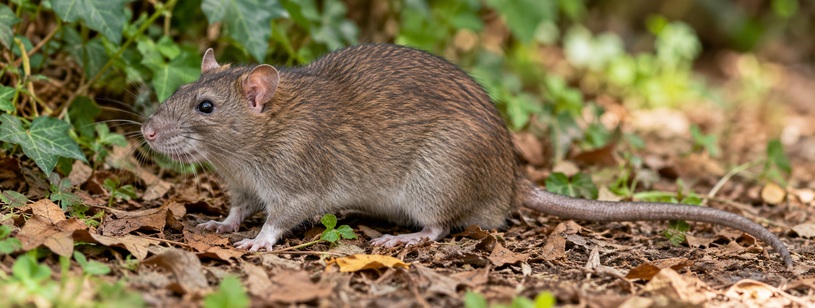
Brown rat (Rattus norvegicus), one example of the genus Rattus.
A rat is an omnivorous rodent with continuously growing incisors and a long, finely scaled tail. The name covers several species. Two familiar examples are the brown rat (Rattus norvegicus) and black rat (Rattus rattus), both in the family Muridae.
These social animals can learn routes and find food in very different environments. Pet rats are domesticated forms of the brown rat. Their living conditions differ from those of wild individuals, even though they belong to the same species.
Quick facts
| Common name | Rat |
| Scientific name | Rattus — a genus containing several rat species |
| Typical lifespan | Pet rats commonly live around 2–3 years |
| Length | Around 15–27 cm in brown rats, excluding the tail |
| Weight | Often around 200–300 g in brown rats; varies with sex and individual |
| Diet type | Omnivorous: seeds, grain, fruit and animal food |
| Main predators | Owls and carnivorous mammals. |
| Conservation status | Brown and black rats: Least Concern; other species are assessed separately. |
| Geographical distribution | Humans have transported familiar species across numerous continents; individual species have different ranges |
| Habitat | Cities, villages, farmland, gardens and natural habitats, depending on species. |
| Familiar species | Rattus norvegicus — brown rat; Rattus rattus — black rat |
| Pet rat | Domesticated form of Rattus norvegicus |
| Tail | Usually shorter than head and body combined in brown rats |
| Activity | Mainly at night and dusk; daytime activity also occurs |
| Social life | Groups with social relationships and hierarchies |
| Shelter | Burrows, buildings and other refuges; black rats often use elevated places |
| Important senses | Smell, hearing and touch, including sensitive whiskers |
| Reproduction | Live young fed on milk |
| Brown rat gestation | About three weeks, commonly around 21–24 days |
| Young per litter | Often around 7–8 in brown rats, with substantial variation |
- Primary category:Rodents
- Explore this animal's categories:Animals of AfricaAnimals of AsiaAnimals of AustraliaAnimals of EuropeAnimals of North AmericaAnimals of RomaniaAnimals of Romania’s gardens and parksAnimals of South AmericaAnimals that live in groupsArboreal animalsBurrowing animalsDomestic animalsFurry animalsInsect-eating animalsIntelligent animalsLive-bearing animalsMammalsMammals of RomaniaNocturnal animalsOmnivoresPetsRRodentsVertebratesWild animals
Interesting facts
- Colour alone does not identify species. Black rats may be brown or grey rather than black.
- The incisors grow continuously. Gnawing and contact between opposing teeth help wear them down; not all teeth grow in the same way.
- Whiskers help exploration. These sensitive hairs provide information about objects and narrow spaces.
- The tail has several functions. It helps with balance and temperature regulation, but is not a handle for lifting the animal.
- Rats can communicate with ultrasound. Some calls are too high-pitched for people to hear.
- They can learn and remember routes. This helps them reach food and shelter.
Records and extremes
Swimming, climbing and adaptability
Brown rats are strong swimmers, while black rats are agile climbers. These abilities help them reach banks, tunnels, roof spaces and vegetation.
| Ability | Example and context |
|---|---|
| Swimming | Brown rats move well through water and may forage near it |
| Climbing | Black rats regularly use trees and elevated parts of buildings |
| Rapid reproduction | Gestation of around three weeks and repeated litters can allow rapid population growth |
| Extensive spread | Shipping and trade have carried familiar species far beyond their original ranges |
Abilities vary between species. Food, shelter, disease and predators affect reproduction and survival; every pair does not inevitably produce a vast population.
Characteristics
What does a rat look like?
A rat has a fur-covered body, a whiskered muzzle and four limbs with digits and claws. Its tail has fine scales and sparse hairs rather than the dense fur of the trunk.
Two pairs of incisors sit at the front of the mouth, one above and one below. These teeth are adapted for gnawing. Their growth and wear need to remain balanced.
Brown rat or black rat?
| Species or criterion | Identification features |
|---|---|
| Brown rat — Rattus norvegicus | More robust body, relatively small ears, tail usually shorter than head and body combined; often digs burrows |
| Black rat — Rattus rattus | More slender body, pointed muzzle, relatively large ears, tail usually longer than head and body combined; an agile climber |
| Coat colour | Both can have brown or grey coats; the common name alone does not establish identity |
A young rat can be confused with a mouse. Adult common rats are generally larger and more robust. Identifying young animals requires several clues, including proportions of the head, feet and tail.
What is a domestic rat?
Pet rats descend from Rattus norvegicus. Selective breeding has produced many coat colours and patterns, including white and marked individuals.
A different colour does not automatically mean a different species. The temperament and familiarity with people of a domestic rat should not be assumed in an unfamiliar wild animal.
Habits and behaviour
When are rats active?
Brown and black rats are mainly nocturnal, with activity around dusk as well. They may also emerge by day, depending on food, shelter and disturbance. The time of a sighting alone does not establish illness.
They explore through smell, hearing and touch. Whiskers provide information about surfaces and obstacles, particularly in dark places.
How do they live in groups?
The familiar species have regular social lives. Groups develop hierarchies, and interactions may involve sniffing, grooming, play or conflict. Being social does not mean that any two individuals immediately accept each other.
Pet rats need compatible rat companions. People do not fully replace this company, and introductions to unfamiliar rats should be gradual.
Can rats learn?
They can remember routes and associate actions with food rewards. For pet rats, simple activities and appropriate rewards can encourage exploration and cooperation.
A rat should not be frightened or forced to demonstrate intelligence. A safe environment with hiding places and foraging opportunities allows more natural behaviour.
Habitat and geographical distribution
Where do rats live?
Familiar rat species inhabit towns, villages, farmland, gardens and various natural habitats. Buildings and stores can provide shelter and food, but rats do not live only in sewers.
Brown rats often use burrows and refuges near water or food. Black rats may live in trees, roof spaces and other elevated sites.
How did they spread?
Species associated with people travelled aboard ships and with goods. They reached many regions of Europe, Asia, Africa, North and South America, and Australia.
Presence on a continent does not mean occupation of every habitat. Some populations were introduced by humans, and rats have been removed from certain islands to protect native wildlife.
Rats in Romania
Brown rats occur in Romania, where settlements, gardens and green spaces can provide food and cover. Their presence is documented in biodiversity records.
An animal seen beside a lake is not automatically a rat: other rodents can have a similar outline. Muzzle, ear and tail shape provide more useful identification clues than location alone.
Diet and feeding
What do rats eat?
They are omnivores, eating both plant and animal food. Diet varies with species and local resources.
- Plant food: seeds, grain, fruit and other plant parts.
- Animal food: insects and other invertebrates, sometimes eggs or small animals.
- Near people: accessible food scraps, animal feed or stored products.
Black rats may eat substantial amounts of fruit and seeds, while brown rats exploit a broad range of resources. Cheese is not an essential food for either species.
How do they find food?
They use smell, previous experience and exploration. Familiar routes can lead repeatedly to food, although behaviour changes with the environment.
Being able to eat scraps does not make scraps a suitable pet diet. Pet rats need nutritionally complete rat food, fresh water and small amounts of appropriate fresh foods.
Their ecological role
Rats consume plants and animals and are themselves prey for owls and carnivorous mammals. On islands where they have been introduced, they may threaten birds and other wildlife that evolved without such predators.
Reproduction and life cycle
Gestation and birth
Brown rat gestation lasts about three weeks, commonly around 21–24 days. The female prepares a nest and gives birth to small, blind, almost hairless young.
A litter may contain around 7–8 pups, but variation is substantial. No fixed number applies to every female. Breeding can continue throughout the year when food and conditions are favourable.
How do the young develop?
Pups depend on their mother for milk and protection. Fur and senses develop gradually; brown rat eyes usually open at around two weeks of age.
Weaning occurs at roughly 3–4 weeks. These are developmental milestones, not advice to separate or sell young rats at that age.
How long does a rat live?
Pet rats commonly live around 2–3 years. Health, inherited traits and care affect longevity. Wild rats experience higher mortality, and many do not survive to one year.
For domestic animals, accurate sex identification and appropriate grouping are essential to prevent unwanted litters. Health and breeding questions require a veterinarian experienced with rodents.
Names and history
| Classification level | Name |
|---|---|
| Class | Mammalia — mammals |
| Order | Rodentia — rodents |
| Family | Muridae |
What is Rattus?
Rattus is a genus in the family Muridae and order Rodentia. Brown rats and black rats are different species within it.
Brown rats are also called Norway rats, while black rats may be called roof rats or ship rats. A common name does not reliably establish an animal’s origins or its exact colour.
Rats and people
Food stores, transport and settlements helped certain rat species spread. Brown rats were later bred and selected in captivity, including for research and as companion animals.
Wild populations and domesticated forms now coexist. Pet rats must not be released into the wild.
Cultural significance and mythology
The rat in the Chinese zodiac
The rat is the first animal in the Chinese zodiac’s twelve-year cycle. In one traditional story, it earns its place by riding on the ox’s back and jumping ahead near the end of a race.
This is a legend rather than an account of an actual animal competition. In East Asian art and traditions, rats may symbolise cleverness and abundance, with meanings varying by context.
Conservation and threats
Do all species have the same status?
Brown and black rats are widespread species described as globally Least Concern in the zoological sources consulted. This category indicates low extinction risk and must not be applied automatically to every species in Rattus.
Local abundance, ecological effects and conservation status are different matters. A species can be widespread worldwide while also being invasive in an introduced range.
Why can rats threaten island wildlife?
Introduced rats may eat eggs, young birds, invertebrates and seeds. New Zealand conservation programmes work to reduce these effects and restore native animal populations.
Control also needs to consider other animals. Poorly chosen methods may harm predators, pets and other unintended species.
Hygiene and living alongside rats
Rats may carry pathogens without appearing ill. Avoid direct contact with wild individuals, urine and droppings. Appearance alone cannot establish risk.
Closed food containers and reduced access to shelter and water help prevent infestations. Wash hands after handling pet rats and their equipment. A bite, or symptoms following contact with rodents, requires medical advice.
In popular culture
Remy in Ratatouille
In Pixar’s Ratatouille, Remy is a rat who dreams of becoming a chef. The story uses the animal’s sense of smell and curiosity in a tale about passion and cooperation.
Speaking and cooking are fictional elements. A real rat with access to a kitchen can contaminate food, even though the film presents its character sympathetically.
Frequently asked questions
Are rats the same as mice?
No. Familiar rats and mice belong to different species and genera. Young animals can be confused; identification uses several traits rather than size alone.
What do rats eat?
They are omnivores, eating seeds, grain, fruit and animal food such as insects. Diet varies with species and environment.
How long do rats live?
Pet rats commonly live around 2–3 years. Mortality is higher in the wild, where many do not reach one year.
Are black rats always black?
No. Rattus rattus can also have brown or grey fur. Body, ear and tail proportions are important clues.
Can rats swim?
Yes. Brown rats are strong swimmers, but pet rats should not be forced into water.
Can a pet rat live alone?
Pet rats need compatible rat companions. Groups require care to prevent conflict and unwanted reproduction.
Why do rats gnaw?
Their incisors grow continuously. Gnawing and tooth contact help wear them down; dental problems require veterinary assessment.
Which rat appears in the images?
The brown rat, Rattus norvegicus. The article covers the genus Rattus while distinguishing familiar species and domestic forms.
Did you know? About rats
- A black rat can have brown or grey fur.
- Incisors grow continuously; whiskers help rats explore.
- Familiar rat species are social and can learn routes.
- Pet rats are domesticated Rattus norvegicus.