Sea lionInteresting facts and information
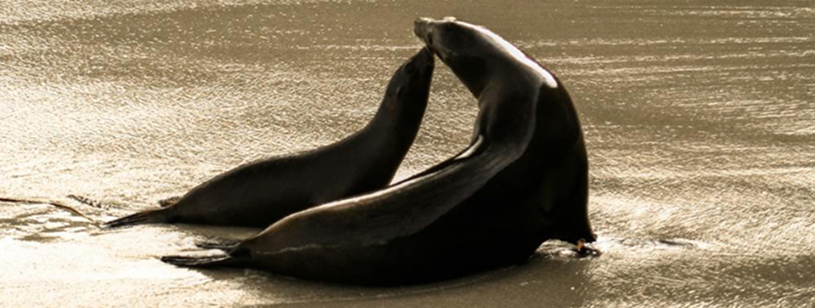
Sea lions are marine mammals in the family Otariidae, which also includes fur seals. Their external ear flaps and ability to turn their hind flippers beneath the body distinguish them from true seals.
They are excellent swimmers, able to reach speeds of up to 40 km / h and sink over 200 metres deep. Although they live in water most of the time, they rest and reproduce on land, forming large colonies.
Sea lions are important predators in marine ecosystems, with a crucial role in maintaining the balance of fish and cephalopods.
Quick facts
| Common name | Sea lion |
| Scientific name | Otariidae (sea lions; family also includes fur seals) |
| Typical lifespan | Usually 15-25 years in the wild, up to 30 years in captivity |
| Maximum speed | About 30-40 km/h in short bursts |
| Dimensions | About 1.5 - 3.3 metres long |
| Weight | About 50 to 1,100 kg (males are much larger than females) |
| Diet type | Carnivorous (fish, cephalopods, crustaceans) |
| Main predators | Orcas, large sharks; humans (bycatch, hunting and pollution) |
| Conservation status | Assess separately by species and population; different taxa and regions have different needs |
| Distribution | Coasts of the North and South Pacific and the South Atlantic: the Americas, Galápagos, Australia, New Zealand, Japan and Russia |
| Habitat | Coastal waters, beaches, rocky islands; cold to tropical areas |
- Primary category:Marine mammals
- Explore this animal's categories:
Interesting facts
- Fast swimmers - Sea lions can reach about 30-40 km/h in short bursts, driven by their powerful front flippers.
- Good divers - They slow their heart rate to save oxygen; most dives last a few minutes, and some species can dive several hundred metres deep.
- Territorial males - In the breeding season, large males defend territories on the beach, where many females give birth and mate.
- Visible ears - Unlike true seals, sea lions have small external ear flaps.
- Very vocal - They bark, growl and roar; males call loudly to defend their territories, and mothers and pups recognise each other's voices.
- Walking on land - Unlike true seals, they can turn their hind flippers forward and walk, and even run, on all four flippers.
- Playful and curious - Sea lions often approach divers and boats and can learn many tasks.
Records and remarkable features
- Sea lions are marine mammals in the family Otariidae, which also includes fur seals. Their external ear flaps and ability to turn their hind flippers beneath the body distinguish them from true seals.
Characteristics
Sea lions are strong, streamlined marine mammals. Unlike true seals, they use their long front flippers for swimming and can walk on land using all four flippers.
Main physical characteristics:
| Characteristic | Details |
|---|---|
| Length | About 1.5-3.3 metres (males are larger than females) |
| Weight | About 50-1,100 kg, depending on species and sex |
| Body Structure | Streamlined body, strong flippers |
| Front flippers | Long and powerful; used for swimming and for supporting the body on land |
| Rear flippers | Can be turned forward under the body for walking |
| Visible external ears | Small ear flaps, unlike true seals |
| Fur and blubber | Short, coarse fur and a layer of blubber that keeps them warm |
| Teeth | Large canines and simple cheek teeth for grabbing fish and squid |
Special adaptations:
- Swimming with the front flippers - Sea lions "fly" through the water with their front flippers, while true seals swim mainly with their hind flippers.
- Diving - They slow their heart rate and store oxygen in their blood and muscles during dives.
- Keeping warm or cool - Blubber keeps them warm in cold water, and on hot days they cool off in the water or by waving their flippers.
- Moving on land - Their flexible flippers let them walk, climb rocks and even gallop short distances.
Habits and behaviour
Sea lions are social animals that gather in large colonies and are territorial, playful and very vocal.
Social behaviour:
- Colonies - Sea lions gather on beaches and rocks, sometimes in thousands.
- Territorial males - In the breeding season, the largest males defend stretches of beach and mate with the females there.
- Communication - They use barks, growls and roars to defend territory and keep in contact; mothers find their pups by their calls and smell.
- Curious and playful - Sea lions often play in the waves, interact with divers and can be trained in captivity.
Food and hunting techniques:
- Opportunistic carnivores - They feed on fish, squid, octopus and crustaceans.
- Group hunting - Several sea lions sometimes work together to herd shoals of fish.
- Good divers - Depending on the species, they can dive to more than 300-500 metres.
- Swallowing food whole - They do not chew; they swallow small prey whole and shake large prey into pieces.
Self-defense and survival:
- Speed and agility - They can escape predators by swimming fast and turning suddenly.
- Safety in numbers - Living in colonies helps them spot orcas and sharks.
- Fights - Males fight for territories using their teeth and body weight.
Habitat and geographic distribution
Sea lions live along the coasts of the Pacific Ocean and the South Atlantic, in both cold and warm waters, and come ashore on beaches and rocky islands.
Habitat types:
| Habitat | Predominant species |
|---|---|
| Rocky coasts and sandy beaches | California sea lion (Zalophus californianus) |
| Islands and reefs | Australian sea lion (Neophoca cinerea) |
| Cold northern coasts | Steller sea lion (Eumetopias jubatus) |
| Coasts, fjords and estuaries | South American sea lion (Otaria flavescens) |
| Tropical islands | Galápagos sea lion (Zalophus wollebaeki) |
Geographic distribution:
- North America - The California sea lion is common on the west coast of the USA and Mexico.
- Australia and New Zealand - The Australian sea lion lives in southern and western Australia, and the New Zealand sea lion mainly on New Zealand's subantarctic islands.
- South America - The South American sea lion lives along the coasts of Peru, Chile, Argentina, Uruguay and Brazil.
- The North Pacific - The Steller sea lion, the largest of the sea lions, lives from northern Japan and Russia to Alaska and California.
Impact of climate change and human activities:
- Changes in the ocean - Warm-water events such as El Niño can cause food shortages and the deaths of many pups.
- Overfishing - Fewer fish means less food for sea lions.
- Bycatch - Many sea lions drown after being caught in fishing nets.
- Pollution - Plastic, fishing line and chemical pollution harm sea lions.
Some sea lions are still numerous, but others, such as the Australian, New Zealand and Galápagos sea lions, are endangered.
Diet and feeding
Sea lions are opportunistic marine predators that eat fish, squid, octopus and crustaceans. They catch prey both near the surface and in deeper water.
Types of food consumed:
| Food group | Examples |
|---|---|
| Fish | Herring, sardines, anchovies, hake, salmon, pollock |
| Cephalopods | Squid, octopus |
| Crustaceans | Crabs, lobsters, prawns |
| Other animals (occasionally) | Penguins and seabirds; Steller sea lions sometimes eat young seals |
Feeding methods:
- Group hunting - Sea lions sometimes work together to herd fish.
- Fast strikes - They grab prey with their teeth and swallow it whole.
- Day and night - Many hunt by day, but some also feed at night, when squid come closer to the surface.
- Deep dives - Some species, such as the Steller and New Zealand sea lions, dive to several hundred metres in search of food.
Sea lions eat about 5-8% of their body weight a day, so a large male can eat more than 15 kg of food a day.
Reproduction and life cycle
In the breeding season, large males defend territories on the beach. Females give birth on land, in colonies, and mate again soon afterwards.
Life cycle stages:
| Stage | Approximate duration | Characteristics |
|---|---|---|
| Breeding | Usually once a year, often in summer | Large males defend territories with several to many females. |
| Pregnancy | About 11-12 months (including delayed implantation) | Females return to the colony to give birth. |
| Birth | Usually once a year (every 17-18 months in the Australian sea lion) | The female gives birth to a single pup on land. |
| Nursing | About 6-12 months, sometimes longer | Pups drink rich milk; mothers go to sea to feed and come back to nurse. |
| Juvenile | 1-3 years | Young sea lions learn to hunt and swim on their own. |
| Sexual maturity | About 3-8 years | Females mature at about 3-5 years; males can hold territories only when much older and larger. |
Reproductive behavior:
- Males guard their territories - Fights between males are frequent and can cause serious wounds.
- Mothers and pups - Mothers stay with their newborn pups for about a week, then alternate between feeding trips at sea and nursing on land.
- Long nursing - Sea lion pups are nursed for much longer than true seal pups.
- Delayed implantation - Females mate again soon after giving birth, but the embryo starts developing only a few months later.
Sea lions breed slowly, which makes their populations vulnerable to bycatch, food shortages and other threats.
Name and history
Sea lions get their name from the large males of some species, which have a thick mane and a loud roar.
Origin and etymology of the name:
- "Sea lion" - The common name refers to the thick, lion-like mane around the neck of the males of species such as the South American and Steller sea lions, and to their roar.
- The family name Otariidae comes from the Greek otarion, "little ear", referring to their external ear flaps.
Taxonomic classification:
| Taxonomic category | Name |
|---|---|
| Kingdom | Animalia |
| Phylum | Chordata |
| Class | Mammalia |
| Order | Carnivora |
| Family | Otariidae |
| Living species | Six: California, Galápagos, Steller, South American, Australian and New Zealand sea lions |
Sea lion in history and culture:
- Indigenous peoples - Aleut people of Alaska used Steller sea lion skins to cover their kayaks and sea lion intestines to make waterproof parkas.
- Ancient Peru - The Moche culture showed sea lions and sea lion hunts on its pottery.
- An extinct species - The Japanese sea lion, hunted heavily in the past, has not been seen since the 1970s and is considered extinct.
Large, noisy and charismatic, sea lions have become symbols of the coasts where they live.
Cultural significance and mythology
Sea lions have been important to many coastal peoples as a source of food, skins and oil, and today they are among the most popular marine animals.
Sea lion in mythology and popular beliefs:
- North Pacific peoples - For Aleut and other Indigenous peoples of the North Pacific, sea lions provided food, oil, skins for boats and materials for clothing.
- New Zealand - The New Zealand sea lion is known in Māori as whakahao (male) and kake (female).
- San Francisco - Since 1989, hundreds of California sea lions have rested on the docks of Pier 39, which has become a famous tourist attraction.
- Galápagos - Sea lions on the Galápagos Islands are famous for lying on benches and beaches among people.
Sea lion symbolism:
- Strength - Large bulls are a symbol of strength and leadership.
- Playfulness - Their curiosity and play make sea lions a symbol of joy.
- Wild oceans - Sea lions are seen as symbols of healthy coasts and seas.
Conservation status and threats
Some sea lion species are numerous, but several are endangered because of bycatch, food shortages, disease and past hunting.
Conservation status
| Species | Status (IUCN) |
|---|---|
| Steller sea lion (Eumetopias jubatus) | Near Threatened |
| Australian sea lion (Neophoca cinerea) | Endangered |
| Galápagos sea lion (Zalophus wollebaeki) | Endangered |
| California sea lion (Zalophus californianus) | Least Concern |
Main threats:
- Changes in the ocean - Marine heatwaves and El Niño events can reduce food and kill many pups.
- Overfishing - Smaller fish stocks reduce the food available to sea lions.
- Bycatch - Many sea lions are caught and drowned in fishing nets.
- Pollution and disease - Pollution and diseases such as bird flu, which has killed many South American sea lions since 2023, harm populations.
- Conflict with fishermen - In some regions, sea lions are killed because they compete with fisheries.
Conservation efforts:
- Protected areas - Australia, the USA, New Zealand, Ecuador and Argentina protect important sea lion colonies.
- Fishing rules - Some fisheries use devices and rules to reduce sea lion bycatch.
- Clean-up campaigns - Removing marine litter and fishing line helps prevent entanglement.
- Monitoring - Researchers count pups and track sea lions to plan protection measures.
Some species, such as the California sea lion, have recovered well, while others still need urgent protection.
In popular culture
Sea lions in literature:
- Explorers' journals - Early explorers of the Pacific and South America described large sea lion colonies.
- Nature books - Sea lions are popular subjects in books about marine life.
Sea lions in cinematography and television:
- "Finding Dory" (2016, Pixar) - Fluke and Rudder are lazy, funny sea lions who guard their favourite rock from Gerald.
- Circus and shows - The image of a sea lion balancing a ball on its nose comes from old circus and aquarium shows.
Sea lions at work:
- The US Navy Marine Mammal Program trains California sea lions to find and mark objects underwater.
- Researchers study sea lions' ability to learn and remember, for example their sense of rhythm.
Sea lion as cultural symbol:
- Tourism - Sea lion colonies, such as those on Pier 39 and the Galápagos, attract many visitors.
- Marine parks - Sea lions are among the best-known animals in aquariums and zoos.