CapybaraInteresting facts and information
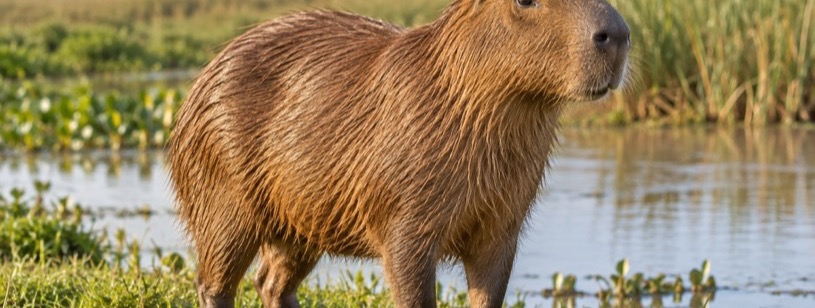
The capybara (Hydrochoerus hydrochaeris) is the world’s largest living rodent and a semiaquatic mammal of South America. It lives near rivers, lakes, marshes and wetlands, where water provides a place to cool down, travel and escape from danger.
At first glance it may look like an enormous guinea pig or a tailless beaver, but its features reflect a life beside water. Capybaras eat plants and often live in groups. Their familiar, relaxed appearance has made them popular in photographs, wildlife programmes and educational material.
Quick facts
| Common name | Capybara |
| Scientific name | Hydrochoerus hydrochaeris |
| Class | Mammalia (mammals) |
| Order | Rodentia |
| Family | Caviidae |
| Diet | Herbivorous: grasses, aquatic plants, leaves, stems and sometimes bark |
| Habitat | Rivers, lakes, marshes, flooded grasslands and wetlands |
| Distribution | South America, mainly east of the Andes |
| Length | Approximately 1–1.3 metres |
| Weight | Usually about 35–65 kg; some individuals are heavier |
| Behaviour | Social and semiaquatic; often active around dawn and dusk |
| Conservation status | Least Concern (LC) |
- Primary category:Mammals
- Explore this animal's categories:
Curiosities and fascinating facts
- The largest living rodent: the capybara is a giant relative of guinea pigs, rather than a pig or a beaver.
- A life beside water: this semiaquatic mammal depends on rivers, lakes, marshes and seasonally flooded areas.
- It can remain underwater for several minutes. When threatened, it may dive and stay hidden long enough to escape a predator.
- It lives in groups. Other group members can help detect danger and provide protection.
- Its feet are adapted to water. Partially webbed toes help it swim and move through muddy ground.
- Calm does not mean domesticated. A capybara is a wild animal with particular needs for space, water and social contact.
Records and remarkable features
- The world's largest living rodent: no other living rodent species normally reaches the capybara's size.
- A large wetland mammal: its range includes the Pantanal, flooded grasslands and river margins in South America.
- Equally capable on land and in water: it can graze on land, swim and dive, moving between the two environments.
- A distinctive appearance: its broad head and barrel-shaped body make it easy to recognise. Internet popularity is not a measured biological record.
Physical characteristics
The capybara has a bulky body, a large head, a broad muzzle, small ears and coarse reddish-brown or brown fur. Its rounded, heavy-looking body is well suited to moving between water and vegetation along the banks.
The eyes, ears and nostrils sit high on the head. This lets the animal watch its surroundings while much of its body remains submerged. Partially webbed toes assist swimming and movement over marshy ground.
| Feature | Role |
|---|---|
| Large, sturdy body | A substantial body supported by short limbs, used on land and in water |
| Partially webbed toes | Help with swimming and moving through mud |
| Eyes and nostrils high on the head | Allow awareness of the surroundings while partly submerged |
| Coarse, relatively sparse fur | A characteristic coat through which the skin may be visible |
Habits and behaviour
Capybaras are social animals. Group size varies with the season, habitat and available resources. Living together helps with vigilance: when one animal notices a predator, its alarm call can prompt the others to react quickly.
They communicate through sounds, scent, body positions and movements. Their calls include whistles and alarm barks. During hot weather, water provides a place to cool down, as well as a refuge from predators in more open landscapes.
Although famous for looking relaxed, a capybara is not defenceless. It can run towards water, dive and remain concealed. Group members also help one another notice danger.
Habitat and geographical distribution
The capybara lives in South America, mainly east of the Andes. It inhabits riverbanks, lakeshores, ponds, marshes, seasonally flooded grasslands and riverside forests. Accessible water is a central part of its habitat.
It belongs among both South American animals and freshwater animals. Its natural habitat centres on inland waters and surrounding vegetation, rather than the open sea.
Diet and feeding
The capybara is a herbivore. It eats grasses, aquatic plants, leaves, stems and sometimes bark. The available plants change with the seasons: wet periods bring fresh growth, while dry periods can make tougher vegetation more important.
Fibrous plants are difficult to digest. The capybara's digestive system, including microbes that help break down plant material, allows it to obtain nutrients from this food.
- Grasses and plants growing along the banks;
- Aquatic vegetation;
- Leaves and soft stems;
- Bark and tougher plant material, particularly when fresh growth is scarce.
Reproduction and life cycle
Capybaras give birth to live young, as most mammals do. A female can have several pups in one litter. The newborns are relatively well developed: they have fur, can stand and walk soon after birth, and begin exploring their surroundings early.
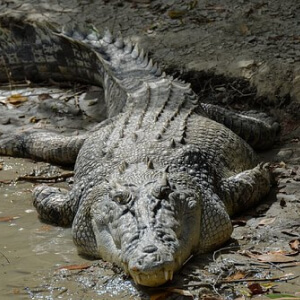
The pups drink milk and gradually begin eating vegetation. Group life offers additional protection through the adults' vigilance. Young capybaras are nevertheless vulnerable to predators, including jaguars, anacondas and caimans.
Name and history
The name “capybara”, used in several languages, comes from Indigenous South American naming traditions. Its scientific name, Hydrochoerus hydrochaeris, refers to its association with water and a pig-like appearance.
That appearance can be misleading. A capybara is neither a pig nor a beaver. It belongs to the rodent family Caviidae, which also includes guinea pigs. Beavers are rodents too, but belong to a different family.
Cultural significance and mythology
In parts of South America, the capybara is a familiar animal of rural wetlands and river landscapes. Its relationship with people includes traditional hunting and local uses, rather than one single story shared throughout its range.
Images of capybaras resting near other animals have also encouraged a modern reputation for calmness. This is a human interpretation of particular scenes. It does not mean that every encounter between a capybara and another animal is peaceful.
Conservation status and threats
The capybara is classified as Least Concern on the IUCN Red List. It has a wide distribution and uses several kinds of wetland habitat. This global category does not mean that every local population is free from pressure.
Hunting, wetland loss and conflicts around farmland can affect capybaras in parts of their range. Protecting wetlands also benefits the birds, fish, reptiles, amphibians and other animals that share these environments.
In popular culture
The capybara has become a familiar animal in online photographs and videos. Scenes in which it rests beside other species have contributed to its relaxed public image. Its status as the world's largest living rodent is also an easy feature to remember.
In educational material, it provides a useful way to explain rodents, plant-eating animals, semiaquatic mammals and social behaviour. Looking beyond its familiar appearance reveals the adaptations that make life beside water possible.
Frequently asked questions
- Is the capybara the largest rodent? Yes. It is the world's largest living rodent.
- Is a capybara a pig? No. It is a rodent in the same family as guinea pigs.
- Where do capybaras live? In South American wetlands, beside rivers, lakes, marshes and flooded grasslands.
- What do capybaras eat? Grasses, aquatic plants, leaves, stems and other vegetation.
- Can capybaras swim? Yes. They swim well and can dive to hide from danger.
- Are capybaras dangerous? They are wild animals and can defend themselves. Observe them from a respectful distance.
- Are capybaras endangered? Their global Red List category is Least Concern, although some local populations face hunting and habitat loss.
Did you know? About capybara
- The capybara is the largest living rodent.
- It belongs to the guinea pig family, rather than the pig family.
- It swims well and can hide underwater when threatened.
- Capybaras live in groups and communicate through sound, scent and body positions.
- Partially webbed toes help them move through water and mud.
- Newborn pups have fur and can walk soon after birth.
- Their plant-based diet includes grasses and aquatic vegetation.
- Despite their online popularity, capybaras remain wild animals.