SparrowInteresting facts and information
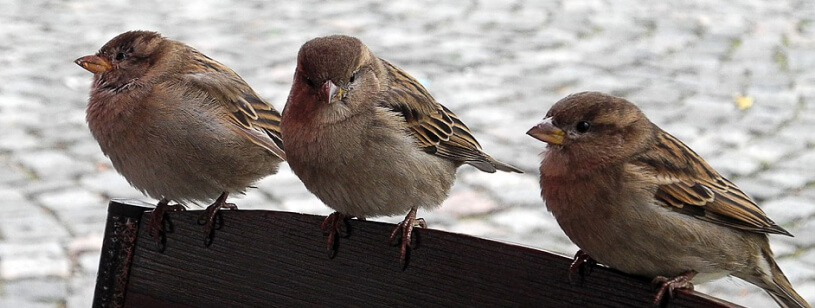
The house sparrow (Passer domesticus) is a small bird closely associated with human settlements. It feeds on seeds and other foods and gives insects to its young. Its population trends differ between regions, and other sparrow species have different habits.
House sparrows often nest close to people. Their numbers have fallen in some regions, even though the species remains widespread.
Quick facts
| Common name | Sparrow |
| Scientific name | Passer domesticus (house sparrow); other sparrow species are also discussed |
| Typical lifespan | Usually 2-5 years in the wild; up to about 12-14 years in captivity |
| Maximum speed | About 38 km/h, up to about 50 km/h when escaping danger |
| Length | About 14-18 cm |
| Wingspan | About 20-25 cm |
| Weight | About 24-40 g |
| Diet | Omnivore (mainly seeds, plus insects and scraps) |
| Main predators | Cats, sparrowhawks and other birds of prey, magpies, snakes and mustelids |
| Conservation status | Least Concern globally (IUCN); declining in some regions |
| Distribution | Worldwide on all continents except Antarctica, mostly near people |
| Habitat | Cities, villages, farmland and woodland edges |
- Primary category:Birds
- Explore this animal's categories:
Interesting facts
- One of the most widespread birds - Originally from Eurasia and North Africa, the house sparrow was introduced by people to the Americas, southern Africa, Australia and New Zealand, where it quickly became common.
- Clever and adaptable - House sparrows learn quickly; some have learned to open automatic doors by flying in front of the sensor to get into cafés and stations.
- Living underground - In 1979, house sparrows were found living and even breeding 640 metres underground in a coal mine in Yorkshire, England.
- Dust baths - Sparrows often bathe in dust as well as water, which helps keep their feathers clean and free of parasites.
- A famous campaign - In 1958, China's "Four Pests" campaign killed huge numbers of sparrows; without them, insect pests such as locusts increased and helped make a famine worse.
- A neighbour of people - The house sparrow depends heavily on human settlements for food and nesting places.
- Local accents - The calls of sparrows can differ from place to place, a little like human dialects.
Records and remarkable features
- Among the most numerous birds - A 2021 study estimated that there are about 1.6 billion house sparrows in the world.
- Its own day - World Sparrow Day is celebrated every year on 20 March to raise awareness of declining sparrow numbers.
- A hawk named after it - The Eurasian sparrowhawk is named after its favourite prey, small birds such as sparrows.
Physical Features and Unique Adaptations
The house sparrow (Passer domesticus) is a small but sturdy bird with a compact body, a short, strong beak and a fairly short tail. Males and females look different, which makes them easy to tell apart.
Essential physical adaptations
- Different males and females - Males have a grey crown, a black bib, and a chestnut-brown back streaked with black, while females are plain brown and buff, with a pale stripe behind the eye.
- A strong, conical beak - Ideal for cracking seeds, but also good for catching insects and eating other foods.
- Strong legs - Let them hop quickly on the ground and grip branches and wires.
- Warm feathers - Fluffing up their feathers helps sparrows survive cold winters.
- Quick flight - Sparrows are not long-distance flyers, but they can take off suddenly and fly fast to escape predators.
Habits and behaviour
House sparrows are very social birds that live in flocks and have a busy social life.
Social structure and communication
- Living with people - House sparrows prefer to live in cities, villages and farms, where food is easy to find.
- Flocks - They usually feed and roost in flocks, which helps protect them from predators.
- Lots of calls - Sparrows use many chirps and calls to warn of danger, defend their nest and call their chicks.
Defence and survival techniques
- Camouflage - Their brown and grey colours help them blend into bushes and the ground.
- Fast reflexes - When attacked, sparrows fly off quickly in unpredictable directions.
- Learning - They quickly learn new ways to find food, such as following people who feed birds or taking crumbs from café tables.
Daily activity
- Active by day - Sparrows are busy throughout the day, especially in the morning and late afternoon.
- Dust baths - They roll and flutter in dry dust or sand, which helps clean their feathers and remove parasites.
Habitat and geographic distribution
The house sparrow is one of the most widespread birds in the world. It lives almost anywhere people live, but is absent from dense forests, open deserts far from people and polar regions.
Overall distribution
| Region | Population Estimate |
|---|---|
| Europe | Common in every country, though declining in some cities |
| Asia | Native from the Middle East and Central Asia to India |
| North America | Introduced in the 1850s; now found almost everywhere |
| South America | Introduced; common in towns and farmland |
| Africa | Native in the north; introduced and common in the south and east |
| Australia and New Zealand | Introduced by settlers in the 1860s; widespread |
Habitats
- Towns and cities - Sparrows live around buildings, parks and streets, where they find food scraps.
- Farmland - They are common around farms, where they feed on spilled grain and seeds.
- Woodland edges - They rarely live in dense forests but may be found at their edges.
- Dry areas - In dry regions, they live around towns and oases, where they find food and water.
Impact of climate change
- Fewer insects, caused partly by pesticides, mean less food for sparrow chicks.
- Air pollution may harm sparrows in cities.
- Modern buildings without gaps and holes leave sparrows fewer places to nest.
Diet and feeding
The house sparrow is an omnivore with a very varied diet. It eats mainly seeds and grain, as well as insects, especially in the breeding season, and food scraps in towns.
What do sparrows eat?
| Food type | Specific examples |
|---|---|
| Seeds and cereals | Wheat, oats, millet, maize, sunflower |
| Insects and larvae | Beetles, caterpillars, flies, aphids, spiders |
| Fruit and buds | Berries, small fruits, buds |
| Food scraps | Bread crumbs, rice, chips |
| Flowers | Flower petals and buds, sometimes eaten in spring |
Adaptations for feeding
- A short, strong beak - Ideal for cracking seeds, but also good for catching insects.
- Feeding on the ground - Sparrows usually hop around on the ground, picking up food; they also take leftovers from tables and packaging.
- Learning from people - They quickly learn where and when food is available in markets, cafés and parks.
- Seasonal diet - In summer, they feed their chicks mainly on insects, while in winter they eat more seeds and scraps.
Reproduction and life cycle
House sparrows breed quickly, which helps keep their numbers high.
Breeding season
- In Europe, the breeding season usually lasts from about March to August; in warm climates, it can last almost all year.
- The male chooses a nest site and calls loudly to attract a female.
- Pairs are usually monogamous and often stay together for several seasons, although partners sometimes change.
Eggs and hatching
| Characteristic | Details |
|---|---|
| Incubation period | About 11-14 days |
| Number of eggs | Usually 3-6 eggs per clutch |
| Number of clutches per year | Usually 2-4, depending on food and climate |
| Chicks at hatching | Blind and almost naked |
Breeding of chicks
- Both parents feed the chicks, mainly with protein-rich insects.
- The chicks grow their feathers quickly and leave the nest after about 14-16 days.
- After leaving the nest, the young are fed by their parents for another week or two.
Survival and maturity
- Many young sparrows die in their first year, often killed by cats, sparrowhawks, crows or magpies.
- Sparrows can start breeding in their first year of life.
Name and history
Origin of name
- The English word "sparrow" comes from Old English spearwa, an old Germanic name for small birds of this kind.
- The scientific name Passer domesticus comes from Latin: passer means "sparrow" and domesticus means "of the house", highlighting its link with human homes.
Taxonomic Classification
| Classification | Name |
|---|---|
| Kingdom | Animalia |
| Phylum | Chordata |
| Class | Aves |
| Order | Passeriformes |
| Family | Passeridae |
| Genus | Passer |
| Species | Passer domesticus |
Evolution and dissemination
- Research suggests that the house sparrow began living alongside people in the Middle East about 10,000 years ago, when farming began, and spread with agriculture.
- In the 19th century, people introduced it to North and South America, southern Africa, Australia and New Zealand, where it quickly spread.
- The house sparrow has long benefited from towns and farms, but in recent decades it has declined in some cities.
Cultural significance and mythology
Because they live so close to people, sparrows appear in the myths, religions and stories of many cultures.
- Greek poetry - In a poem by Sappho, the chariot of Aphrodite, goddess of love, is pulled by sparrows.
- The Bible - Jesus says that not one sparrow falls to the ground without God knowing, a saying about God's care for even the smallest creatures.
- Japan - The folk tale "The Tongue-Cut Sparrow" tells of a kind old man rewarded by a sparrow and his greedy wife who is punished.
- A state bird - The house sparrow is the state bird of Delhi, India.
Conservation status and threats
Although the house sparrow (Passer domesticus) is still one of the most common birds in the world, its numbers have fallen sharply in some regions, including many European cities.
Conservation status
| Species | IUCN Status | Population Estimate |
|---|---|---|
| House sparrow (Passer domesticus) | Least Concern, but declining in some regions | Over a billion birds |
| Spanish sparrow (Passer hispaniolensis) | Least Concern | Common |
| Sudan golden sparrow (Passer luteus) | Least Concern | Common in the African Sahel |
Causes of population decline
- Fewer nest sites - Modern buildings and renovated roofs leave fewer gaps and holes for nesting.
- Pesticides - Fewer insects mean less food for the chicks.
- Pollution - Air pollution may affect the health of sparrows in cities.
- Fewer green spaces - Tidier gardens, paved surfaces and fewer weeds and bushes reduce food and shelter.
Protection measures
- Putting up nest boxes and planting bushes in gardens and parks.
- Using fewer pesticides in farms and gardens, so that there are more insects for the chicks.
- Awareness campaigns, such as World Sparrow Day on 20 March.
In popular culture
- Catullus - The Roman poet wrote famous poems about his beloved's pet sparrow and its death.
- Édith Piaf - The French singer's stage name means "little sparrow" in Parisian slang.
- Captain Jack Sparrow - The pirate hero of the Pirates of the Caribbean films is one of the most famous characters with the bird's name.