Grey partridgePerdix perdix — habitat, diet and reproduction
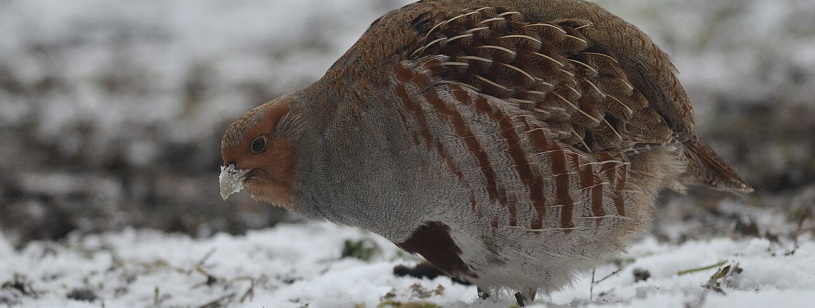
Grey partridge with an orange face, grey breast and chestnut bars along its sides. · Ekaterina Chernetsova (Papchinskaya) / Wikimedia Commons / CC BY 2.0 (https://creativecommons.org/licenses/by/2.0/). Cropped and resized. Source: https://commons.wikimedia.org/wiki/File:Grey_partridge_(40403955463).jpg
The grey partridge (Perdix perdix) is a compact farmland bird with an orange face. It feeds and nests on the ground. Patterned feathers blend with dry plants and soil. In Romania it is resident throughout the year.
Quick facts
| Common name | Grey partridge |
| Scientific name | Perdix perdix |
| Lifespan | Around 3 years in BTO estimates for birds reaching breeding age |
| Length | 28–32 cm |
| Weight | 310–600 g, varying among individuals |
| Diet | Seeds, shoots and insects; young chicks depend on insects |
| Predators | Foxes, birds of prey and other ground-hunting animals |
| Conservation status | Least Concern globally, with declining populations |
| Distribution | Europe and Asia; introduced in North America |
| Habitat | Fields, grasslands and farmland with vegetated refuges |
| Family | Phasianidae |
| Reproduction | Large clutch; female incubates for approximately 23–25 days |
- Primary category:Birds
- Explore this animal's categories:
Interesting facts
- Down-covered chicks leave the nest soon after hatching.
- Diet changes with age: insects are crucial for young chicks.
- Family groups gather to forage outside the breeding season.
- Fine feather patterns provide camouflage against soil and dry vegetation.
Records and extremes
European sources commonly report roughly 13–17 eggs, with variation among clutches. Large broods need insect-rich feeding areas.
BTO lists a British ringing record of 5 years, 2 months and 13 days. Typical survival is shorter; this record is not presented as a worldwide maximum.
Characteristics
The orange face and throat contrast with a grey breast and chestnut flank bars. A dark horseshoe-shaped belly patch may be visible. A short chestnut tail shows in flight.
Males usually have stronger markings, while females often show smaller belly patches. Juveniles lack the full adult pattern. Compact bodies move easily through low vegetation.
Behaviour
Birds walk and run while searching for food, especially around dawn and dusk. They may rest under low cover during the day.
Alarmed birds burst into rapid, noisy flight, usually travelling a short distance close to the ground. Family coveys form outside breeding; pairs establish in spring.
Habitat and distribution
Native to Europe and parts of Asia, the species also has introduced North American populations. Romanian birds are resident.
Open lowlands and valleys provide suitable habitat where farmland retains grassy strips, shrubs and uncultivated margins. Dense forests and high mountains are less suitable.
Its grassland origins help explain its use of cereal fields. Vegetated patches offer places to nest and shelter young.
Diet and feeding
Adults gather seeds, grain, shoots and young leaves. Winter stubbles can retain valuable food.
Chicks initially require insects such as larvae, beetles and aphids. Plant foods become more important as they grow.
GWCT experiments found that size and colour influenced chick food choices. In the field, accessibility also matters, and reduced insect supplies can limit survival.
Reproduction and life cycle
The female lines a shallow ground scrape with grass. Dense vegetation at field edges or beneath shrubs conceals the nest.
Incubation takes around 23–25 days. Chicks leave soon after hatching but still rely on adults for warmth and protection.
Cold rain and shortages of insects can reduce survival. Field margins combine feeding areas with shelter.
Name and history
Linnaeus described the species in 1758. Perdix comes from an ancient name for the partridge. The family Phasianidae also includes pheasants.
Its European history is closely linked to farming. Diverse crops and vegetated boundaries once offered abundant habitat; agricultural intensification changed those conditions.
Conservation and threats
The global classification is Least Concern, although many populations have declined. Global status and regional trends describe different scales.
Removing shrubs and grass strips reduces nesting cover. Pesticides can reduce chick food, while machinery and vegetation burning threaten ground nests.
Grassy margins, insect-rich areas and winter stubbles support the species and other farmland wildlife.
Frequently asked questions
Can grey partridges fly?
Yes, usually fast and low over short distances when disturbed.
Do they leave Romania in winter?
They are resident throughout the year.
Where is the nest?
In a shallow ground scrape concealed by vegetation.
Why do chicks need insects?
Insects supply essential food during early growth.
When do chicks leave the nest?
Soon after hatching, already covered in down and able to walk.
What helps them on farmland?
Vegetated margins, insect-rich chick habitat and winter seed supplies.