Common chaffinchFringilla coelebs — habitat, diet and reproduction
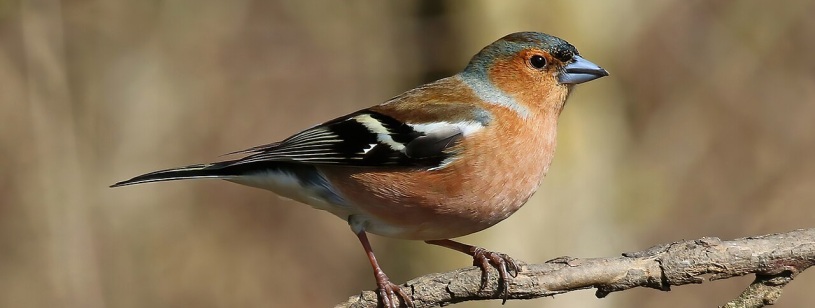
Common chaffinch male with a blue-grey crown, pink-brown breast and white wing markings. · Charles J. Sharp / Sharp Photography / Wikimedia Commons / CC BY-SA 3.0 (https://creativecommons.org/licenses/by-sa/3.0/). Cropped and resized. Source: https://commons.wikimedia.org/wiki/File:Chaffinch_(Fringilla_coelebs)_male.jpg
The common chaffinch (Fringilla coelebs) is a songbird of woods, parks and tree-filled gardens. Males have blue-grey crowns and pink-brown breasts. Females are more subdued, but both sexes show white wingbars. Learned elements of song vary between places.
Quick facts
| Common name | Common chaffinch |
| Scientific name | Fringilla coelebs |
| Lifespan | BTO estimate around 3 years for birds reaching breeding age; exceptional birds approach 14 |
| Length | 14–16 cm |
| Weight | 18–29 g |
| Diet | Seeds and invertebrates, changing with the season |
| Predators | Sparrowhawks and cats |
| Conservation status | Least Concern globally |
| Distribution | Europe and parts of Asia; introduced elsewhere |
| Habitat | Woodland, orchards, parks and gardens with trees |
| Family | Fringillidae |
| Reproduction | Usually 4–5 eggs; female incubates for around 12–13 days |
- Primary category:Birds
- Explore this animal's categories:
Interesting facts
- Song variants can spread between birds through learning.
- In some populations, females winter farther south than males.
- White wing markings help identify the less colourful female.
- Invertebrates are especially important while chicks are growing.
Records and extremes
A BTO ringing record documents a bird reaching 13 years, 11 months and 26 days. This exceptional individual approached 14 years. The figure belongs to the British ringing database.
Chaffinches became central to research on learned birdsong during the 1950s. Studies explored how hearing other birds influences developing song and its transmission within populations.
Characteristics
Males have a blue-grey crown and nape, pinkish-brown cheeks and breast, and a reddish-brown back. Females are mainly grey-brown. Both show white wingbars and white along the outer tail.
The short, strong bill processes seeds. Birds frequently descend to collect food from the ground.
Behaviour
The song runs through a descending sequence and ends with a flourish. Breeding males sing from trees, while shorter calls serve other functions.
Outside breeding, chaffinches gather in flocks and may mix with other seed-eating birds. Open feeding ground near cover is useful.
Romanian populations are partially migratory. Some remain through winter, while others move south; females and young birds tend to travel farther than males.
Habitat and distribution
The Eurasian species occurs across Europe and parts of Asia. It uses both broadleaved and coniferous woods, as well as orchards, parks and gardens.
Winter flocks also visit farmland and other open places near shelter. In spring, song can reveal a bird before its plumage becomes visible.
Diet and feeding
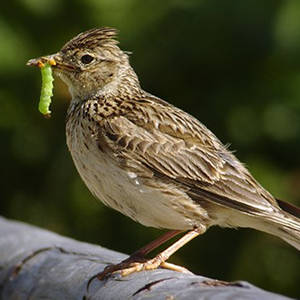
Insects, larvae and other invertebrates feature strongly during the warmer months. Caterpillars help support growing chicks. Food is collected from vegetation and the ground.
Seeds and some fruits become more important in autumn and winter. Feeding flocks investigate farmland and patches of wild plants.
Reproduction and life cycle
The female builds a cup in a tree or shrub, using moss, plant fibres and spider silk. Soft material lines the interior.
A typical clutch contains 4–5 eggs. The female incubates for about 12–13 days, and the helpless chicks require food brought to the nest.
Young usually leave after around 13–16 days, with variation among nests. Insects and larvae support their rapid growth.
Name and history
Linnaeus described the species in 1758. The Latin coelebs means unmarried, associated with winter groups containing mainly males.
Modern research has revised the classification of this finch group. Some North African and Atlantic island forms are now treated as separate species. This account covers the Eurasian Fringilla coelebs.
Conservation and threats
The species is globally Least Concern, although local populations can decline. BTO links recent British losses to trichomonosis, a disease caused by a parasite.
Trees, shrubs and seed-bearing ground provide nesting sites and food. Insect-rich vegetation matters during breeding.
Watch from a distance and avoid approaching occupied nests.
Frequently asked questions
How can I recognise a female chaffinch?
Look for grey-brown plumage, white wingbars and a short, strong bill.
Why do songs differ between places?
Learning from other birds allows local song variants to develop and spread.
Do chaffinches stay in Romania for winter?
Some stay while others migrate; movements differ by sex and population.
Why is a chaffinch feeding on the ground?
It may be collecting seeds or invertebrates, depending on the season.
Are chaffinches related to goldfinches?
Both belong to the finch family, Fringillidae.
When is the song easiest to hear?
During the breeding season in woods, orchards and parks with trees.