PangolinInteresting facts and information
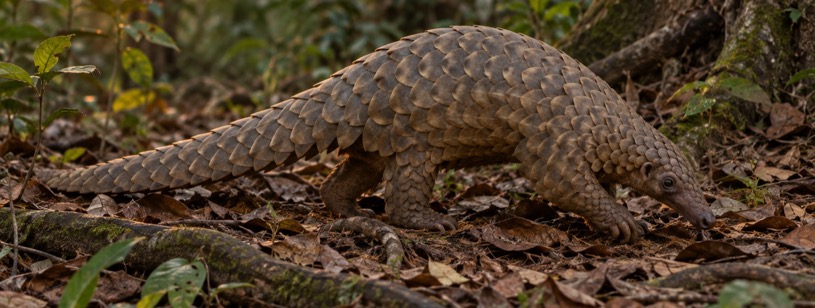
Pangolins are mammals recognised by the large, hard scales that cover much of the body like natural armour. Although their appearance can suggest a reptile, female pangolins give birth to live young and feed them milk.
Different species inhabit parts of Africa and Asia. Most are elusive and mainly nocturnal. They eat almost entirely ants and termites, using strong claws to open nests and a long, sticky tongue to collect insects. Illegal wildlife trade is a major threat to these animals.
Quick facts
| Common name | Pangolin |
| Scientific group | Order Pholidota |
| Class | Mammalia (mammals) |
| Family | Manidae |
| Living species | Nine in the Mammal Diversity Database; many older references list eight |
| Diet | Insectivorous: mainly ants and termites |
| Habitat | Forests, savannas, scrub and grasslands, depending on the species |
| Distribution | Sub-Saharan Africa and parts of South, East and Southeast Asia |
| Distinctive feature | Protective scales made of keratin, a protein also found in hair and nails |
| Behaviour | Generally solitary and elusive; many species mainly nocturnal |
| Defence | Rolling into a ball to cover the head and soft underside |
| Conservation status | Eight traditionally assessed species are threatened; newer taxonomic splits need separate assessment |
Curiosities and fascinating facts
- Mammals with large protective scales: pangolin scales consist of keratin, rather than bone or metal.
- They have no teeth. They swallow insects without chewing, and muscular, tough-lined stomachs help break up the food.
- A remarkably long tongue: in some species it extends a considerable distance to reach ants and termites inside narrow galleries.
- A compact defensive ball: the animal covers its head and soft underside, leaving hard scales facing outwards.
- A mammal, despite the scales: female pangolins give birth to live young and feed them milk.
- Specialist insect eaters: their consumption of ants and termites makes them part of the food webs of their habitats.
- Difficult to observe: many species are solitary and mainly active at night, so direct sightings can be rare.
Records and remarkable features
- An unusual kind of mammal armour: the overlapping scales distinguish pangolins from other living mammal groups.
- Severely affected by trafficking: illegal trade in their meat and scales is a major conservation problem. A single universal ranking of trafficked animals would be misleading.
- Specialists in ants and termites: claws open nests and a sticky tongue collects insects from their tunnels.
- Protection with limits: rolling up can deter natural predators, but does not protect a pangolin from a person picking it up.
Physical characteristics
Pangolins have elongated bodies, small heads, narrow snouts, short legs and powerful claws. Overlapping scales cover the back, sides and tail. The face and underside are less well protected, so the animal curls up when threatened.
The scales are hard plates made of keratin, a protein also found in human hair and nails. Their arrangement differs from that of reptile scales, although reptile skin also contains keratin. The presence of scales does not turn a pangolin into a reptile.
| Feature | Role |
|---|---|
| Keratin scales | Protection of much of the body |
| Long, strong claws | Opening ant and termite nests and digging |
| Long, sticky tongue | Collecting ants and termites from narrow galleries |
| Narrow snout | Reaching into cracks and nest openings |
| Strong tail | Support and, in some species, climbing or balance |
Habits and behaviour
Pangolins are generally solitary rather than herd-living animals. They search for food using a well-developed sense of smell. Many species are mainly nocturnal, although activity varies between species and individuals.
On finding an ant or termite nest, a pangolin opens it with its claws and inserts its sticky tongue. A feeding visit does not necessarily destroy the entire colony, allowing insects to remain and the site to be used again.
When threatened, it can roll into a tight ball with its scales outside. This can help against natural predators, but makes it easy for people to capture the animal. It is a defensive behaviour, not a safeguard against poaching.
Habitat and geographical distribution
Pangolins occur in Africa and Asia. African species use habitats such as savannas, forests, scrub and grasslands. Asian species occur in forested and other suitable landscapes, including some modified areas where food and shelter remain.
The precise habitat depends on the species. Some spend much of their time on the ground and use burrows; others climb trees. A general pangolin page therefore describes a group with different needs, rather than one species living in every listed environment.
| Region | Examples of habitat |
|---|---|
| Africa | Savannas, forests, scrub, grasslands and areas with termite nests |
| Asia | Tropical and subtropical forests, hills, forest edges and some modified landscapes |
Diet and feeding
Pangolins are insectivores: ants and termites make up almost all their diet. Strong digging claws, narrow snouts and sticky tongues are suited to reaching these insects, while teeth are absent.
Instead of chewing, a pangolin swallows its prey. Muscular stomach walls and a tough internal lining help process the food; swallowed grit may also assist. This resembles the use of a muscular gizzard in some birds, without making the digestive systems identical.
- Ants and ant larvae;
- Termites and termite larvae;
- Small insects found in galleries, decaying wood or soil;
- Occasional other small invertebrates, depending on the species and circumstances.
Reproduction and life cycle
Females give birth to live young and nurse them with milk. A single pup is usual in many species, although litter size varies. The young have soft scales at birth that gradually harden.
Early in life, a pup depends on its mother. Young pangolins of several species ride on their mother's tail or back, and mothers may curl around a pup to shield it with their scales.
Low reproductive output makes recovery difficult when populations suffer heavy losses. Removing large numbers of animals can outpace the replacement of those animals through breeding.
Name and history
The word “pangolin” comes from a Malay term associated with rolling up, describing the familiar defensive response. Pangolins belong to the order Pholidota and the family Manidae.
Species counts have changed with new research. Many references list eight living species, four African and four Asian. The Mammal Diversity Database now recognises nine, including Manis aurita, the Indo-Burmese or Himalayan pangolin. It includes the more recently proposed name Manis indoburmanica as a synonym. Different checklists and conservation assessments may not be updated at the same time.
Pangolins have been compared with anteaters, armadillos and reptiles because of their diet, claws or armour. These similarities do not make all those animals close relatives. Armadillos, for example, have a different kind of armour and belong to another mammal group.
Cultural significance and mythology
In some regions, the pangolin's unusual appearance and secretive life have inspired local stories and beliefs. Such traditions differ between communities and should not be presented as one shared mythology.
Demand for scales for traditional remedies contributes to trade pressures. The IUCN Pangolin Specialist Group reports no scientific evidence supporting the claimed medicinal effectiveness of the scales. Cultural beliefs should therefore be distinguished from demonstrated biological or medical properties.
Conservation status and threats
Pangolins face severe conservation pressures. The eight traditionally recognised species have IUCN assessments ranging from Vulnerable to Critically Endangered. A newly recognised taxon should not automatically be assigned an assessment made for a different taxonomic scope; the Mammal Diversity Database lists Manis aurita as Not Evaluated.
Poaching, trafficking, hunting and habitat loss affect populations across their range. Scales are traded and meat is consumed locally or sold as a high-value product in some markets. Low reproductive output adds to the difficulty of recovery.
Conservation includes tackling illegal trade, protecting habitat, reducing demand and working with local communities. Understanding the animal is part of that work: rarity is a reason for protection, rather than a reason to buy a specimen or a product made from it.
In popular culture
Pangolins feature in wildlife documentaries, conservation campaigns and educational accounts of wildlife trafficking. Their overlapping scales make them memorable, but they are living mammals rather than surviving prehistoric reptiles.
They illustrate why appearances can mislead. A mammal can have scales, a toothless animal can feed effectively, and natural armour can offer little protection against people. These contrasts help explain their adaptations and conservation needs.
Frequently asked questions
- Is a pangolin a reptile? No. It is a mammal, despite its scales.
- What are the scales made of? Keratin, a protein also found in human hair and nails.
- What do pangolins eat? Mainly ants and termites, collected with a long, sticky tongue.
- Do pangolins have teeth? No. They swallow insects without chewing them.
- Where do pangolins live? In parts of Africa and Asia, with habitats differing between species.
- Why do they roll into a ball? To protect the head and soft underside behind the scales.
- Are pangolins threatened? Yes. Hunting and trafficking are major pressures. The eight traditionally assessed species have threatened Red List categories; newer taxonomic splits need separate consideration.
Did you know? About pangolin
- Pangolins are mammals, despite their scales.
- The scales contain keratin, a protein also found in human nails.
- Pangolins have no teeth and do not chew their food.
- Ants and termites make up almost all their diet.
- They can curl into a tight ball when threatened.
- The Mammal Diversity Database recognises nine living species; older references often list eight.
- Newborn pups have soft scales that gradually harden.
- Illegal wildlife trade has severe effects on pangolin populations.