PelicanInteresting facts and information
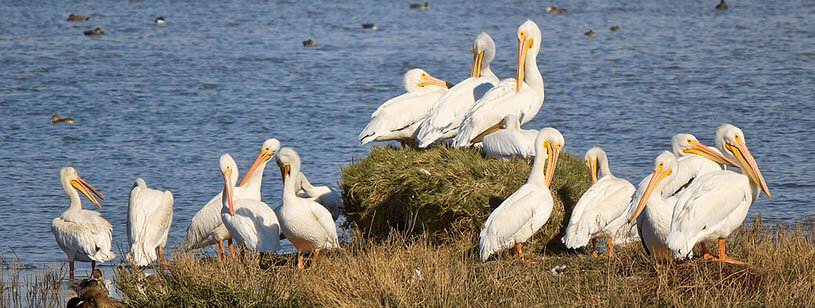
Pelicans (Pelecanus) are large waterbirds with long bills and expandable throat pouches. They use these pouches while catching prey. Feeding methods and habitats vary between species.
Pelicans are excellent fliers that can soar for hours on rising currents of warm air, saving energy. They are also strong swimmers, pushing themselves through the water with their webbed feet.
The best-known species include the great white pelican (Pelecanus onocrotalus), which nests in Romania's Danube Delta, and the Dalmatian pelican (Pelecanus crispus), one of the largest and heaviest flying birds in the world.
Quick facts
| Common name | Pelican |
| Scientific name | Pelecanus spp. |
| Typical lifespan | About 15-30 years in the wild, sometimes over 40 years in captivity |
| Maximum speed | Usually flies at about 40-50 km/h |
| Length | About 1-1.8 m, depending on the species |
| Wingspan | About 2-3.5 m, depending on the species |
| Weight | About 4-15 kg, depending on the species |
| Diet type | Mainly fish; also crustaceans and amphibians |
| Main predators | Few as adults; eggs and chicks are taken by gulls, foxes, jackals and crocodiles; humans |
| Conservation status | Varies by species: several Least Concern, some Near Threatened (IUCN) |
| Geographical distribution | All continents except Antarctica |
| Social behaviour | Lives in large colonies and often fishes in groups |
| Special adaptations | Stretchy throat pouch, energy-saving soaring flight, webbed feet for swimming |
- Primary category:Birds
- Explore this animal's categories:Animals of AfricaAnimals of AsiaAnimals of AustraliaAnimals of EuropeAnimals of North AmericaAnimals of RomaniaAnimals of South AmericaAnimals of the Danube DeltaBirdsBirds of RomaniaBirds with unusual beaksCarnivoresEgg-laying animalsFeathered animalsFish-eating animalsFlying animalsMigratory animalsMigratory birdsPVertebratesWaterbirdsWetland animals
Interesting facts
- A pelican's pouch can hold about 11-13 litres of water - Pelicans do not swallow this water; they drain it out of the pouch before swallowing the fish they have caught.
- One of the largest wingspans of any bird - The Dalmatian pelican (Pelecanus crispus) can have a wingspan of up to about 3.5 metres, close to that of the great albatrosses.
- Team fishing - A group of pelicans can surround a shoal of fish and drive it into shallow water, where the fish are easier to catch.
- Hungry chicks - A great white pelican chick may eat around 70 kg of fish before it can fly.
- High flyers - Pelicans can soar to more than 3,000 metres, riding rising currents of warm air.
- Breeding colours - In the breeding season, some pelicans develop brighter colours on the bill, pouch and face; the American white pelican even grows a hard "horn" on its upper bill.
- Keeping cool - On hot days, pelicans flutter their throat pouch, which helps them lose heat by evaporation.
Records and remarkable features
- Pelicans (Pelecanus) are large waterbirds with long bills and expandable throat pouches. They use these pouches while catching prey. Feeding methods and habitats vary between species.
- The Australian pelican has the longest bill of any bird, up to about 50 cm long.
- The Dalmatian pelican, weighing up to about 15 kg, is one of the heaviest flying birds in the world.
Characteristics
Pelicans are large waterbirds known for their long bills with stretchy pouches, broad wings and webbed feet. Their unusual bodies make them skilful fishers and strong fliers, and their feeding methods vary between species.
Appearance
- Impressive size - Pelicans are about 1-1.8 metres long, and the largest have a wingspan of up to about 3.5 metres.
- A long, strong bill - The Australian pelican's bill, up to about 50 cm long, is the longest of any bird.
- A stretchy throat pouch - Used to scoop up fish and drain the water before swallowing.
- Mainly white or grey feathers - Varies between species; the brown pelican (Pelecanus occidentalis) has darker plumage.
- Webbed feet - Help them swim and push through the water while fishing.
- A long, flexible neck - Allows them to scoop and handle prey precisely.
Special adaptations
- Energy-saving flight - Pelicans soar on rising warm air and fly in V-shaped formations, saving a lot of energy.
- Cooling - They open their pouch and flutter it quickly to get rid of excess heat.
- Group fishing - Some species fish as a team, forming semicircles to drive fish into shallow water.
- A light skeleton - Their hollow bones and air sacs help such large birds float and fly.
Habits and behaviour
Pelicans are social birds that live in large groups, where they fish, nest and rest together. Although they are waterbirds, they spend a lot of time on land, gathering on islands and riverbanks.
Social behaviour
- Large colonies - Some species gather in groups of hundreds or even thousands of birds.
- Communication - Adult pelicans are mostly quiet, but they use grunts, bill-clapping and body movements, especially in the breeding season.
- Sharing space - In the colony, they share fishing grounds and nesting areas.
- Seasonal migration - Some species, such as the great white pelican (Pelecanus onocrotalus), migrate from Europe to Africa for the winter.
Hunting techniques
- Scooping with the pouch - A pelican scoops up fish, drains the water and then swallows its prey.
- Group fishing - Some species form semicircles to drive fish into shallow water.
- Plunge-diving - The brown pelican and the Peruvian pelican dive into the water from a height to catch fish.
- Fishing with other birds - Sometimes pelicans fish alongside cormorants, which drive fish towards the surface.
Interaction with people
- A symbol in religion - In Christian art, the pelican is a symbol of self-sacrifice.
- Used to people - In many harbours and tourist areas, pelicans beg for fish from fishermen.
- Vulnerable to pollution - Oil spills, fishing lines and plastic waste are a major threat to these birds.
Habitat and geographic distribution
Pelicans live on every continent except Antarctica, in freshwater and coastal habitats.
| Region | Species present | Preferred habitat |
|---|---|---|
| Europe, Asia, Africa | Pelecanus onocrotalus, Pelecanus crispus, Pelecanus rufescens, Pelecanus philippensis | Lakes, rivers, deltas, lagoons |
| North and South America | Pelecanus occidentalis, Pelecanus erythrorhynchos, Pelecanus thagus | Sea coasts, estuaries, lakes |
| Australia and New Guinea | Pelecanus conspicillatus | Rivers, swamps, coasts |
Types of habitat
- Lakes and large rivers - Preferred by the great white pelican and the Dalmatian pelican.
- Lagoons, estuaries and coasts - Brown and Peruvian pelicans live along the sea coast.
- Isolated islands - Pelicans nest on islands and reed beds, where predators cannot easily reach them.
Human impact and threats
- Habitat loss - Wetlands are drained for farming and building.
- Water pollution - Pesticides and oil spills harm pelicans' health.
- Overfishing - Reduces their food, and fishing nets and lines can injure or drown pelicans.
- Persecution - In some regions, pelicans are killed by fishermen who see them as competitors.
Diet and feeding
Pelicans mainly eat fish, but they also take crustaceans, amphibians and other water animals. Their hunting methods vary between species, and some drive fish into shallow water to catch them more easily.
What do pelicans eat?
The pelican's diet depends on where it lives.
| Type of food | Examples |
|---|---|
| Fish | Carp, crucian carp, perch, anchovies, sardines, mullet |
| Crustaceans | Small crabs, shrimps, crayfish |
| Amphibians | Frogs, tadpoles |
| Other water animals | Small turtles, molluscs |
| Occasionally, birds | Chicks of seabirds or ducklings (rare, in some species) |
Feeding techniques
- Scooping with the pouch - A pelican plunges its bill into the water, scoops up its prey and drains the water before swallowing.
- Group fishing - Several pelicans form a semicircle to drive shoals of fish into shallow water.
- Plunge-diving (brown and Peruvian pelicans) - These species dive into the water from a height to catch fish.
- Fishing with other birds - Sometimes pelicans fish together with cormorants, which drive fish to the surface.
Adapting to the food supply
- Long journeys - Some species fly long distances, even daily, to reach good fishing areas.
- Feeding times - Many pelicans fish mainly in the morning and evening.
- No food storage - Despite a popular myth, pelicans do not carry fish around in their pouch; they swallow it straight away.
Reproduction and life cycle
Pelicans are seasonally monogamous, forming pairs for the breeding season. They nest in dense colonies, laying their eggs in nests on the ground, in reeds or, in some species, in trees.
| Feature | Details |
|---|---|
| Age at maturity | 3-4 years |
| Breeding season | Spring and summer, depending on the climate |
| Type of reproduction | Egg-laying |
| Eggs per nest | 1-3 |
| Incubation period | About 29-36 days |
| Time to first flight | About 10-12 weeks |
| Lifespan | About 15-30 years in the wild, sometimes over 40 years in captivity |
Breeding process
- Forming pairs - Males impress females with bill movements, head-swaying and strutting displays.
- Building the nest - Nests are simple, made of grass, reeds and sticks, in places that predators find hard to reach.
- Incubating the eggs - Both parents incubate the eggs, holding them on top of their webbed feet.
- Feeding the chicks - The parents regurgitate food, and the chicks reach deep into their parents' pouch and throat to eat.
- First flights - At about 10-12 weeks, the young begin to fly and soon learn to fish.
Survival strategies
- Safety in numbers - Nesting in large colonies helps protect the eggs and chicks from predators.
- Sibling rivalry - In many pelicans, the older chick gets most of the food and often pushes out its younger sibling, so usually only one chick survives.
- Defensive parents - They defend their nest with their huge bills and strong wings.
Name and history
The pelican has long been an important symbol in religion and heraldry, linked especially with parental sacrifice and protection.
Origin of the name
- The word "pelican" comes from the Greek pelekan, probably related to pelekys, "axe", perhaps because of the shape of the bill.
- The scientific name Pelecanus is used for the whole genus of pelicans.
The pelican in human history
- A medieval symbol of sacrifice - People believed that a mother pelican wounded her own breast to feed her young with her blood, so the pelican became a Christian symbol of Christ's sacrifice.
- Ancient Egypt - The pelican was linked with the goddess Henet and was believed to protect the dead on their journey to the afterlife.
- Exploration - Sir Francis Drake's famous ship, later renamed the Golden Hind, was first called the Pelican.
The pelican in folklore
- The "pelican in her piety" - The image of a pelican feeding its young with its blood became a common symbol of self-sacrifice and charity.
- Queen Elizabeth I - A famous portrait of the English queen shows her wearing a pelican jewel, a symbol of her love for her people.
- A friend of fishermen - In many fishing towns, pelicans are a familiar sight, waiting near boats for scraps.
Cultural significance and mythology
In many cultures, the pelican stands for sacrifice, parental care and generosity. It appears often in art, religion and heraldry.
The pelican in mythology and religion
- A Christian symbol - In the Middle Ages, people believed that the pelican pierced its own breast to feed its young with its blood, a symbol of the sacrifice of Christ. This image appears in many medieval paintings, carvings and church windows.
- Ancient Egypt - The pelican was linked with the goddess Henet and with the protection of the dead.
- Where the myth came from - The legend may have arisen because pelicans press their bills against their chest when feeding their chicks, or because of the red pouch of the Dalmatian pelican in the breeding season.
The pelican in heraldry and symbolism
- Coats of arms - The pelican feeding its young appears on the coats of arms of many families, towns, colleges and churches.
- Louisiana - The brown pelican is the state bird of Louisiana, nicknamed the "Pelican State", and appears on its flag and seal.
- Corpus Christi College - Colleges of this name at Oxford and Cambridge have the pelican as their emblem.
The pelican in folklore
- A famous rhyme - "A wonderful bird is the pelican, his bill will hold more than his belican" is a well-known humorous rhyme by Dixon Lanier Merritt (1910).
- A symbol of generosity - Because of the legend of its sacrifice, the pelican is used as a symbol of charity and care.
- Romania - The Danube Delta is home to Europe's largest colonies of great white pelicans, and the pelican is a symbol of the delta.
Conservation status and threats
Several pelican species, such as the great white pelican (Pelecanus onocrotalus) and the brown pelican, are not threatened globally, while others, such as the Dalmatian pelican (Pelecanus crispus), are Near Threatened because of habitat loss, persecution and pollution.
| IUCN status | Example species | Regions |
|---|---|---|
| Least Concern (LC) | Pelecanus onocrotalus (great white pelican), Pelecanus occidentalis (brown pelican) | Europe, Africa, Asia, the Americas |
| Near Threatened (NT) | Pelecanus crispus (Dalmatian pelican) | Southeastern Europe, Central Asia |
| Near Threatened (NT) | Pelecanus philippensis (spot-billed pelican) | South and Southeast Asia |
Main threats
- Habitat loss - The wetlands where pelicans nest are destroyed by farming, building and drainage.
- Water pollution - Pesticides, heavy metals and plastic in the water harm pelicans and their prey.
- Overfishing - Fewer fish means less food for pelicans and longer journeys to find it.
- Disturbance of colonies - Uncontrolled tourism and human activity near nesting areas can make pelicans abandon their nests.
- Fishing gear and power lines - Many pelicans get tangled in fishing nets or are killed by colliding with power lines.
Conservation efforts
- Protecting wetlands - National parks and nature reserves, such as the Danube Delta and Lake Prespa, protect pelican colonies.
- Nesting platforms - Floating rafts and platforms have helped Dalmatian pelicans breed safely in places such as Greece and Bulgaria.
- Banning harmful pesticides - The ban on DDT in the USA helped the brown pelican recover from near disappearance.
- Education and awareness - Programmes encourage fishermen and local communities to protect pelicans and their habitats.
In popular culture
Pelicans appear in books, films, cartoons and video games thanks to their unusual looks and interesting behaviour.
Literature and fables
- Storm Boy (Colin Thiele, 1964) - An Australian children's novel about a boy who raises an orphaned pelican called Mr Percival.
- The Pelican Brief (John Grisham, 1992) - A legal thriller whose title refers to brown pelicans; it was made into a film in 1993.
- The pelican rhyme - Dixon Lanier Merritt's humorous verse about the pelican's huge bill is still widely quoted.
Films and cartoons
- Finding Nemo (2003) - Nigel, a friendly brown pelican, helps Marlin and Dory find Nemo.
- Storm Boy (1976 and 2019) - Australian films based on Colin Thiele's novel.
Video games
- Animal Crossing - Pelicans such as Pelly, Phyllis and Pete run the post office in several games of the series.
The pelican as a symbol
- Books - Pelican Books, a famous series of non-fiction paperbacks, was launched in 1937 with a pelican logo.
- Louisiana - The pelican appears on the flag and seal of the "Pelican State".
- Sport - The New Orleans Pelicans basketball team in the NBA is named after the bird.