MandrillInteresting facts and information
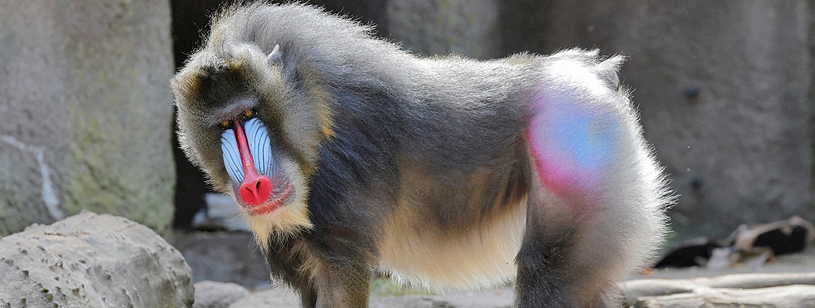
The mandrill (Mandrillus sphinx) is a large monkey of the forests of west-central Africa. Adult males have strongly coloured faces and are much larger than females. Mandrills eat fruit and a variety of other plant and animal foods.
Mandrills live in forests in west-central Africa and can form large social groups. They are monkeys, not apes; the drill (Mandrillus leucophaeus) is another species in the same genus.
Quick facts
| Common name | Mandrill |
| Scientific name | Mandrillus sphinx |
| Typical lifespan | About 20 years in the wild, up to about 40 years in captivity |
| Length | About 55-95 cm (without tail) |
| Length of tail | About 5-10 cm |
| Weight | About 10-15 kg (females), usually 20-37 kg (males) |
| Diet type | Omnivore (fruit, seeds, leaves, roots, insects, eggs, small animals) |
| Main predators | Leopards; humans |
| Conservation status | Vulnerable (IUCN) |
| Distribution | West-central Africa (southern Cameroon, Equatorial Guinea, Gabon, Republic of the Congo) |
| Living environment | Tropical rainforests and forest-savannah edges |
- Primary category:Mammals
- Explore this animal's categories:
Interesting facts
- The largest monkey - The mandrill is the world's largest monkey; adult males usually weigh about 25-35 kg, and some even more.
- One of the most colourful mammals - Adult males have a bright red stripe down the nose, blue ridges on the sides of the snout and a colourful rump.
- Colours show status - The most dominant males have the brightest colours.
- Huge groups - Mandrills can live in groups called hordes of several hundred animals; one horde in Gabon was counted at about 1,300.
- Long canines - Adult males have canine teeth up to about 6 cm long.
- Cheek pouches - Mandrills can store food in their cheek pouches and eat it later.
Records and remarkable features
- The mandrill (Mandrillus sphinx) is a large monkey of the forests of west-central Africa. Adult males have strongly coloured faces and are much larger than females. Mandrills eat fruit and a variety of other plant and animal foods.
Physical characteristics and adaptations
The mandrill is one of the most distinctive primates in the world, with a powerful body and bright colours. Males and females differ a lot in size, and the male's colours show his social status.
Key physical adaptations
- A strong, muscular body - Built for walking on the ground and also for climbing trees.
- A large head and long snout - The long snout has bony ridges on each side, covered in blue skin in males.
- Very long canines - Males have canines up to about 6 cm long, used mainly for threats and in fights between males.
- A colourful face - Adult males have a red stripe down the nose and blue ridges on the sides of the snout; the colours are brightest in dominant males.
- A short tail - The tail is only about 5-10 cm long.
- Strong limbs - Mandrills walk on all fours on the ground and can also climb well.
- Olive-brown fur - The fur is dark olive to grey-brown, with a lighter belly and a yellowish beard in males.
- Large size differences between sexes - Males are about two to three times heavier than females and much more colourful.
Dimensions and variations
| Characteristic | Males | Females |
|---|---|---|
| Body length | About 75-95 cm | About 55-70 cm |
| Length of tail | About 5-10 cm | About 5-10 cm |
| Weight | Usually about 20-37 kg, sometimes more | About 10-15 kg |
Habits and behaviour
The mandrill is a social primate that lives in large groups. It is active during the day and spends time both on the ground and in the trees.
Daily life
- Active by day - Mandrills feed and travel during the day.
- On the ground by day, in the trees at night - They search for food mainly on the forest floor, but sleep in trees for safety.
- Large groups - Mandrills form the largest natural groups of any primate apart from humans, sometimes with several hundred animals.
Social organisation
- Female-based groups - Hordes are made up mainly of females and their young.
- Males come and go - Many adult males live alone and join the hordes mainly in the breeding season, when the most dominant males do most of the mating.
- Grooming - Mandrills groom each other's fur, which strengthens social bonds.
Communication
- Facial expressions - Mandrills show their teeth, shake their heads or make other faces to send messages.
- Calls - They use grunts and other calls to keep in contact in the dense forest, and alarm calls when there is danger.
- Scent marking - Males have a scent gland on the chest which they rub on trees.
Defence techniques
- Threat displays - Males show their long canines to warn rivals and predators.
- Fleeing - When in danger, the group quickly moves into dense vegetation or up into trees.
- Fighting - Adult males can fight fiercely with their canines if necessary.
Habitat and geographic distribution
The mandrill lives only in the tropical rainforests of west-central Africa.
Distribution context
| Region | Countries |
|---|---|
| Rainforests of west-central Africa | Southern Cameroon (south of the Sanaga River), mainland Equatorial Guinea, Gabon, Republic of the Congo |
| Forest-savannah mosaics | For example in Lopé National Park in Gabon |
Habitat types
- Dense rainforest - Their main habitat, with plenty of fruit and shelter.
- Forest-savannah edges - Mandrills sometimes visit areas where forest and grassland meet, but they do not live in open savannah.
- Coastal forests - Some populations live in forests near the coast.
Environmental change
- Deforestation - Loss of forest is a major threat to the species.
- Hunting - Mandrills are hunted for bushmeat in many areas.
- Roads and settlements - New roads make forests easier to reach for hunters and split the mandrills' habitat.
Diet and feeding
The mandrill is an omnivore with a varied diet, made up mainly of fruit and seeds, but also other plant parts and small animals.
What does the mandrill eat?
| Food group | Examples and context |
|---|---|
| Fruit and seeds | Wild fruit, figs, seeds and nuts; the main part of the diet |
| Leaves and stems | Young leaves, shoots and the pith of plants |
| Roots and tubers | Dug up from the forest floor |
| Insects and invertebrates | Ants, termites, beetles, snails |
| Small vertebrates | Frogs, lizards, small rodents |
| Eggs and birds | Birds' eggs and chicks |
| Mushrooms | Forest fungi |
Feeding methods
- Picking fruit from trees or from the forest floor.
- Digging for roots and turning over stones and leaves to find insects.
- Catching small animals when the chance arises.
- Cracking hard nuts and seeds with their strong teeth.
By eating fruit and spreading the seeds in their droppings, mandrills help the forest regrow.
Reproduction and life cycle
In mandrills, the dominant males father most of the young.
Breeding season
- Most mating takes place in the dry season, and most births in the rainy season, when food is plentiful.
- The most dominant and colourful males guard females and do most of the mating.
- Females have swollen pink skin on the rump when they are ready to mate.
Gestation and birth
| Characteristic | Details |
|---|---|
| Duration of pregnancy | About 175 days (nearly 6 months) |
| Number of young per birth | 1 |
| Nursing period | About 6-12 months |
| Sexual maturity | About 4-5 years for females; males reach full size at about 9-10 years |
Raising young
- Babies depend completely on their mothers in their first months of life.
- Mothers carry their babies on the belly and later on the back.
- Young mandrills learn what to eat and how to behave by watching their mothers and other group members.
Survival
- Young mandrills can be taken by leopards and other predators.
- Daughters usually stay in their mothers' group, while young males leave as they grow up.
Name and history
Origin of the name
- The name "mandrill" is thought to combine "man" with "drill", an old name for a West African monkey, now used for the mandrill's close relative.
- The scientific name Mandrillus sphinx was given by Carl Linnaeus in the 18th century.
Taxonomic classification
| Classification | Name |
|---|---|
| Kingdom | Animalia |
| Phylum | Chordata |
| Class | Mammalia |
| Order | Primates |
| Family | Cercopithecidae |
| Genus | Mandrillus |
| Species | Mandrillus sphinx |
Evolution and fossils
- The mandrill's closest living relative is the drill (Mandrillus leucophaeus).
- Genetic studies show that mandrills and drills are more closely related to some mangabeys (Cercocebus) than to baboons (Papio), although they look like baboons.
- Mandrills were once grouped with baboons because of their long snouts.
Cultural significance and mythology
Because of its striking colours, the mandrill has long fascinated scientists, artists and visitors to zoos.
Mandrill in myths and symbolism
- Central Africa - In parts of Gabon and Cameroon, mandrills have traditionally been hunted for meat, and they are well known to forest communities.
- Charles Darwin - In "The Descent of Man" (1871), Darwin described the mandrill's bright colours as an example of sexual selection.
- Art - The German painter Franz Marc painted "The Mandrill" (1913), now in Munich.
Mandrill in modern symbolism
- A favourite zoo animal - Its colourful face makes it one of the most recognisable monkeys.
- Research - Mandrills are studied to understand how colours and social status are linked.
- Conservation - The mandrill is a symbol of the threatened forests of central Africa.
Conservation status and threats
The mandrill is listed as Vulnerable by the International Union for Conservation of Nature (IUCN) and is threatened by hunting and habitat loss.
Conservation status
| Region | Assessment scope | Trends |
|---|---|---|
| Whole range (Gabon, Cameroon, Equatorial Guinea, Republic of the Congo) | Vulnerable | Decreasing |
| Protected areas such as Lopé National Park | Large hordes still present | Monitoring |
Main pressures
- Deforestation - Logging and farming reduce the mandrills' forest.
- Bushmeat hunting - Mandrills are hunted for meat; their large, noisy groups make them easier to find.
- Habitat fragmentation - Roads and settlements split up their habitat.
- Conflict with people - Mandrills sometimes raid crops, which can lead to them being killed.
Protection measures
- Protected areas - National parks in Gabon and Cameroon protect important populations.
- Working with local communities - Projects try to reduce hunting by offering other sources of income.
- Research and monitoring - Scientists follow mandrill hordes with radio collars and camera traps.
- Legal protection - International trade in mandrills is controlled under CITES.
In popular culture
Books and literature
- "The Descent of Man" (1871) - Charles Darwin discussed the mandrill's colours.
- Nature books and encyclopedias often use the mandrill's face as an example of bright colours in mammals.
Films and music
- "The Lion King" (1994) - The wise character Rafiki is often described as a mandrill, although his look also borrows from baboons.
- Mandrill - An American funk and soul band formed in 1968 named itself after the animal.
Mascots and symbols
- Rainforest conservation - The mandrill appears in campaigns to protect African forests.
- Zoos - Many zoos use the mandrill on posters and signs because of its striking face.
- Internet popularity - Its colourful face often appears in photos and videos shared online.