BatInteresting facts and information
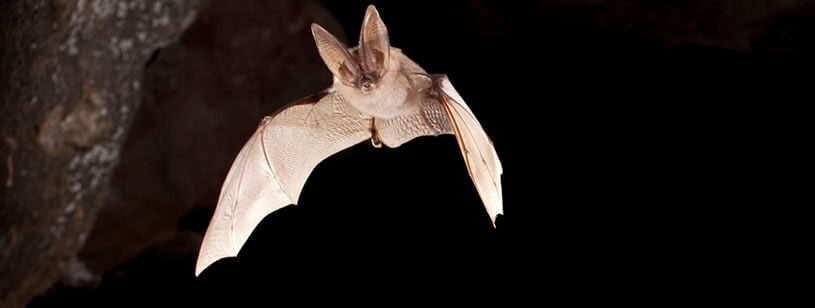
Bats (Chiroptera) are mammals capable of powered flight. Their diets vary: many eat insects, while others feed on fruit, nectar or other foods. Bats can see, and many also use echolocation.
Most bats are active at night and use echolocation to find obstacles and prey in the dark. Bats play a vital role in nature by controlling insects, pollinating plants and spreading seeds. Although they are surrounded by myths and superstitions, bats are not a danger to people who leave them alone, and many species are very useful to farmers.
Quick facts
| Common name | Bat |
| Scientific name | Chiroptera |
| Typical lifespan | 5 - 30 years or more, depending on species |
| Maximum speed | Varies by species; the Brazilian free-tailed bat may reach about 160 km/h |
| Dimensions | Wingspan from about 15 cm to 1.5 m |
| Weight | About 2 g to 1.5 kg |
| Diet type | Insects, fruit, nectar, small animals or blood (depending on species) |
| Main predators | Owls, hawks, falcons, snakes, humans |
| Conservation status | Varies by species; some are Endangered or Critically Endangered |
| Distribution | Worldwide except the polar regions and the most extreme deserts |
| Habitat | Caves, forests, towns, tropical and temperate areas |
- Primary category:Mammals
- Explore this animal's categories:Animals of AfricaAnimals of AsiaAnimals of AustraliaAnimals of EuropeAnimals of North AmericaAnimals of RomaniaAnimals of Romania’s forestsAnimals of Romania’s gardens and parksAnimals of South AmericaAnimals that use echolocationBFlying animalsFurry animalsHibernating animalsInsect-eating animalsLive-bearing animalsMammalsMammals of RomaniaNocturnal animalsOmnivoresPredatory animals of RomaniaVertebratesWild animals
Interesting facts
- Some are extremely fast flyers - The Brazilian free-tailed bat (Tadarida brasiliensis) has been recorded flying at around 160 km/h, which would make it one of the fastest animals in level flight.
- They live surprisingly long for their size - Some small bats live for more than 30 years, far longer than other mammals of a similar size.
- Their echolocation is extremely precise - Bats send out sounds and listen to the echoes, which lets them find obstacles and prey with amazing accuracy, even in total darkness.
- Their diets are very varied - Most bats eat insects, but others eat fruit, nectar, small animals, fish or even blood.
- They are vital to ecosystems - A small insect-eating bat can catch hundreds of insects in an hour, helping to control crop pests.
Records and remarkable features
- Bats are the only mammals capable of true, powered flight.
- With more than 1,400 species, they make up about a fifth of all mammal species.
- Kitti's hog-nosed bat, which weighs about 2 g, is one of the smallest mammals in the world.
Characteristics
Bats are the only mammals capable of active flight. Their bodies are adapted for flying and, in many species, for echolocation. They are light and flexible, and their wings are made of a thin membrane of skin stretched between very long finger bones.
Main physical features:
| Feature | Details |
|---|---|
| Size | Wingspan from about 15 cm to 1.5 m |
| Weight | About 2 g to 1.5 kg |
| Colour | Brown, grey, black, reddish or even white |
| Fur | Short, soft and insulating |
| Wings | Thin and flexible, made of skin stretched over the finger bones |
| Ears | Often large and mobile, important for echolocation |
| Tail | In many species, the tail is joined to the wings by a membrane |
| Eyesight | Good in some species, weaker in others, but no bat is blind |
| Hearing | Extremely sensitive, essential for echolocation |
Special adaptations:
- Echolocation - Most bats send out high-pitched sounds that bounce off objects around them, helping them find their way in the dark.
- Light skeleton - Thin bones and flexible joints make flying easier.
- Fast metabolism - Insect-eating bats can eat up to about half their body weight in a single night.
- Hibernation and torpor - In cold climates, bats hibernate to survive the months without food.
Types of bat
Bats were traditionally divided into two large groups (scientists now classify them differently, based on DNA):
| Group | Features |
|---|---|
| Megabats (fruit bats and flying foxes) | Include the large flying foxes; they have good eyesight and mostly do not use echolocation |
| Microbats (mostly small bats that eat insects, and also vampire bats) | Most of them use echolocation to find their way and hunt |
Each group has its own adaptations that allow it to live in many different ecological niches.
Habits and behaviour
Bats are mostly active at night and use echolocation, sight or smell to find their way and their food. Many are social and form large colonies in caves, trees or buildings.
Social behaviour:
- Colonies can number millions - Bats roost together for protection and to keep warm.
- Communication with sound - They make clicks, squeaks and ultrasonic calls to interact with each other.
- Some species live alone - Others live in small groups or roost on their own.
Feeding and hunting methods:
- Insect-eaters - Catch insects in flight, eating large numbers of mosquitoes and moths every night.
- Fruit-eaters - Feed on tropical fruit and help spread the seeds.
- Nectar-feeders - Pollinate flowers that open at night, which is essential for many tropical plants.
- Carnivores - Some species hunt lizards, frogs, small birds and rodents.
- Blood-feeders - Vampire bats feed on blood, using saliva that stops it from clotting.
Defence and survival strategies:
- Zigzag flight - Bats are agile and unpredictable in the air, which helps them escape predators.
- Hidden roosts - They avoid owls, hawks and snakes by roosting in hard-to-reach places.
- Torpor - They slow down their metabolism to survive cold periods.
Bats are well adapted for survival and are one of the most diverse groups of mammals.
Habitat and geographic distribution
Bats are among the most widespread mammals and live on every continent except Antarctica, although they are absent from the coldest and driest places.
Habitat types:
| Habitat | Main regions |
|---|---|
| Rainforests | South America, Africa, Asia |
| Caves and cliffs | North America, Europe, Australia |
| Savannas and grasslands | Africa, South America |
| Towns and cities | Many regions worldwide, excluding Antarctica; some species also use towns and cities |
| Deserts and dry areas | Middle East, south-western USA, Australia |
Geographic distribution:
- South and Central America - The greatest variety of bats, including vampire bats and nectar-feeding bats.
- Europe and North America - Mainly insect-eating bats, most of which hibernate in winter.
- Africa and Asia - Bats of all kinds, including the largest flying foxes.
- Australia - Many native species, including flying foxes and nectar-feeding bats.
Impact of human activities on bats:
- Habitat loss - Deforestation destroys the places where bats feed and roost.
- Light pollution - Artificial light disturbs night-flying bats.
- Disease - White-nose syndrome, a fungal disease, has killed millions of bats in North America.
- Hunting and superstition - In some regions, bats are killed out of fear or hunted for food.
Bats are essential for healthy ecosystems, but some species are seriously threatened.
Diet and feeding
Bats have a very varied diet, from insects and fruit to nectar, meat and even blood. This flexibility has allowed them to live in many habitats and to play important roles in their ecosystems.
Types of food:
| Food group | Examples and context |
|---|---|
| Insect-eaters | Mosquitoes, moths, beetles, crickets |
| Fruit-eaters | Bananas, mangoes, figs, guavas |
| Nectar-feeders | Pollen and nectar from night-blooming flowers |
| Carnivores | Lizards, frogs, small birds, fish |
| Blood-feeders | Blood of mammals and birds (only vampire bats) |
How they feed:
- Catching insects in flight - Insect-eating bats hunt at night, catching prey with their mouth or scooping it up with their wing or tail membrane.
- Chewing fruit - Many fruit bats squeeze out the juice and soft parts and spit out the tough fibres.
- Nectar-feeding bats use elongated tongues to reach nectar. Feeding structures differ between species.
- Hunting larger prey - Some carnivorous bats grab small birds, frogs or lizards; fishing bats snatch fish from the water with their feet.
- Vampire bats bite carefully - They make a small cut with their sharp teeth, and their saliva contains anticoagulants that keep the blood flowing.
Feeding adaptations:
- Precise echolocation - Insect-eating bats use ultrasound to find prey in the dark.
- Good smell and eyesight - Fruit and nectar bats find food by its scent and colour.
- Fast metabolism - Bats eat large amounts of food to fuel the high energy cost of flying.
Bats control insect numbers, pollinate plants and spread seeds.
Reproduction and life cycle
Bats have unusual breeding cycles: some species delay fertilisation or the development of the embryo so that their young are born at the best time of year.
Life cycle stages:
| Stage | Approximate timing | What happens |
|---|---|---|
| Mating | Seasonal or all year round | Some species store sperm and delay fertilisation |
| Pregnancy | 40 - 180 days | Depends on the species and climate |
| Birth | Usually one pup | The pup depends completely on its mother |
| Nursing | 1 - 3 months | Mother's milk is essential for growth |
| Maturity | 6 months - 2 years | Some species mature slowly |
| Lifespan | 5 to more than 30 years | Some small species live extremely long |
Reproductive behaviour:
- Usually one pup a year - Unlike rodents, bats breed slowly.
- Pups cling to their mother - In the first days, pups hold on to their mother's fur, and in some species she carries them in flight.
- Maternity colonies - In some species, females gather in large groups where the pups are raised together.
Because they breed so slowly, bat populations recover slowly from losses.
Name and history
Bats have been noticed since ancient times and have inspired fascination, myths and scientific study.
Origin of the name:
- "Bat" - The English word comes from Middle English bakke, which is probably of Scandinavian origin.
- The scientific name Chiroptera - From Greek cheir ("hand") and pteron ("wing"), describing their wings made from hands.
- Names in other languages - chauve-souris in French and murciélago in Spanish.
Taxonomic classification:
| Taxonomic rank | Name |
|---|---|
| Kingdom | Animalia |
| Phylum | Chordata |
| Class | Mammalia |
| Order | Chiroptera |
| Suborders | Traditionally Megachiroptera and Microchiroptera; today usually Yinpterochiroptera and Yangochiroptera |
Bats in history:
- Ancient China - A symbol of good luck and long life.
- Medieval Europe - Associated with the devil and witches.
- Mesoamerica - Camazotz, a bat god of the Maya, was linked with darkness and death.
- Early science - In the 18th century, scientists such as Linnaeus classified bats as mammals.
Different cultures have seen bats in very different ways, from symbols of happiness and long life to evil and mysterious creatures.
Cultural significance and mythology
Different cultures see bats very differently: as symbols of luck and protection, or of death and evil. In parts of Asia they are thought to bring prosperity, while in medieval Europe they were feared and later linked with vampires.
Bats in myths and beliefs:
- China - Bats are symbols of luck, long life and prosperity. In Chinese, the word for bat (fú) sounds the same as the word for good fortune.
- Maya mythology - Camazotz, whose name means "death bat", was a dark god linked with death and sacrifice.
- Medieval Europe - Bats were thought to be servants of witches and the devil and often appear in books about the occult.
- Vampire legends - Eastern European vampire stories became linked with bats, especially after Bram Stoker's novel Dracula (1897).
- Other traditions - In some cultures, bats are seen as guardians or as guides for souls passing into the afterlife.
What bats symbolise:
- Good luck and long life - In East Asia, bats are bringers of happiness.
- Death and darkness - In Western folklore, bats are linked with death and vampires.
- Protection and rebirth - In some Indigenous cultures, bats stand for the passage between life and death.
Myths about bats vary widely, but their real role in nature is far more positive than the superstitions suggest.
Conservation status and threats
Bats are vital for healthy ecosystems, but many species are threatened by habitat destruction and disease.
Conservation status
| Species | Status (IUCN) |
|---|---|
| Common vampire bat (Desmodus rotundus) | Least Concern |
| Large flying fox (Pteropus vampyrus) | Endangered |
| Kitti's hog-nosed bat (Craseonycteris thonglongyai) | Near Threatened |
| Schreibers's bent-winged bat (Miniopterus schreibersii) | Vulnerable |
Main threats:
- Habitat loss - Deforestation reduces feeding areas and roosts.
- Pollution and pesticides - Insects treated with chemicals can harm the bats that eat them.
- White-nose syndrome - A deadly fungal disease that has killed millions of bats in North America.
- Hunting and superstition - In some regions, bats are killed out of fear or eaten.
Conservation efforts:
- Protecting habitats - Protecting caves, old trees and tropical forests.
- Using fewer pesticides - Organic and wildlife-friendly farming helps bat populations.
- Disease monitoring - Researchers are working to understand and control white-nose syndrome.
- Public education - Programmes that help overcome superstitions about bats.
Bats are essential to the world's ecosystems, but some species are in serious danger and need urgent protection.
In popular culture
Bats in literature and comics:
- Dracula (Bram Stoker, 1897) - Count Dracula can turn into a bat, which helped link bats with vampires.
- Batman (DC Comics, 1939 - present) - One of the most famous superheroes, whose image is based on the bat.
Bats in video games:
- Pokémon (1996 - present) - Zubat and Golbat are based on bats.
Bats as a cultural symbol:
- Halloween - Bats are one of the best-known symbols of Halloween.
- Tattoos and modern art - Bats stand for mystery, protection and a connection with nature.