KatydidTettigoniidae — habitat, diet and reproduction
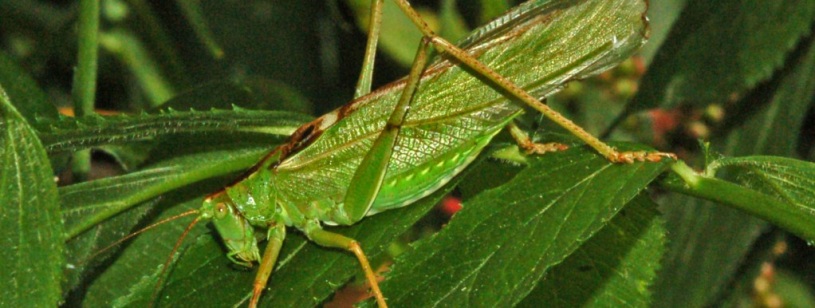
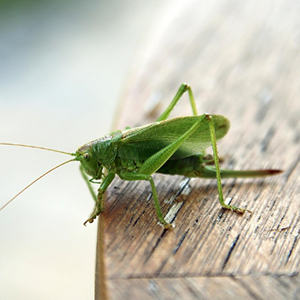
A male Tettigonia viridissima, representing the family Tettigoniidae. · Hectonichus / CC BY-SA 3.0 (https://creativecommons.org/licenses/by-sa/3.0). Cropped and resized.
Katydids, also called bush-crickets, are long-antennaed insects in the family Tettigoniidae, related to crickets. Many are green and blend into leaves. Tettigonia viridissima, pictured here, is a large European example known for the male’s loud song and powerful jumping legs.
Quick facts
| Common name | Katydid; bush-cricket |
| Scientific group | Family Tettigoniidae; photograph shows Tettigonia viridissima |
| Diet | Plants and/or small animals, depending on species |
| Main predators | Birds and other insect-eating animals; varies by species |
| Conservation status | Varies by species; T. viridissima is widespread in Europe |
| Distribution | Many regions worldwide, including Romania |
| Habitat | Grass, shrubs, woodland edges and gardens |
| Length | Adult T. viridissima body: approximately 2.7–3.8 cm, excluding ovipositor |
| Class | Insecta |
| Order | Orthoptera |
| Family | Tettigoniidae |
| Reproduction | Eggs, nymphs and adults; no pupal stage |
- Primary category:Insects
- Explore this animal's categories:
Interesting facts
- Antennae are usually longer than the body.
- Males of many species sing by rubbing their forewings.
- Hearing organs are located on the front legs.
- A female’s sword-like projection is an egg-laying organ.
Characteristics
A katydid has six legs, two antennae and a body divided into head, thorax and abdomen. Enlarged hind thighs power jumping.
Tettigonia viridissima is usually green with brown along the upper surface. Long wings extend beyond the abdomen, while the body measures approximately 2.7–3.8 cm without the female’s ovipositor. Other family members are smaller or have short wings; including wings and antennae gives a very different impression of size.
Behaviour
Males produce songs by rubbing structures on the forewings. Sounds help locate mates and may have a species-specific rhythm.
Vibration-sensitive hearing organs are on the front legs rather than forming obvious mammal-like ears. Katydids hide, jump and, in suitably winged species, fly. A motionless green individual may remain hard to see even when its song is clearly audible.
Habitat and distribution
Tettigoniidae occur across many world regions, living in grass, shrubs or trees according to species. Tettigonia viridissima extends from western Europe towards Central Asia.
Woodland edges, tall grass, rough vegetation and gardens can provide habitat. Garden patches with standing plants offer feeding and hiding places that closely trimmed lawns do not provide in the same way.
Diet and feeding
Diets vary: some species mainly consume plants, others hunt insects, and many combine different foods. Tettigonia viridissima eats small arthropods as well as plant material.
Its mandibles can process prey, so a green leaf-like appearance does not mean a strictly herbivorous diet. Katydids themselves feed birds and other insect-eating animals, linking plants, prey and predators within the community.
Reproduction and life cycle
Females of many species have a long ovipositor for placing eggs in a suitable location. It is not a sting used against people.
Egg-laying sites may be soil or plant material. Tettigonia viridissima lays in soil, where egg development can span several seasons. Hatchlings are nymphs resembling small adults without fully developed wings. Successive moults lead to adulthood, with no pupal stage such as that of butterflies.
Name and history
Katydids belong to Orthoptera alongside crickets and grasshoppers. Their very long antennae help distinguish them from many short-horned grasshoppers.
The names katydid and bush-cricket vary regionally, while Tettigoniidae identifies the family. Species identification uses wing form, the ovipositor, other body details and sometimes song; being green is not enough.
Conservation and threats
Conservation needs vary widely across the family. A common adaptable species does not represent relatives restricted to a particular habitat.
Frequent cutting can remove shelter, and changing land use alters suitable vegetation. Retaining grassy and shrubby margins helps connect habitat patches. Katydids contribute both to food webs and to the familiar sounds of warm seasons.
Frequently asked questions
Is a katydid the same as a grasshopper?
They are related, but katydids usually have very long antennae unlike many grasshoppers.
How does it sing?
Males of many species rub specialised structures on their forewings.
Where are its ears?
Hearing organs are located on the front legs.
Does the female have a venomous sting?
The long projection at the abdomen tip is an ovipositor used for laying eggs.