OkapiInteresting facts and information
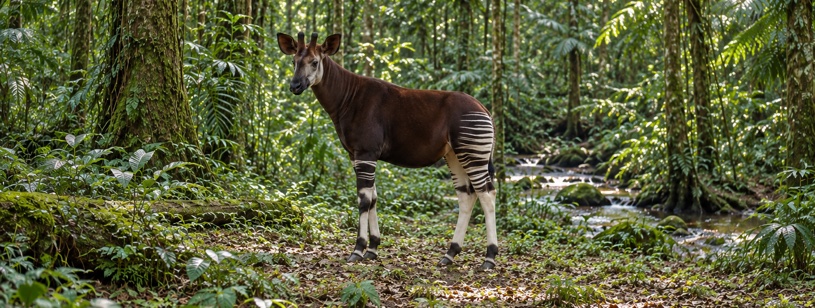
AI illustration of an okapi in a forest setting.
The okapi (Okapia johnstoni) is a plant-eating mammal of the Democratic Republic of the Congo’s tropical forests. Although its striped legs and hindquarters resemble a zebra’s, it is related to giraffes. A brown coat, large ears and a long tongue suit life in dense vegetation.
Sometimes called the “forest giraffe”, it is usually solitary, feeds mainly on leaves and is difficult to observe in the wild. The IUCN Red List classifies the species as Endangered because of pressures on the animals and their habitat.
Quick facts
| Common names | Okapi; forest giraffe |
| Scientific name | Okapia johnstoni |
| Class / order / family | Mammalia / Artiodactyla / Giraffidae |
| Close relative | Giraffe |
| Shoulder height | Approximately 1.4–1.6 metres |
| Weight | Approximately 180–350 kg; females are generally larger |
| Body length | Around 2.5 metres |
| Diet | Herbivorous: mainly leaves, buds and shoots |
| Habitat | Dense tropical forests in Central Africa |
| Present natural range | Democratic Republic of the Congo |
| Behaviour | Generally solitary; may be active by day and night |
| Pregnancy / offspring | Approximately 14–16 months; usually one calf |
| Conservation status | Endangered (EN), IUCN |
- Primary category:Mammals
- Explore this animal's categories:
Curiosities and fascinating facts
- It is not a giraffe–zebra hybrid. The okapi is a distinct species in the giraffe family. Its stripes do not make it a close relative of zebras.
- A long, flexible tongue: the dark tongue can reach around 30 centimetres in length and is used to grasp leaves and groom parts of the face.
- Stripe patterns vary between individuals. These differences can help researchers recognise animals in photographs.
- It leaves scent messages. Glands on the feet deposit scent along forest trails.
- A calf does not follow its mother all the time. During its early weeks it spends much of its time hidden, with the mother returning to nurse it.
- Protecting an okapi's habitat benefits a whole forest. Other species depend on the same environment.
Records and remarkable features
The okapi stands out for its unusual combination of features and the long development of its calf before birth.
- A forest-adapted relative of the giraffe: both belong to Giraffidae, although their appearance and habitats differ greatly.
- A pregnancy lasting more than a year: calves develop for about 14–16 months. This is not the longest pregnancy among mammals.
- An especially flexible tongue: it can grasp vegetation rather than simply push food into the mouth.
Physical characteristics
The okapi has a sturdy body, a shorter neck than a giraffe and a velvety reddish-brown coat. Contrasting pale and dark stripes cover its hindquarters and parts of its legs. The face has lighter patches and a dark muzzle.
| Feature | Role or characteristic |
|---|---|
| Large, mobile ears | Help detect sounds through dense vegetation. |
| Long tongue and mobile lips | Allow the animal to select and grasp leaves. |
| Dense coat with an oily surface | Helps water run off the body. |
| Contrasting stripes | Help break up the outline in patchy forest light. |
| Ossicones in males | Skin-covered bony projections, similar to those of giraffes. |
Females are generally larger than males. Adult males normally have two short ossicones; females usually lack developed ones. These are permanent structures, unlike the branched antlers that deer shed.
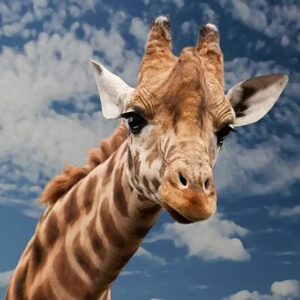
For comparison, the giraffe has much longer legs and a longer neck, while zebras belong to the horse family. External appearance alone does not always reveal how closely two animals are related.
Habits and behaviour
Okapis are usually solitary. A female with a calf is an important exception. They do not form the large herds associated with some grassland herbivores.
They can be active during both day and night. Feeding often peaks in the middle of the morning and later in the afternoon, although the pattern varies. They travel along forest trails and use scent to detect whether other individuals have passed through an area.
They are discreet, but not completely silent. Researchers have recorded several kinds of calls, including components too low in frequency for people to hear. Some have been studied in connection with communication between a mother and her calf.
Hearing helps them detect danger. Natural predators include the leopard. Retreating into vegetation and avoiding encounters are important ways of staying safe.
Habitat and geographical distribution
Wild okapis now occur only in the Democratic Republic of the Congo. They are endemic to that country: their present natural range is restricted to it. The Democratic Republic of the Congo is a different country from the neighbouring Republic of the Congo.
The Ituri Forest is an important region, although okapis also occur in other forests within their range. They favour dense vegetation and tall forest, which provide shelter and food. They are not animals of the open savanna.
Small openings left by fallen trees can provide feeding places where young plants grow. These natural gaps are different from large cleared areas that interrupt the continuity of the forest.
The Okapi Wildlife Reserve protects an important part of the Ituri Forest and has been a UNESCO World Heritage Site since 1996. Many other species live there, and the forest is also vital to local communities.
Diet and feeding
The okapi is a herbivore that mainly selects leaves and shoots. Its diet includes many plant species, but it does not eat everything it encounters in the forest.
- Leaves and buds: an important part of its food.
- Shoots and young growth: selected with the flexible tongue and lips.
- Other foods: fruit, ferns and sometimes fungi.
The tongue is prehensile, meaning that it can grasp objects. It draws vegetation into the mouth, while the narrow muzzle helps the animal select particular plant parts. This is browsing, rather than continuous grazing on a grassy plain.
Okapis are ruminants: they bring swallowed food back into the mouth to chew it again. A stomach with several compartments helps them digest fibrous material. They have also been observed eating clay, which may provide minerals.
Reproduction and life cycle
After a pregnancy of approximately 14–16 months, a female usually gives birth to one calf. A newborn may weigh around 14–30 kilograms. It stands soon after birth, but remains dependent on its mother.
| Stage | Development |
|---|---|
| Early weeks | The calf spends much of its time hidden; its mother returns to nurse it. |
| Around the third week | It begins trying solid food. |
| Early months | It grows rapidly and gradually learns to use its surroundings. |
| Around 3 years | It reaches adult size. |
The calf has its distinctive stripes from birth. It may also have a short mane along the back, more noticeable than in an adult. A concealed resting place helps it avoid predators while its mother searches for food.
San Diego Zoo Wildlife Alliance's fact sheet reports a median lifespan of around 17 years in managed populations. This is a population measure, not an exact lifespan for every wild okapi, whose life is much harder to follow.
Name and history
The scientific name is Okapia johnstoni, with the species name honouring Harry Johnston. The animal entered Western zoological literature in 1901, after information and specimens reached researchers.
Local communities had known the animal for generations. Calling it “discovered in 1901” refers to its recognition in Western zoology, rather than the first time a person encountered an okapi.
The name “forest giraffe” neatly describes its relationship and habitat. An okapi is not a young giraffe or a short-necked variety of one: it is a distinct species.
Cultural significance and mythology
The okapi is a symbol of the Democratic Republic of the Congo's natural heritage. It appears on currency and emblems associated with wildlife protection, representing part of the country's distinctive forest biodiversity.
The Ituri Forest is also home to Mbuti and Efe communities. Protecting the region needs to take account of local needs and relationships with the forest. Conservation of natural heritage therefore connects with the region's cultural heritage.
Conservation status and threats
The IUCN Red List classifies the okapi as Endangered (EN), a higher risk category than Vulnerable. Living in dense, difficult-to-reach forest does not shelter it from human pressures.
- Deforestation and habitat degradation reduce and fragment the forest.
- Hunting and snares kill animals, including for meat and skins.
- Illegal mining adds pressure within protected landscapes.
- Armed conflict and insecurity obstruct patrols, research and the protection of local communities.
The exact wild population is not known. Such a secretive animal cannot be counted by simple direct observation. Researchers use signs, camera traps and other methods to understand its distribution and population trends.
Protection includes anti-poaching patrols, habitat conservation and cooperation with local residents. The Okapi Conservation Project supports the species and its forest. Coordinated zoo programmes complement this work, but cannot replace protection in the wild.
In popular culture
World Okapi Day is marked on 18 October. Campaigns use the animal's distinctive appearance to explain why Congolese forests need protection.
Okapis also appear in educational material, photographs and zoo presentations. They illustrate a simple lesson: two animals can have similar stripes without being close relatives. Classification, diet and habitat help us understand the differences.
Frequently asked questions
- Is the okapi related to the zebra? It is not a close relative. Okapis belong to Giraffidae and are related to giraffes.
- Where do okapis live? In the wild, they inhabit tropical forests in the Democratic Republic of the Congo, in Central Africa.
- What do okapis eat? Mainly leaves, buds and shoots, as well as other foods such as fruit and ferns.
- Why do okapis have stripes? The pattern helps with forest camouflage. It may also help a calf follow its mother, but that proposed function is not a certainty in every situation.
- Do okapis have horns? Males normally have two short ossicones, which are skin-covered bony structures. Females usually lack developed ossicones.
- How long is an okapi pregnancy? About 14–16 months. A female usually has one calf.
- Are okapis endangered? Yes. Their Red List category is Endangered (EN), with habitat loss, hunting and insecurity among the main threats.
- Do okapis live in herds? Usually not. They are mainly solitary, apart from some encounters and mothers with calves.
Did you know? About okapi
- Okapis and giraffes are related, although they live in very different habitats.
- The velvety coat helps water run off the body.
- Scent marks are important to an animal living a solitary forest life.
- An okapi’s pregnancy lasts longer than a year.