AardvarkAn African ant and termite specialist
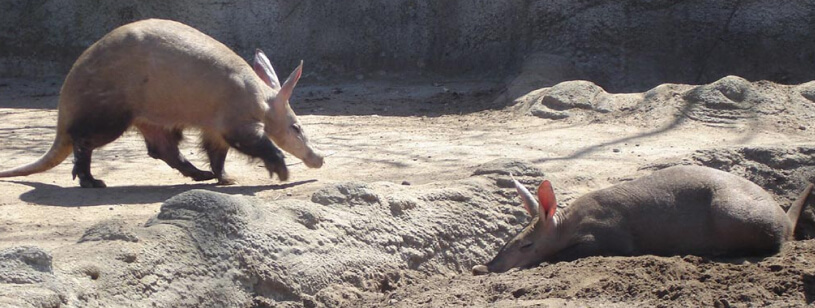
Aardvarks have long snouts, large ears and powerful digging limbs.
The aardvark (Orycteropus afer) is a mainly nocturnal mammal from sub-Saharan Africa. Its powerful claws open the nests of ants and termites, and its sticky tongue collects the insects inside.
Despite its pig-like snout, it belongs to a different mammal lineage. Aardvarks dig burrows for shelter, and other animals often use those spaces after they have been abandoned.
Quick facts
| Common name | Aardvark; ant bear |
| Scientific name | Orycteropus afer |
| Lifespan | Can exceed 20 years in human care; wild estimates vary |
| Movement | Walks and forages on the ground; digs with powerful limbs |
| Height | About 60 cm at the shoulder |
| Length | Head and body roughly 1–1.5 m, plus the tail |
| Weight | Commonly about 40–80 kg; individuals vary |
| Diet | Mainly ants and termites |
| Predators | Lions, leopards, hyenas and large pythons |
| Global conservation status | Least Concern (LC), IUCN |
- Primary category:Mammals
- Explore this animal's categories:
Interesting facts
- Its teeth are unusual. Instead of a thick enamel covering, adult aardvark teeth contain bundles of tiny dentine tubes. Dentine is the hard material that also lies beneath the enamel of human teeth.
- It can close its nostrils. This helps keep loose soil and insects out of its nose while it opens ant nests and termite mounds.
- Smell guides the search for food. Aardvarks investigate the ground with their long snouts. Their large ears also help them notice approaching danger.
- One animal's shelter can become another's home. Abandoned aardvark burrows shelter other mammals, reptiles and birds. This makes digging important beyond the aardvark's own survival.
- An aardvark is not an anteater. Both eat ants and termites, but the American anteaters belong to a different group of mammals. Similar feeding problems have produced some similar adaptations.
- Arthur is a fictional aardvark. The character from Marc Brown's books and the PBS series has a human-like life and appearance. Real aardvarks are solitary wild mammals.
Records and remarkable features
- A specialised tongue: the sticky tongue can extend about 30 cm, reaching insects inside narrow passages.
- Powerful excavation: strong limbs and curved claws break into insect nests and move soil out of burrows. How quickly an animal digs depends on the soil and the task.
- An evolutionary survivor: Orycteropus afer is the only living species in the order Tubulidentata. Other members of this lineage are known from fossils.
- Shelter that changes the landscape: digging creates underground spaces that other animals can use. Ecologists call animals that alter habitats in this way ecosystem engineers.
Characteristics
The aardvark has a rounded back, a long snout, large upright ears and a thick tail. Its greyish or brownish skin has relatively little hair and can take on the colour of the soil where it digs.
Physical appearance
- Size: head-and-body length is roughly 1–1.5 m; the tail adds further length. Adults commonly weigh about 40–80 kg. Measurements differ between individuals.
- Legs and feet: short, muscular limbs and strong claws are suited to digging rather than climbing.
- Ears: the long ears can move to detect sounds and can fold back during burrowing.
- Tail: broad at the base and tapering towards the tip, it is a conspicuous part of the animal's outline.
Adaptations for feeding and shelter
Thick skin helps protect the aardvark from insect bites. Its sticky tongue collects small prey, while closable nostrils protect the nose. The specialised cheek teeth lack enamel and continue growing as they wear.
Underground shelters also provide a different environment from the exposed ground. Burrows and changes in activity help aardvarks cope with daily temperature changes, although severe food shortages can still threaten them.
Habits and behaviour
Aardvarks are usually solitary and mainly active at night. A female may be accompanied by her young. Daytime activity also occurs, so seeing an aardvark by day does not by itself mean that it is ill.
Searching for food
- At night, an aardvark follows scent cues and investigates insect nests across its feeding area.
- It opens a nest with its claws and repeatedly extends its tongue to collect ants or termites.
- It moves between feeding places rather than relying on a single nest. Travelling distance varies with food availability.
Communication and defence
Scent is important in communication. Aardvarks are often quiet, but they can make grunts and other sounds. When threatened, they may retreat towards a burrow, dig or defend themselves with their claws.
Digging and shelter
An aardvark uses burrows for rest and protection. Some are temporary shelters; others are larger systems used for longer periods. Hard rock or waterlogged ground can make excavation difficult.
Warthogs, porcupines and other animals can use burrows after the aardvark has left. The mix of visitors depends on the habitat and region.
Habitat and geographic distribution
Aardvarks live in sub-Saharan Africa wherever suitable insect food and soils allow them to feed and dig. They occupy savannas, woodland, scrub and some forest habitats.
Habitats and limiting conditions
- Savannas and grassland mosaics: ants, termites and diggable ground provide food and shelter.
- Woodlands and scrub: aardvarks forage among vegetation as well as in open country.
- Forest habitats: suitable areas can support aardvarks, but permanently waterlogged ground is difficult to burrow in.
- Rocky or very dry ground: access to food and the ability to excavate can limit where they live.
Examples of occurrence
| Part of the range | Examples |
|---|---|
| Southern Africa | South Africa, Botswana and Zimbabwe |
| South-western Africa | Parts of Namibia and Angola with suitable habitat |
| East Africa | Kenya and Tanzania |
| Central Africa | Parts of the Democratic Republic of the Congo and neighbouring countries |
| West Africa | Suitable savanna and woodland areas within the species' range |
Occurrence in a country does not mean that aardvarks occupy every habitat there. Local populations can be difficult to study because the animals spend much of their time underground or active after dark.
Diet
Aardvarks specialise in eating ants and termites. They are often called myrmecophagous mammals: the term means that ants and similar insect prey dominate their feeding.
Foods and their roles
| Food | Role in the diet |
|---|---|
| Ants | A major food source; the species eaten depend on the area |
| Termites | A major food source, collected from nests and feeding areas |
| Other insects | Occasional foods recorded in dietary accounts |
| Aardvark cucumber (Cucumis humifructus) | Underground fruits are eaten in parts of the range; seeds have been recovered from aardvark dung |
How feeding works
The nose locates food, the claws open a route into the nest, and the tongue collects the insects. These tools work together: a long tongue alone would be of little use without access to the nest.
Food also supplies moisture. The relative contribution of ants, termites and occasional foods changes with local conditions; the diet cannot be described by one fixed percentage for every aardvark.
Reproduction and life cycle
A female normally gives birth to one young after a pregnancy of about seven months. She raises it in the shelter of a burrow.
Mating and birth
Breeding timing varies across the range. Adults come together for mating, but aardvarks do not normally live in permanent family groups. The young is born with pinkish skin and little hair.
Growing up
- Early weeks: the young remains sheltered and depends on its mother's milk.
- Exploration: as it develops, it accompanies its mother and begins feeding on insects.
- Independence: published accounts place independence at around six months, although development varies.
Lifespan
Aardvarks can live for more than 20 years in human care. Wild lifespan is harder to establish and published estimates differ. A managed-care longevity record should not be treated as the average age of a wild animal.
Name and history
Where the names come from
Aardvark is an Afrikaans word meaning “earth pig”. The name describes the snout and digging habits rather than a close relationship with pigs. The genus name Orycteropus refers to a digging foot; afer refers to Africa.
Scientific classification
Peter Simon Pallas described the species in 1766. It belongs to the family Orycteropodidae and the order Tubulidentata. Anteaters and armadillos belong to other mammal lineages.
Names in other languages
| Language | Name |
|---|---|
| English | Aardvark; ant bear |
| Afrikaans | Aardvark |
| French | Oryctérope du Cap |
| German | Erdferkel |
| Scientific name | Orycteropus afer |
Conservation status and threats
Global conservation status
The aardvark is listed as Least Concern (LC) by the IUCN. This is a global assessment, not a claim that every local population is secure or that the total number of aardvarks is known.
Main pressures
- Habitat change: farming and development can remove or alter feeding and burrowing areas.
- Hunting: aardvarks are hunted for meat and other uses in parts of their range.
- Drought and food shortages: research in the Kalahari has documented poor condition and deaths when insect food became scarce during severe drought.
- Conflict around burrows: digging can be unwelcome on farmland, creating another source of pressure.
Why protection matters
Conserving suitable habitat protects both aardvarks and the animals that use their burrows. Field monitoring helps identify local pressures, while research on food supply and drought shows why apparently hardy animals can still be vulnerable to environmental change.
In popular culture
Arthur and children's television
Arthur Read is the aardvark at the centre of Marc Brown's Arthur books and the PBS animated series. His glasses, clothes and upright posture belong to a fictional character, not to the anatomy or behaviour of the real animal.
Children's literature
Jill Tomlinson's The Aardvark Who Wasn't Sure also features a young aardvark. Such stories can introduce an unfamiliar animal while giving it thoughts and adventures created for human readers.
Did you know?
- The aardvark’s long snout resembles a pig’s, but the two belong to different mammal orders.
- A female normally produces one young after a pregnancy of about seven months.
- Large ears help an aardvark detect sounds, while its nose guides the search for insect food.
- Aardvarks are mainly nocturnal, but they can also be active during daylight.
- Aardvark burrows can provide shelter for other animals after the original occupant has left.
- Ants and termites are the main foods. The aardvark cucumber is another recorded food in parts of the range.
- The sticky tongue can extend about 30 cm into narrow insect passages.
- The name aardvark comes from Afrikaans and means “earth pig”.
- An aardvark can close its nostrils to help keep soil and insects out during feeding.