DonkeyInteresting facts and information
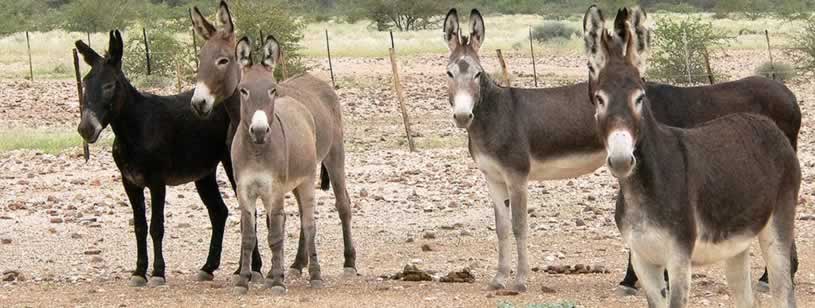
The domestic donkey (Equus africanus asinus) descends from African wild asses. People keep donkeys for work and companionship in many regions. Domestic donkeys and threatened wild asses have different conservation situations.
Although it is often underestimated compared with the horse, the donkey is intelligent, adaptable and able to survive in harsh conditions. Today donkeys are kept for work, milk and meat, and also as companions and in animal-assisted therapy.
Quick facts
| Common name | Donkey |
| Scientific name | Equus africanus asinus |
| Typical lifespan | 25 - 40 years |
| Maximum speed | About 25-30 km/h over short distances |
| Dimensions | About 90 - 160 cm at the withers |
| Weight | About 80 - 480 kg, depending on breed |
| Diet type | Herbivore (grass, leaves, hay, bark) |
| Main predators | Wolves, jackals, hyenas and big cats (for free-living donkeys) |
| Conservation status | Domestic animal; the wild ancestor, the African wild ass, is Critically Endangered |
| Distribution | Worldwide, especially in dry and semi-dry regions |
| Habitat | Deserts, dry grasslands, mountains, farmland |
- Primary category:Mammals
- Explore this animal's categories:
Overview
- Donkeys have an excellent memory - They can recognise people, other donkeys and places they have not seen for many years.
- They are tougher than horses - Donkeys can manage on less food and water and are well adapted to dry climates.
- They are cautious, not stubborn - When a donkey refuses to move, it is usually because it is weighing up a possible danger before acting.
- They are very loud - A donkey's bray can be heard several kilometres away.
- They have a very efficient digestive system - Donkeys get nutrients from poor-quality food, which lets them survive in dry and mountainous areas.
Records and remarkable features
- The domestic donkey (Equus africanus asinus) descends from African wild asses. People keep donkeys for work and companionship in many regions. Domestic donkeys and threatened wild asses have different conservation situations.
Characteristics
Donkeys are sturdy plant-eating mammals well adapted to rough ground and dry climates. Compared with horses, they are usually smaller, tougher and more cautious, with an efficient metabolism and remarkable intelligence.
Main physical features:
| Feature | Details |
|---|---|
| Size | About 90 - 160 cm at the withers |
| Weight | About 80 - 480 kg, depending on breed |
| Colour | Grey, brown, beige, black, white or spotted |
| Ears | Long and mobile; help with hearing and losing heat |
| Tail | Like a cow's, with a tuft of long hair at the end |
| Hooves | Small, upright and very tough |
| Teeth | About 36-44 teeth, adapted for chewing dry plants |
| Eyesight | A wide field of view |
| Hearing | Very sensitive; can pick up sounds from far away |
Special adaptations:
- Large ears - Help them lose heat in hot climates and hear danger, and other donkeys, from far away.
- An efficient digestive system - Extracts nutrients and water from poor food, so donkeys survive in harsh conditions.
- Great strength - A healthy donkey can carry a load of roughly 20-30% of its body weight; heavier loads harm its welfare.
- Defensive kicks - When a donkey feels threatened, it can kick with great force.
Habits and behaviour
Donkeys are intelligent, curious and very cautious animals. Unlike horses, which tend to run at the first sign of danger, donkeys often stop and assess the situation first, which has given them their reputation for being "stubborn".
Social behaviour:
- Living alone or in small groups - In the wild, donkeys often live alone, in pairs or in small groups.
- Strong bonds - Donkeys form close friendships, and if a donkey loses its companion, it may become depressed and stop eating.
- Loud calls - Their brays carry a long way, which helps them stay in contact across large areas.
- Guarding livestock - On many farms, donkeys are used to protect sheep and goats from foxes and dogs, because they react strongly to intruders.
Feeding and survival:
- Opportunistic herbivores - Donkeys eat grass, hay, leaves, bark and even dry, tough plants.
- Coping without water - Donkeys can go longer without water than horses, getting some moisture from plants, and can drink a lot quickly when they reach water.
- Coping with heat - Their bodies are well adapted to hot, dry conditions.
Defence and survival strategies:
- Powerful kicks - Donkeys can defend themselves against predators such as wolves and wild dogs.
- Natural caution - They avoid places that look dangerous and remember safe routes very well.
- Close relationships - Donkeys can become very attached to people or to other donkeys.
Habitat and geographic distribution
Donkeys are very adaptable and are found all over the world, mostly as domestic animals, with some feral populations.
Habitat types:
| Habitat | Main regions |
|---|---|
| Deserts | Sahara, Middle East, Australia |
| Grasslands and savannas | Africa, Asia, South America |
| Mountains | Himalayan foothills, Andes, Atlas Mountains |
| Dry regions | South-western USA, Spain, Middle East |
Geographic distribution:
- North-east Africa - The home of the African wild ass, the donkey's wild ancestor.
- Asia - Donkeys are widely used for transport and work, including in mountain areas.
- Europe and the Americas - Domestic donkeys are kept on farms, for tourism and as companions.
- Australia and the USA - Feral donkeys, called burros in the USA, live in dry areas and are considered invasive in Australia.
Impact of human activities on donkeys:
- Habitat loss - The African wild ass has declined sharply because of hunting, competition with livestock and habitat loss.
- The donkey skin trade - In some regions, many donkeys are killed for their skins, which are used to make a gelatine (ejiao) for traditional Chinese medicine.
- Abandonment - In many countries, donkeys are abandoned when they are no longer needed for work.
Donkeys are incredibly resilient animals, but some populations urgently need protection.
Diet and feeding
Donkeys are herbivores adapted to eating food that is low in nutrients, thanks to an extremely efficient digestive system. They can live in dry environments because they get the most out of the plants they eat.
Types of food:
| Food group | Examples |
|---|---|
| Grass, hay and straw | The main food for both domestic and feral donkeys |
| Leaves and bark | Extra food in dry areas |
| Drought-resistant plants | Shrubs, dry grasses, even some cacti |
| Grain and bran | Occasional supplements on farms |
| Salt and minerals | Donkeys seek out salt to make up for missing minerals |
Feeding methods:
- Slow, thorough chewing - Donkeys chew their food carefully and digest dry, fibrous plants very efficiently.
- Eating tough plants - They can digest coarse, fibrous vegetation, which helps them survive in dry areas.
- Drinking - Donkeys can drink a large amount of water quickly when they find it, which helps them in deserts. Related profile: Desert animals.
Thanks to their adaptable diet, donkeys can live in places where many other herbivores could not survive.
Reproduction and life cycle
Donkeys breed slowly. Females usually give birth to a single foal, and their pregnancy is longer than a horse's.
Life cycle stages:
| Stage | Approximate timing | What happens |
|---|---|---|
| Mating | Seasonal or all year round | Males (jacks) compete for females (jennies) |
| Pregnancy | About 11 - 14 months | The female usually gives birth to a single foal |
| Birth | Foals can walk within hours of birth | |
| Maternal care | About 6 - 9 months | Mothers are very protective of their foals |
| Maturity | About 2 - 3 years | Depends on sex and living conditions |
| Lifespan | 25 - 40 years | Some domestic donkeys live to more than 50 |
Reproductive behaviour:
- Protective mothers - Jennies defend their foals from predators and other dangers.
- Strong family ties - Donkeys can form lasting bonds with their foals and other group members.
- Controlled breeding - On many farms, donkey breeding is managed to prevent too many births or unwanted crosses.
Thanks to its long life and tough nature, the donkey is a valuable animal, although it breeds more slowly than many other domestic herbivores.
Name and history
The donkey is one of the oldest domestic animals: people have used donkeys for more than 5,000 years. Descended from the African wild ass, it has spread to every continent because of its vital role in farming and transport.
Origin of the name:
- "Donkey" - The English word appeared in the 18th century and its origin is uncertain. The older English word "ass" comes from the Latin asinus.
- The scientific name Equus africanus asinus refers to its wild African ancestor, Equus africanus.
- Names in other languages - âne in French and burro or asno in Spanish.
Taxonomic classification:
| Taxonomic rank | Name |
|---|---|
| Kingdom | Animalia |
| Phylum | Chordata |
| Class | Mammalia |
| Order | Perissodactyla |
| Family | Equidae |
| Genus | Equus |
| Species | Equus africanus asinus |
The donkey in history and culture:
- Ancient Egypt - Donkeys were used for transport and work and appear in Egyptian art.
- The Roman Empire - Donkeys were used on farms and to carry goods over long distances.
- The Middle Ages - Donkeys were essential on European farms because they were cheaper to keep than horses.
- Folk culture - In many regions, donkeys are symbols of hard work, humility and perseverance.
The donkey is one of the oldest and most versatile domestic animals and has had a profound impact on human civilisation.
Cultural significance and mythology
Donkeys appear in myths, religions and traditions around the world, where they are linked with work, patience, humility and endurance. Throughout history, they have been both respected and mocked, and they play an important role in folklore and symbolism.
The donkey in mythology and religion:
- The Bible and Christianity - The donkey appears many times in the Bible as a symbol of humility; Jesus rode into Jerusalem on a donkey, a sign of peace and humility.
- Greek mythology - Donkeys were linked with the god Dionysus and his companion Silenus, who rode a donkey.
- European folklore - In many medieval stories, the donkey is a loyal but underestimated animal that stands for the humble worker.
- Asia - In China and India, donkeys are valued as patient, hard-working animals, important in farming and transport.
What the donkey symbolises:
- Humility and patience - The donkey is linked with ordinary working people and is a symbol of perseverance.
- Stubborn or wise? - In many cultures, the donkey is seen either as stubborn or as careful and clever.
- Protection and loyalty - In some cultures, donkeys are seen as guardians of herds and homes.
Conservation status and threats
Domestic donkeys are widespread and not at risk, but wild asses are seriously threatened, and some traditional donkey breeds are declining because farming has become mechanised.
Conservation status
| Species or breed | Status |
|---|---|
| African wild ass (Equus africanus) | Critically Endangered (IUCN) |
| Asiatic wild ass (Equus hemionus) | Near Threatened (IUCN) |
| Traditional domestic donkey breeds | Many are declining as donkeys are used less in farming |
Main threats:
- Habitat loss - Wild asses are affected by farming, settlements and competition with livestock.
- The skin trade - In some countries, large numbers of donkeys are killed for their skins, used in traditional Chinese medicine.
- Less use for work - In many regions, donkeys are abandoned as farming becomes mechanised.
- Competition for food - Wild and feral donkeys compete with livestock and wildlife for grazing and water.
Conservation efforts:
- Protecting wild asses - Reserves in Africa and Asia try to save the remaining wild populations.
- Donkey sanctuaries - In many countries, animal welfare organisations care for abandoned and mistreated donkeys.
- Campaigns against the skin trade - Several countries have banned the export of donkey skins to protect their donkey populations.
Domestic donkeys are still very numerous, but wild asses need urgent conservation measures.
In popular culture
Donkeys in literature:
- Don Quixote (Miguel de Cervantes, 1605) - Sancho Panza travels on a donkey, often called Dapple in English translations, a symbol of the simple, practical man.
- One Thousand and One Nights - Donkeys appear in many of the tales.
- European fairy tales - Donkeys are often foolish or magical characters, and some can even talk.
Donkeys in film and television:
- Shrek (2001-2010) - Donkey, Shrek's loyal and funny friend, is one of the best-known donkeys in popular culture.
- Winnie-the-Pooh - Eeyore, the gloomy old grey donkey, is one of the best-loved characters.
- Pinocchio (Disney, 1940) - Naughty boys on Pleasure Island are turned into donkeys as a punishment.
Donkeys in video games:
- Minecraft - Donkeys can be ridden and used to carry items.
Donkeys as cultural symbols:
- A symbol of hard work - In many cultures, donkeys stand for work and perseverance.
- A symbol in politics - In the United States, the donkey is the symbol of the Democratic Party.
Did you know? About donkey
- Donkeys originally come from the dry regions of north-east Africa and are well built to survive in harsh conditions.
- A donkey will not do something if it thinks it is unsafe.
- Donkeys dislike rain. Their coat is not very waterproof, and if they stay out in the rain for a long time, their health can suffer.
- Donkeys love to roll on the ground; it helps them groom and relax.
- Donkeys and horses can interbreed. The offspring of a female horse and a male donkey is called a mule, and the offspring of a male horse and a female donkey is called a hinny.
- Ethiopia has the largest number of donkeys in the world.
- Since 2005, donkeys in the UK must have a passport, like horses.
- Donkeys can be used to protect livestock from foxes, coyotes and dogs. Related profile: Wolf.
- Donkey milk is closer in composition to human milk than cow's milk is.
- A cross between a zebra and a donkey is called a zonkey or zedonk.
- In the Bible, Balaam's donkey speaks to its master.
- During the First World War, at Gallipoli, the young stretcher-bearer John Simpson Kirkpatrick used donkeys to carry wounded soldiers to safety. One of them, Murphy, was posthumously awarded the RSPCA Australia Purple Cross in 1997, and the pair are remembered with a statue at the Australian War Memorial.
- Feral donkeys, called burros, live in dry parts of the south-western United States and Mexico.
- In many developing countries, donkeys are essential for transporting people, water and goods.
- There are more than 50 million donkeys in the world; Ethiopia, Pakistan, China, Egypt and Mexico are among the countries with the most.
- Donkeys are very intelligent. They have an excellent memory and remember routes very well.
- Thanks to their large ears, donkeys have excellent hearing, and their brays can carry for several kilometres.
- Unlike horses, donkeys are not easily frightened; they tend to stop and investigate instead of running away.
- Donkeys usually live in small groups and form strong friendships with particular companions. Related profile: Monkey.
- In ancient Egypt, donkeys were the main pack animals and carried goods along long trade routes.