FlamingoInteresting facts and information
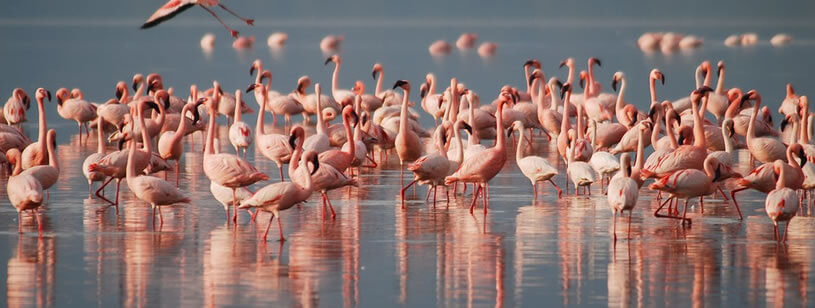
Flamingos are long-legged waterbirds in the family Phoenicopteridae. Their pink or reddish plumage comes from pigments obtained through their food. Different species feed in shallow lakes, lagoons and other wetlands.
Carotenoid pigments in food contribute to the pink or reddish plumage. Flamingos are social birds that can gather in large colonies.
Different flamingo species have different feeding habits and conservation needs. Pollution, disturbance and changes to wetlands can affect their populations.
Quick facts
| Common name | Flamingo |
| Scientific name | Phoenicopteridae |
| Typical lifespan | Often 20-30 years or more in the wild; over 50 years in captivity |
| Maximum speed | Flies at about 50-60 km/h |
| Height | About 80-150 cm |
| Weight | About 1.5-4 kg |
| Diet type | Filter feeder (algae, small crustaceans, insect larvae, molluscs) |
| Main predators | Eagles, jackals, hyenas, marabou storks; gulls take eggs and chicks |
| Conservation status | Varies by species: from Least Concern to Vulnerable (IUCN) |
| Distribution | Africa, southern Europe, South and West Asia, South America, the Caribbean |
| Habitat | Salt lagoons, alkaline lakes, estuaries, coastal marshes |
Interesting facts
- Flamingos can fly hundreds of kilometres in one night - Thanks to their long wings and light bodies, they are strong fliers and can cross deserts and seas to reach new lakes.
- Their pink colour comes from their food - Flamingos get their colour from carotenoid pigments in the algae and small crustaceans they eat. The chicks are grey and turn pink over 2-3 years.
- They stand on one leg - This posture may help them save body heat and needs very little muscle effort.
- Huge gatherings - On the lakes of East Africa, more than a million lesser flamingos can gather at the same time.
- Flamingos make "crop milk" - Both parents feed their chick a red, nutritious liquid made in their throat, rich in fat and protein.
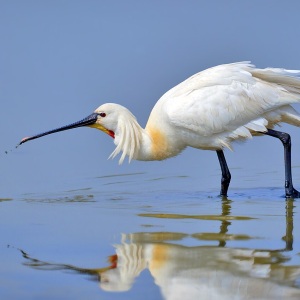
- Their bill is a natural sieve - Flamingos feed with their head upside down, filtering algae and tiny animals out of the water.
- Faithful partners - Flamingo pairs often stay together for several breeding seasons.
- They are noisy birds - Flocks keep in touch with loud honking and grunting calls, a little like geese.
- One egg at a time - The female usually lays a single egg each year, which both parents incubate for about a month.
- They live where few other animals can - Flamingos thrive on very salty and alkaline lakes, where few other large animals can survive.
Records and remarkable features
- Flamingos are long-legged waterbirds in the family Phoenicopteridae. Their pink or reddish plumage comes from pigments obtained through their food. Different species feed in shallow lakes, lagoons and other wetlands.
- The greater flamingo is the largest species, up to about 1.5 m tall, while the lesser flamingo is the smallest and the most numerous.
- One of the oldest known birds was a greater flamingo at Adelaide Zoo in Australia, which lived to about 83 years.
Characteristics
The flamingo is a remarkable waterbird with a slender body, a long neck and a specialised bill for filtering food. Its pink colour, its habit of standing on one leg and its unusual way of feeding make it one of the best-known birds in the world.
Main physical characteristics
| Feature | Details |
|---|---|
| Height | About 80-150 cm |
| Weight | About 1.5-4 kg |
| Wingspan | About 95-165 cm |
| Colour | Pink, red or whitish, with black flight feathers (depending on the species and diet) |
| Differences between sexes | Females are slightly smaller than males |
| Long, thin legs | Adapted for wading in shallow water |
| Bent bill with filters | Specialised for sieving food from water |
Special adaptations for survival
- A filter bill - The flamingo dips its head upside down in the water and uses its tongue like a pump to push water through comb-like plates in its bill, trapping food.
- Pink feathers from food - Carotenoid pigments in algae and crustaceans colour the feathers; flamingos that do not get these pigments become pale.
- Standing on one leg - May help reduce heat loss in cool water and lets them rest with little effort.
- Light, air-filled bones - Help them fly long distances.
- A flexible neck - With 19 vertebrae, it moves easily while feeding.
Habits and behaviour
The flamingo is a very social bird that lives in colonies of hundreds, thousands or even more than a million birds. Flocks often move and display together, especially in the breeding season.
Social behaviour
- Safety in numbers - Large colonies make it harder for predators to attack eggs and chicks.
- Feeding takes up much of the day - Flamingos spend many hours a day feeding in shallow water.
- Group displays - In the breeding season, flocks perform synchronised "dances": they march together, turn their heads from side to side and flash their wings.
- Calls - Their goose-like honking helps flocks keep together.
Defence and survival methods
- Crèches - Young chicks gather in large groups, sometimes thousands strong, watched over by a few adults.
- Flying at night - Flamingos often travel at night, when it is cooler and safer.
- Living on harsh lakes - Some species feed on very salty or alkaline lakes, where few predators or competitors live.
Habitat and geographic distribution
Flamingos prefer shallow, salty or alkaline waters, such as coastal lagoons, salt lakes and estuaries. Many move long distances depending on the season and the food supply.
Habitat types
| Habitat type | Characteristics |
|---|---|
| Salt and alkaline lakes | Remote lakes with water full of algae and tiny crustaceans, ideal for flamingos. |
| Coastal lagoons and estuaries | Sheltered shallow waters where flamingos can feed safely. |
| Marshes and wetlands | Used seasonally, during droughts or migration. |
Geographic distribution
| Region | Flamingo species present |
|---|---|
| Africa | Greater flamingo (Phoenicopterus roseus), lesser flamingo (Phoeniconaias minor) |
| South America | Andean flamingo (Phoenicoparrus andinus), Chilean flamingo (Phoenicopterus chilensis), James's flamingo (Phoenicoparrus jamesi) |
| Caribbean, Central America and Florida | American flamingo (Phoenicopterus ruber) |
| Southern Europe | Greater flamingo (Phoenicopterus roseus) |
| South and West Asia | Greater flamingo, lesser flamingo |
Impact of climate change and human activities
- Habitat loss - Drainage of wetlands and building reduce feeding and breeding areas.
- Water pollution - Industrial and farm waste harms water quality and food supplies.
- Uncontrolled tourism - In some places, people disturbing colonies can make flamingos abandon their nests.
- Droughts and climate change - Falling water levels in salt lakes threaten flamingos in Africa and South America, while flooding can drown nesting sites.
The flamingo is one of the most spectacular waterbirds, and protecting its wetlands is essential for its long-term survival.
Diet and feeding
The flamingo is a specialised filter feeder that eats tiny crustaceans, algae and other small organisms, sieved from the water with its unusual bill. Its food also gives it its pink colour, thanks to carotenoid pigments.
Types of food
| Food group | Examples |
|---|---|
| Small crustaceans | Brine shrimp (Artemia), copepods |
| Microscopic algae | Spirulina, Dunaliella salina, diatoms |
| Molluscs and insect larvae | Midge larvae, small snails |
| Organic matter | Tiny particles of decaying plants and animals |
Feeding methods
- Feeding upside down - The flamingo puts its head upside down in the water and pumps water through the plates in its bill, trapping food.
- Stirring the mud - It tramples the bottom with its feet to stir up small animals.
- Feeding in groups - Flamingos often feed in large flocks.
Daily food
- Lesser flamingos feed mainly on tiny algae, while greater flamingos eat more small animals, such as brine shrimp and insect larvae.
- The chicks are fed "crop milk", a liquid made by both parents, rich in protein and fat.
Reproduction and life cycle
Flamingos are usually monogamous, and pairs often stay together for several breeding seasons. Breeding is a group event, with spectacular displays and lots of noise.
Mating
- Group displays - Large groups of flamingos march, turn their heads and flash their wings together, which helps the birds pair up and get ready to breed.
- Forming pairs - Once paired, partners often stay together for several seasons.
Egg-laying and incubation
| Feature | Details |
|---|---|
| Breeding | Varies with the climate and food supply |
| Nest | A mound of mud, built at the water's edge |
| Eggs | Usually 1 egg per season |
| Incubation | About 27-31 days |
| Parents | Both parents incubate the egg and feed the chick |
Development of the chicks
- Chicks hatch with grey-white down and a straight bill, which starts to bend after a few weeks.
- Crop milk - Both parents feed the chick a liquid made in their throat, rich in protein and fat.
- Feeding themselves - At about 2-3 months, the young start filtering their own food, although their parents may still feed them for a while.
- Turning pink - The young become pink after 2-3 years; before that, their feathers are greyish-white.
Flamingos usually begin breeding at about 3-6 years old.
Name and history
Flamingos are an ancient group of birds, and people have known them for thousands of years, from ancient Egypt to the Andes.
Origin of the name
- The word "flamingo" comes from the Portuguese and Spanish flamengo, from the Latin flamma, "flame", because of the bird's fiery colour.
- The scientific name Phoenicopterus comes from Greek and means "crimson-winged".
Taxonomic classification
| Taxonomic category | Name |
|---|---|
| Kingdom | Animalia |
| Phylum | Chordata |
| Class | Aves |
| Order | Phoenicopteriformes |
| Family | Phoenicopteridae |
| Genera | Phoenicopterus, Phoeniconaias, Phoenicoparrus |
| Species | 6 recognised species |
Flamingos in history and culture
- Ancient Egypt - The hieroglyph for the colour red was a picture of a flamingo.
- Ancient Rome - Flamingo tongues were considered a luxury dish at the tables of the rich.
- Peru - The famous Nazca Lines include a giant bird figure that is often identified as a flamingo.
- Evolution - Surprisingly, DNA studies show that the closest relatives of flamingos are grebes.
The flamingo remains a symbolic bird, standing for balance, beauty and toughness in harsh environments.
Cultural significance and mythology
Because of its striking colour and unusual behaviour, the flamingo has become a powerful symbol in art, design and popular culture.
Flamingos in mythology and traditions
- Ancient Egypt - The flamingo was used as the hieroglyph for "red", and flamingos appear in Egyptian art.
- Ancient Rome - Flamingos were seen as exotic luxuries, and their tongues were served at grand feasts.
- The Bahamas - The American flamingo is the national bird of the Bahamas.
Flamingo symbolism
- Beauty and elegance - Its graceful one-legged pose has made it a symbol of balance and poise.
- Fun and confidence - Its bright pink colour makes it a popular symbol of fun, summer and standing out.
- Togetherness - Because it lives in large colonies, the flamingo is also a symbol of friendship and community.
Flamingos in popular belief
- A symbol of the tropics - Flamingos are widely used as symbols of holidays, beaches and warm places.
- Kitsch and fun - Plastic pink flamingos have become a famous, humorous garden decoration.
- Luxury and style - In modern design, the flamingo is linked with exotic, glamorous style.
Conservation status and threats
Flamingos are tough birds, but they are vulnerable to habitat change and human activity. Several species are threatened or declining.
Conservation status
| Species | Status (IUCN) |
|---|---|
| Greater flamingo (Phoenicopterus roseus) | Least Concern |
| American flamingo (Phoenicopterus ruber) | Least Concern |
| Chilean flamingo (Phoenicopterus chilensis) | Near Threatened |
| Andean flamingo (Phoenicoparrus andinus) | Vulnerable |
| James's flamingo (Phoenicoparrus jamesi) | Near Threatened |
| Lesser flamingo (Phoeniconaias minor) | Near Threatened |
Main threats
- Habitat loss - The wetlands where flamingos nest are drained for farming, building or mining.
- Water pollution - Pesticides and industrial waste harm flamingos' food supply.
- Climate change - Falling water levels in salt lakes threaten food and nesting sites.
- Egg collecting and hunting - In some regions, flamingo eggs are collected and birds are hunted illegally.
- Disturbance - In some tourist areas, people disturb colonies, which can make flamingos abandon their nests.
Conservation efforts
- Protected areas - National parks and reserves protect important lakes and lagoons.
- Monitoring populations - Scientists count colonies to detect declines.
- Laws against hunting - Many countries ban the hunting of flamingos and the collection of their eggs.
- Breeding in zoos - Some zoos breed flamingos and support research and conservation projects.
The flamingo is an emblem of wetlands, and protecting these ecosystems is essential for its survival.
In popular culture
Flamingos in literature
- Alice's Adventures in Wonderland (Lewis Carroll, 1865) - Flamingos are used as mallets in the Queen of Hearts' croquet game.
- The Flamingo's Smile (Stephen Jay Gould, 1985) - A popular science book named after an essay about the flamingo's upside-down way of feeding.
- Poems and fables - The flamingo is often used as a symbol of grace and delicate beauty.
Flamingos in fashion and design
- A tropical symbol - Flamingo images are popular on clothes, accessories and decorations.
- Summer fashion - Flamingo-patterned shirts and swimwear are popular in summer.
- Plastic pink flamingos - Designed by Don Featherstone in 1957, they became an iconic American lawn ornament.
Flamingos in music, film and art
- The Flamingo, Las Vegas - One of the famous early casino hotels of Las Vegas, opened in 1946, is named after the bird.
- Pink Flamingos (1972) - A cult film by the American director John Waters.
- Art - Flamingos are a popular subject in modern art, illustration and tattoos.