SkunkInteresting facts and information
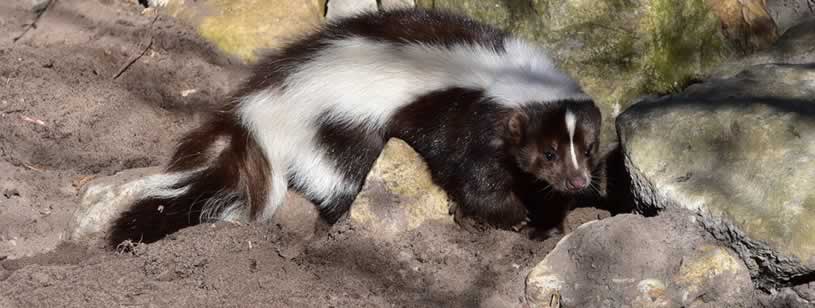
Skunks are mammals in the family Mephitidae. Many have conspicuous black and white markings and can release a strong-smelling defensive spray. They eat varied plant and animal food, with habits differing between species.
Despite its smelly reputation, the skunk is a useful animal that eats rodents, insects and other pests. Its striking black and white fur warns predators to keep away.
Skunks use warning behaviour and their defensive spray to deter threats. Predators and responses differ between species and situations.
Quick facts
| Common name | Skunk |
| Scientific name | Mephitidae |
| Typical lifespan | Usually 3-7 years in the wild, up to about 10-15 years in captivity |
| Maximum speed | About 15 km/h; skunks rely on their spray rather than speed |
| Length | About 30-90 cm (including tail) |
| Weight | About 0.5-5 kg (depending on species) |
| Diet type | Omnivore (insects, fruit, small animals, eggs, roots) |
| Main predators | Great horned owls and other owls, coyotes, bobcats, eagles |
| Conservation status | Most species are Least Concern; some are Vulnerable |
| Geographical distribution | North, Central and South America; stink badgers in Southeast Asia |
| Habitat | Forests, grasslands, deserts, farmland, suburbs |
| Social behaviour | Solitary; several may share a den in cold weather |
| Special adaptations | Strong-smelling defensive spray, bold warning colours |
Interesting facts
- A skunk's smell carries a long way - Its spray contains sulphur compounds that people can smell more than a kilometre away and that sting the eyes and nose of predators.
- Skunks give a warning first - Before spraying, a skunk stamps its feet, raises its tail, hisses and, in spotted skunks, even does a handstand.
- Their aim is impressive - A skunk can spray up to about 3 metres, aiming at the attacker's face.
- Skunks often use warning signals and try to avoid a confrontation before spraying, although behaviour depends on the animal and situation.
- Their black and white coat is a warning - The bold colours tell predators that the skunk is dangerous, so many leave it alone.
- They slow down in winter - Skunks do not truly hibernate, but in cold areas they become very inactive and live off their fat reserves.
Records and remarkable features
- Skunks are mammals in the family Mephitidae. Many have conspicuous black and white markings and can release a strong-smelling defensive spray. They eat varied plant and animal food, with habits differing between species.
Characteristics
The skunk is a small to medium-sized mammal known for its distinctive black and white fur and its strong-smelling spray. These features help it avoid predators and survive in many environments.
Appearance
- Stripes or spots - Most species have white stripes on a black background, while spotted skunks have a pattern of broken stripes and spots.
- A sturdy body and bushy tail - The long, fluffy tail is raised as a warning to predators.
- Short legs and strong claws - Ideal for digging dens and searching for food in the ground.
- Variable size - The smallest species are about 30-40 cm long and the largest up to about 80-90 cm, including the tail.
Special adaptations
- A chemical defence - Skunks have two special glands near the base of the tail that release a foul-smelling spray when they feel threatened.
- Warning colours - The black and white pattern is a strong visual signal that the skunk is not worth attacking.
- Warning displays - Before spraying, skunks raise their tails, arch their backs and stamp the ground with their front feet.
- Winter torpor - Skunks do not fully hibernate, but in cold weather they enter short periods of torpor to save energy.
Habits and behaviour
Skunks are mostly solitary, nocturnal and opportunistic animals that spend much of their time looking for food and avoiding predators.
Social behaviour
- Solitary - Skunks usually live alone, although in cold weather several may share a den for warmth.
- Brief meetings - Males and females meet mainly in the breeding season, and the female raises the young on her own.
- Litters - A female can give birth to up to about 10 young, which depend completely on her for the first months.
Defence and survival techniques
- Spray as a last resort - The skunk sprays its secretion at predators, causing burning eyes and nausea.
- Getting ready to spray - Faced with danger, the skunk turns its back, raises its tail and aims.
- Bluffing - It stamps, hisses and makes short charges to scare off attackers before it sprays.
- Surviving winter - It shelters in dens and reduces its activity to save energy.
Habitat and geographic distribution
Skunks live in the Americas, while their close relatives, the stink badgers, live in Southeast Asia. They use many habitats, from forests to towns.
| Region | Example species | Preferred habitat |
|---|---|---|
| North America | Striped skunk (Mephitis mephitis), eastern spotted skunk (Spilogale putorius) | Forests, farmland, suburbs |
| Central and South America | Striped hog-nosed skunk (Conepatus semistriatus) | Tropical forests, grasslands |
| South America | Molina's hog-nosed skunk (Conepatus chinga) | Mountains, grasslands |
| Southeast Asia | Sunda stink badger (Mydaus javanensis) | Forests and mountains of Indonesia and Malaysia |
Types of habitat
- Temperate forests - North American skunks live in mixed woodland, where they find safe places for dens.
- Farmland - Skunks often live near farms and fields because food is plentiful there.
- Suburbs and towns - Many skunks have adapted to living near people and search gardens and rubbish bins for food.
- Dry areas - Some species cope well with dry, rocky ground.
Human impact and threats
- Habitat loss - Deforestation and the spread of towns reduce the skunks' natural habitat.
- Road deaths - Many skunks are hit by cars, because they move slowly and rely on their warning colours.
- Pets and people - Dogs often attack skunks and get sprayed, and people may kill skunks they see as pests.
- Disease - Skunks can carry rabies, which can lead to culling of local populations.
Diet and feeding
Skunks are opportunistic omnivores, which means they eat a wide variety of food depending on the season and habitat. This flexible diet helps them thrive in many places, including near people.
What do skunks eat?
| Type of food | Notes |
|---|---|
| Insects (crickets, beetles, grubs, bees, wasps) | All species, especially in summer |
| Rodents and other small mammals (mice, voles, moles) | Striped and spotted skunks |
| Eggs and small birds | Striped and spotted skunks |
| Amphibians and small reptiles (frogs, lizards, small snakes) | Many species |
| Fruit and nuts (blackberries, blueberries, apples, acorns) | All species, especially in autumn |
| Human food waste | Skunks living near people |
Feeding techniques
- Digging - Skunks use their strong claws to dig up insects, grubs and roots.
- Hunting - They catch mice, lizards or small birds by surprise.
- Raiding bins - In towns, skunks search rubbish bins for easy food.
- Skunks may eat bees and their larvae. This does not mean that they are immune to every bee sting.
Adapting to food supply
- In autumn and winter, skunks eat more fruit, seeds and roots.
- In spring and summer, their diet is rich in insects and small animals.
- In towns, skunks eat leftovers and food waste.
Reproduction and life cycle
Skunks breed once a year. Males may become aggressive towards each other in the breeding season, and the young are raised only by the mother.
| Feature | Details |
|---|---|
| Age at maturity | About 10-12 months |
| Breeding season | Mainly February - March (striped skunk) |
| Pregnancy | About 59-77 days |
| Young per litter | 2-10 |
| Nursing | About 6-8 weeks |
| Independence | At about 3-4 months |
| Lifespan | Usually 3-7 years in the wild, up to about 10-15 years in captivity |
Breeding
- Males mate with several females but do not help raise the young.
- The young, called kits, are born blind and almost hairless and depend completely on their mother for the first weeks.
- After about 2-3 months, the kits follow their mother on foraging trips and learn to find food; they stay with her until late summer or autumn.
Survival of the young
- The mother raises her kits in a safe den, often an old burrow dug by another animal.
- Young skunks can produce their spray from just a few weeks old, an essential defence.
- In some species, such as the western spotted skunk, the embryo implants only months after mating, so the young are born at the best time of year.
Name and history
People have known skunks for a very long time. They appear in the culture of Native Americans, in the history of European settlers and in modern science.
Origin of the name
- The word "skunk" comes from an Algonquian language spoken by Native Americans in north-eastern North America.
- The scientific name Mephitis comes from Latin and means "foul smell" or "poisonous vapour".
- In Spanish, skunks are often called zorrillo ("little fox"), and in French mouffette, from an Italian word for a bad smell.
Skunks in human history
- Native Americans knew skunks well and used them for food and fur.
- European settlers in North America quickly learned to respect the skunk's spray.
- In the late 19th and early 20th centuries, skunk fur was popular in fashion and was often sold under names such as "Alaska sable".
- Today, skunks are studied for their unusual chemical defence and their role in controlling insects and rodents.
Skunks in folklore
Cultural significance and mythology
- Native American stories - In several Native American traditions, the skunk appears as a small but powerful animal whose spray can defeat much larger enemies.
- A symbol of self-respect - Because it walks calmly and does not run from danger, the skunk is sometimes seen as a symbol of confidence and of standing one's ground.
Conservation status and threats
Most skunk species are not threatened with extinction, but some face habitat destruction, persecution and road deaths.
| IUCN status | Species | Range |
|---|---|---|
| Least Concern (LC) | Striped skunk (Mephitis mephitis), Sunda stink badger (Mydaus javanensis) | North America; Southeast Asia |
| Vulnerable (VU) | Eastern spotted skunk (Spilogale putorius) | Central and eastern USA |
| Vulnerable (VU) | Pygmy spotted skunk (Spilogale pygmaea) | Pacific coast of Mexico |
Main threats
- Habitat destruction - Deforestation and farming reduce the skunks' natural space.
- Road deaths - Many skunks are hit by cars, especially at night, when they are active.
- Conflict with people - Some people see skunks as pests, even though they help control rodents and insects.
- Rabies and other diseases - Skunks can carry rabies, which sometimes leads to culling.
- Pet trade - In some countries, skunks are kept as pets, sometimes after their scent glands are removed, which raises welfare concerns.
Conservation efforts
- Protected areas - Rare species are monitored and protected in national parks and reserves.
- Awareness - Some campaigns explain the useful role of skunks in ecosystems.
- Pet rules - Some countries and states ban keeping skunks as pets or taking them from the wild.
- Disease control - Rabies vaccination programmes for wildlife help prevent the spread of the disease.
In popular culture
- Pepé Le Pew - A love-struck French skunk in Warner Bros. Looney Tunes cartoons, first appearing in 1945.
- Bambi (Disney, 1942) - Flower, the shy, sweet-natured skunk, is one of Bambi's best friends.
- Over the Hedge (2006) - Stella, a skunk, is one of the main characters of this animated film.