MacaqueMacaca — habitat, diet and reproduction
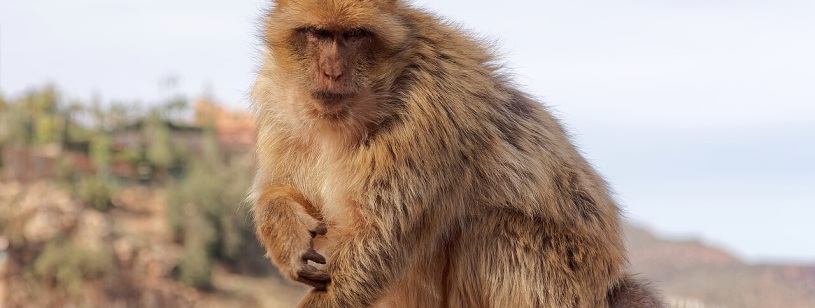
Barbary macaque (Macaca sylvanus) on a rock. · Jakub Hałun / CC BY 4.0 (https://creativecommons.org/licenses/by/4.0). Cropped and resized.
Macaques are a genus of monkeys with more than 20 species, ranging from Afghanistan and India to Japan, plus the Barbary macaque of North Africa. They are highly adaptable, living in rainforests, snowy mountains and even cities. They form large groups with clear rules and hierarchies.
Quick facts
| Common name | Macaque |
| Scientific name | Macaca (genus) |
| Lifespan | About 20–30 years |
| Length | Body about 40–70 cm, depending on species |
| Weight | About 2.5–18 kg, depending on species and sex |
| Diet | Omnivore: fruit, seeds, leaves, insects, eggs |
| Predators | Leopards, tigers, pythons, large birds of prey |
| Conservation status | Varies: some species Least Concern, others endangered |
| Distribution | South, East and South-East Asia; North Africa; Gibraltar |
| Habitat | Forests, mountains, mangroves, farmland and cities |
| Family | Cercopithecidae |
| Lifestyle | In groups with a hierarchy |
Interesting facts
- Japanese macaques warm themselves in hot springs in winter.
- A female Japanese macaque began washing sweet potatoes in water, and the habit spread through her group.
- The Rh factor in blood groups is named after the rhesus macaque.
- The Barbary macaque is the only monkey living free in Europe, on the Rock of Gibraltar.
Characteristics
Macaques have a sturdy body, a bare face and usually brown, grey or black fur. Tail length varies greatly: some species have long tails, others almost none, like the Barbary macaque.
Males are larger than females and have long canines. Cheek pouches store food temporarily so it can be eaten in safety.
Behaviour
Macaques live in groups of a few to more than a hundred animals. Females usually stay in their birth group, while males leave at maturity.
Grooming strengthens friendships and reduces conflict. They learn quickly by imitation, and some groups use stones as tools or wash food in water.
Habitat and distribution
The genus ranges across Asia from Afghanistan and India to China, Japan and Indonesia. The Barbary macaque lives in the Atlas Mountains of Morocco and Algeria, with a small population on Gibraltar.
Macaques use very different habitats, from rainforest to cold mountains and busy cities. The Japanese macaque lives further north than any other non-human primate.
Diet and feeding
They are omnivores, eating fruit, seeds, leaves, flowers, fungi, insects, crabs, eggs and sometimes small animals.
In cities and temples, many macaques get used to human food and may steal from bags or houses. Feeding by tourists changes their behaviour and can lead to bites.
Reproduction and life cycle
Females usually give birth to a single infant after a pregnancy of about five to six months. The infant clings to its mother’s belly, then rides on her back.
Related females help care for infants. Macaques mature at three to five years, and females can breed every year or two.
Name and history
The word “macaque” comes from Portuguese, borrowed from an African language.
The rhesus macaque has been widely used in medical research. The Rh blood factor was discovered in experiments with this species, and in 1949 a rhesus macaque named Albert II was among the first monkeys sent to high altitude on a rocket.
Conservation and threats
Status varies widely. The rhesus and long-tailed macaques are widespread, but the Barbary and lion-tailed macaques are Endangered.
Main threats include deforestation, hunting and the illegal trade in infants as pets. Conflicts with people grow where macaques lose habitat and move into settlements.
Frequently asked questions
Where do macaques live?
In Asia, from India to Japan and Indonesia, and in North Africa. A small population lives on Gibraltar.
What do macaques eat?
Fruit, seeds, leaves, insects, eggs and small animals; in cities they also eat human food.
How long does a macaque live?
Usually 20–30 years, depending on species and conditions.
Is it good to feed macaques?
No. Feeding makes them aggressive and dependent on people and can lead to bites.