MooseInteresting facts and information
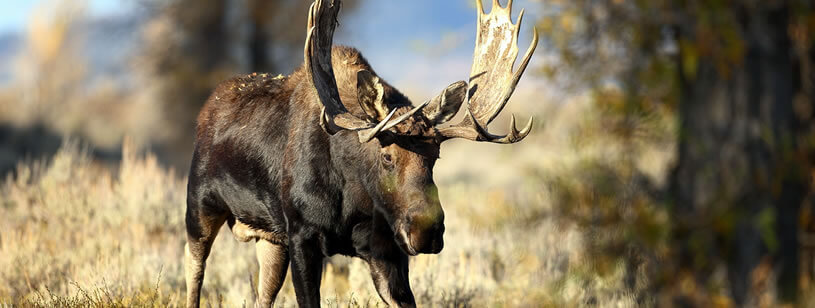
The moose (Alces alces) is the largest living member of the deer family. It has long legs, a broad muzzle and, in adult males, large antlers. It lives in northern forests and wetlands, where its diet and seasonal movements depend on local conditions.
Moose feed on plants and shape their habitats. They can swim and feed on wetland plants, but their feeding and movements change with the season and the population.
Population trends differ between regions; hunting, habitat change, disease, parasites and climate can all affect moose.
Quick facts
| Common name | Moose (called elk in Europe) |
| Scientific name | Alces alces |
| Typical lifespan | Usually up to 15-20 years in the wild; up to about 20-25 years in captivity |
| Maximum speed | Up to about 55 km/h over short distances |
| Height at the shoulder | 1.4 - 2.3 m |
| Length | 2.4 - 3.1 m |
| Weight | Females: 200 - 600 kg; males: 380 - 800 kg |
| Diet type | Herbivore (leaves, twigs, water plants, bark) |
| Main predators | Wolves, bears, humans |
| Conservation status | Least Concern (IUCN); some regional populations are declining |
| Distribution | North America, northern Europe and northern Asia |
| Habitat | Boreal forests (taiga), wetlands, tundra edges |
- Primary category:Mammals
- Explore this animal's categories:
Interesting facts
- The largest deer in the world - A moose can stand more than 2 metres tall at the shoulder, much taller than most other deer.
- Males have huge antlers - They can span up to about 1.8-2 metres and weigh more than 30 kg. They are used in contests during the breeding season.
- At home in the water - Moose swim well, can cover several kilometres without stopping and dive several metres deep to reach underwater plants.
- Each ear moves on its own - This helps a moose pick up sounds from all directions.
- A nose made for diving - A moose can close its nostrils underwater to keep the water out.
- Poor eyesight, excellent smell - Moose rely mainly on smell and hearing to detect predators.
- Built for rough ground - Although it looks heavy, a moose can run at up to about 55 km/h.
- Males shed their antlers every winter - New antlers start growing in spring.
- A danger on the roads - Because of its height and weight, a moose hitting a car can be devastating, and such collisions cause many serious accidents where moose are common.
- A big appetite - An adult moose can eat more than 20-30 kg of plants a day in summer.
Records and remarkable features
- Moose are the largest living deer. Males grow antlers, while females normally do not.
Characteristics
The moose is the largest and heaviest member of the deer family (Cervidae). Its massive antlers, sturdy body and long legs help it cross difficult ground and defend itself against predators.
Main physical features:
- Impressive size - Males can stand up to about 2.3 metres at the shoulder and weigh 380-800 kg; females are smaller, at about 200-600 kg.
- Massive antlers (males only) - Grow every year and can span up to about 2 metres; males use them in contests during the breeding season.
- Strong, muscular body - Suited to dense forests and cold climates.
- Long, strong legs - Allow it to wade through deep snow and swamps and to run fast when needed.
- Short, thick neck - Helps support the weight of the head and antlers.
- Large, flexible upper lip - Ideal for stripping leaves and twigs from trees.
- Dense, insulating coat - Keeps the moose warm in cold weather; its thick hairs shed water.
- Short tail - Moose have a short tail, only about 5-10 cm long.
Special adaptations for survival:
- Excellent hearing and smell - Moose have poor eyesight but make up for it with a keen sense of smell and hearing, which helps them detect predators and find food.
- Strong swimmers - They can swim for long periods and dive to about 5 metres to reach underwater plants.
- Fast-growing antlers - Males shed their antlers every year and grow new ones; antler bone is one of the fastest-growing tissues in mammals.
- Built for harsh winters - The coat has two layers: long, hollow outer hairs that trap air, and a soft, woolly undercoat that keeps in heat.
- A powerful digestive system - Moose can digest large amounts of woody, fibrous plants.
Habits and behaviour
Unlike most deer, which live in herds, the moose is mostly solitary. It is most active in the morning and evening.
Social behaviour:
- Alone or in small groups - Moose do not form large herds. A mother stays with her calf for about a year.
- Males become aggressive in the breeding season - During the rut (September-October), males use their antlers to fight rivals.
- No fixed territories - Moose do not defend territories, but many follow regular seasonal routes.
Breeding season:
- Autumn (September-October) - Males and females call loudly to find each other.
- Fights between males can be intense - They lock antlers and push to find out who is stronger.
- Antlers are shed after the rut - New antlers start to grow the following spring.
Defence and survival methods:
- Running and kicking - When threatened, a moose can run at up to about 55 km/h or strike predators with its hooves.
- Escaping into water - Moose can escape predators by taking refuge in lakes and rivers.
- Warning calls - Females call loudly to protect their calves, and males call during the rut.
Habitat and geographic distribution
Moose live in boreal forests (taiga) and cold temperate regions of the Northern Hemisphere, in North America, Europe and Asia.
Habitat types:
- Boreal forests and taiga - Their main habitat, where they find food and shelter.
- Swamps and wetlands - They favour areas with plenty of water plants.
- Tundra edges and mountains - In Scandinavia and Russia, they also live in upland areas.
- Open land - Moose avoid wide open areas but may cross them when they move between seasons.
Geographic distribution and estimated population:
| Region | Approximate population |
|---|---|
| Canada | 500,000+ |
| USA (Alaska and northern states) | 300,000+ |
| Scandinavia and Finland | 500,000+ |
| Russia | 600,000+ |
| Central and Eastern Europe (mainly Poland and the Baltic states) | Tens of thousands |
Impact of climate change and human activities:
- Climate change - Warmer winters favour ticks and other parasites, which can seriously weaken moose.
- Habitat loss - Farming, logging and settlements reduce the forest available to moose.
- Hunting - Moose are hunted for meat in many regions; where hunting is poorly controlled, numbers can fall.
- Road accidents - In northern countries, collisions with vehicles are a common cause of death.
The moose plays an important role in its ecosystem: it shapes the vegetation and is prey for large predators such as wolves and bears.
Diet and feeding
The moose is a herbivore that eats a wide range of plants, leaves and bark. Because it is so large, it needs a lot of food every day to keep up its energy.
Main food:
- Tree leaves - Moose especially like the leaves of willow, aspen, birch and alder.
- Twigs and bark - In winter, when other food is scarce, they eat twigs and bark.
- Herbs and ferns - In summer, they eat soft plants, which are easier to digest.
- Water plants - Moose wade and swim, dipping their heads underwater to reach plants rich in minerals such as sodium.
- Fungi and lichens - An extra source of nutrients at certain times of year.
Diet by season:
| Season | Main food |
|---|---|
| Spring | Fresh leaves, young shoots |
| Summer | Herbs, water plants, ferns |
| Autumn | Leaves, twigs, lichens |
| Winter | Bark, twigs, conifer needles |
Feeding methods:
- Browsing - Moose eat mostly from shrubs and trees at a height of about 1-3 metres, where they face less competition from smaller herbivores.
- Feeding underwater - They can dive several metres deep to pull up water plants.
- Efficient digestion - Their four-chambered stomach extracts nutrients even from tough, fibrous plants.
Reproduction and life cycle
Moose breed once a year: they mate in autumn and calves are born in late spring. Males compete for females, and mothers look after their calves for about a year.
Mating:
- The rut - Takes place in September and October.
- Contests between males - Males fight with their massive antlers, and the winner mates with the female.
- Loud calls - Males make deep grunts to attract females and warn rivals.
Pregnancy and birth:
- Pregnancy - About 230 days (around 8 months).
- One or two calves - Calves are usually born in May or June.
- Calves weigh about 11-16 kg at birth and can stand within a day.
How calves develop:
- Nursing - Calves drink their mother's milk for about 5 months but start eating plants after a few weeks.
- Protective mothers - Moose mothers defend their calves fiercely against predators such as wolves and bears.
- Independence - Calves usually leave their mother at about one year old, when she is ready to give birth again.
Lifespan:
- In the wild - Usually 15-20 years at most; many die younger.
- In captivity - Up to about 20-25 years.
Name and history
People have known and respected the moose for thousands of years, and it is an important symbol in many cultures.
Origin of the name:
- In North America, the animal is called "moose", a word borrowed from an Algonquian language and often translated as "twig-eater" or "he strips bark".
- In Britain and Europe, the same animal is traditionally called the "elk"; in North America, "elk" means a different deer, the wapiti.
- The scientific name Alces alces comes from the Latin name for the animal, alces.
Taxonomic classification:
| Taxonomic rank | Name |
|---|---|
| Kingdom | Animalia |
| Phylum | Chordata |
| Class | Mammalia |
| Order | Artiodactyla |
| Family | Cervidae |
| Genus | Alces |
| Species | Alces alces |
Discovery and documentation:
- Prehistoric art - Moose appear in rock carvings and paintings made thousands of years ago in northern Europe and Siberia.
- Important to northern peoples - Peoples of northern Europe, Siberia and North America hunted moose for meat, hides and antlers.
- Scientific description - Carl Linnaeus gave the moose its scientific name in 1758.
The moose in mythology and culture:
- Northern Eurasia - In several Siberian traditions, the moose is linked with the sky and with stories about the movement of the sun.
- Indigenous peoples of North America - Many peoples see the moose as an important animal that provides food, clothing and tools.
- A national symbol - The moose is one of the best-known animals of Canada and Sweden.
The moose remains an impressive symbol of the northern wilderness and plays a key ecological role in boreal forests.
Cultural significance and mythology
The moose has been an important symbol in northern and Indigenous cultures for thousands of years. As the largest of the deer, it was admired for its strength and endurance. It was also a symbol of survival and plenty, because it provided food, clothing and tools for people living in cold regions.
The moose in mythology and belief:
- Siberian traditions - In some Evenki stories, a giant cosmic moose runs across the sky, linked with the passing of day and night.
- Indigenous peoples of North America - For peoples such as the Cree and the Algonquin, the moose is a respected animal, and hunting it was surrounded by customs of respect.
- Prehistoric rock art - Moose are among the animals most often shown in ancient rock art from Scandinavia to Siberia.
What the moose symbolises:
- Strength and stability - A symbol of physical endurance and balance in nature.
- Survival - A symbol of living through long, harsh winters.
- Freedom and independence - Because it lives mostly alone, the moose stands for freedom and a close bond with nature.
Conservation status and threats
The moose is listed as Least Concern by the International Union for Conservation of Nature (IUCN). However, in some regions numbers are falling because of climate change, parasites, hunting and habitat loss.
Conservation status
- Large populations in Canada, Scandinavia and Russia - These countries have the most moose, thanks to their large forests.
- Declines in some areas - In parts of the northern United States and Central Europe, parasites, habitat fragmentation and hunting have reduced moose numbers.
Main threats:
- Climate change - Warmer weather favours ticks and other parasites that weaken moose and harm their health.
- Habitat loss - Deforestation and the spread of settlements reduce the areas where moose can feed and move.
- Collisions with vehicles - In northern countries, road accidents involving moose kill thousands of animals each year and also endanger drivers.
- Hunting - Although it is regulated in most places, illegal hunting can affect some populations.
- Natural predators - Wolves and bears mainly kill young, old or sick moose.
Conservation efforts:
- Wildlife corridors - Help moose move safely between separate areas of habitat.
- Hunting rules - In many countries, hunting is carefully regulated to keep populations healthy.
- Monitoring - Biologists use radio collars and DNA analysis to follow moose numbers and health.
- Wildlife crossings - In Canada and Scandinavia, fences, bridges and underpasses help moose cross roads safely.
In popular culture
The moose has become an iconic symbol of the northern wilderness and appears in books, films, video games and sport.
Moose in literature:
- The Call of the Wild (Jack London, 1903) - Near the end of the novel, Buck hunts down a huge bull moose in the northern wilderness.
- "The Moose" (Elizabeth Bishop, 1976) - A well-known poem about a bus journey interrupted when a moose steps onto the road.
- Children's books - Moose often appear in stories about northern forests and Arctic wildlife.
Moose in film and television:
- Brother Bear (Disney, 2003) - The film's comic duo, Rutt and Tuke, are two moose brothers.
- Nature documentaries - National Geographic and the BBC show the moose as one of the most impressive animals of the northern forests.
- The Rocky and Bullwinkle Show - A classic cartoon series in which Bullwinkle is a friendly, naive talking moose.
Moose in video games:
- The Long Dark (Hinterland Studio) - A survival game in which moose are dangerous animals that can also be hunted for food.
- Red Dead Redemption 2 (Rockstar Games, 2018) - Moose are part of the game's wildlife and can be hunted.
Moose in sport and emblems:
- A national symbol in Canada and Sweden - The moose appears on souvenirs, logos and tourist materials in these countries.
- Sports mascots - Some teams in Canada and Scandinavia have a moose as their mascot, as a symbol of strength and endurance.
- Park emblems - The moose appears in the logos of many parks and nature reserves in North America and Europe.
Moose in art:
- Traditional art - The moose appears in many works of northern and Indigenous art.
- Giant statues - Some towns in Canada, Sweden and other northern countries have giant moose statues.
- Tattoos and symbols - The moose is a popular design in tattoos inspired by northern nature.