Slow wormAnguis fragilis — habitat, diet and reproduction
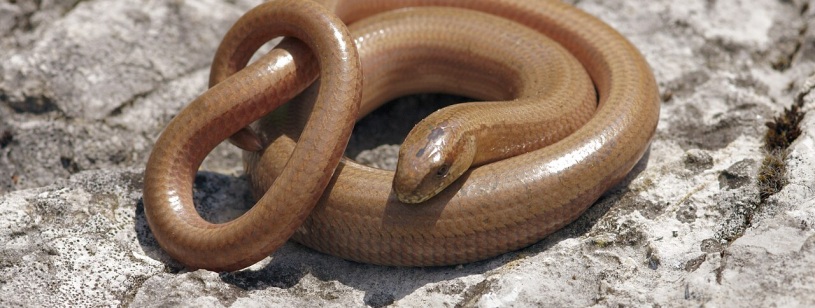
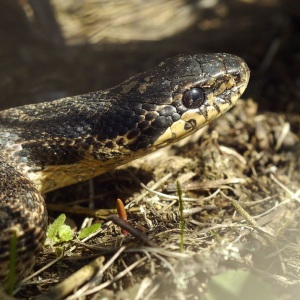
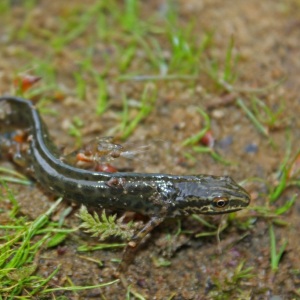
Slow worm (Anguis fragilis) coiled on a rock. · Hans Hillewaert / CC BY-SA 4.0 (https://creativecommons.org/licenses/by-sa/4.0). Cropped and resized.
The slow worm looks like a small, shiny snake but is actually a legless lizard. Unlike snakes, it blinks and can shed its tail to escape predators. It is completely harmless and feeds mainly on slugs and earthworms.
Quick facts
| Common name | Slow worm |
| Scientific name | Anguis fragilis |
| Lifespan | Can exceed 20 years; over 50 years in captivity |
| Length | Usually 40–50 cm |
| Diet | Carnivore: slugs, earthworms, insects, spiders |
| Predators | Birds, hedgehogs, snakes, foxes, badgers and cats |
| Conservation status | Least Concern (LC) |
| Distribution | Europe and western Asia |
| Habitat | Woodland edges, clearings, gardens and damp grassland |
| Family | Anguidae |
| Reproduction | Gives birth to live young |
- Primary category:Reptiles
- Explore this animal's categories:
Interesting facts
- The slow worm has eyelids and blinks, something snakes cannot do.
- It is one of the longest-lived lizards; in captivity one lived over 50 years.
- It has no venom and cannot harm a person.
- A shed tail wriggles for minutes, distracting the predator.
Characteristics
The slow worm has a smooth, glossy, cylindrical body with no visible legs. Small, tightly fitting scales make it look like polished metal. It is usually brown, copper or grey.
Females often have dark sides and a thin line on the back, and some males show blue spots. Young are gold or silver with a dark back stripe. Eyelids, small ear openings and a breakable tail separate it from snakes.
Behaviour
It is slow and secretive, spending much time under stones, logs, leaves or boards on the ground, where it finds moisture and food.
It emerges mostly in the morning, evening and after rain, when slugs are active. In winter it hibernates in groups in burrows or under roots, sometimes with other reptiles.
Habitat and distribution
The species lives across much of Europe. Recent genetic research places populations in eastern Europe, including much of Romania, in a very similar species, Anguis colchica.
In Romania it occurs from lowlands to mountains, in open woods, clearings, damp grassland and gardens.
Diet and feeding
The slow worm eats mostly slugs and earthworms, plus soft insects, larvae and spiders.
Its small, backward-curving teeth suit soft, slippery prey, making it a useful ally in gardens where slugs damage vegetables.
Reproduction and life cycle
The slow worm lays no eggs. Eggs develop inside the female, and live young are born in late summer.
A female usually gives birth to 6–12 young a few centimetres long, independent from birth. Slow worms mature slowly, after several years.
Name and history
The scientific name Anguis fragilis means “fragile snake”, after the easily broken tail.
In Romanian, the name “năpârcă” is sometimes wrongly used for vipers. The belief that it is venomous has led to many needless killings. The adder is easy to tell apart: the slow worm is smooth and glossy, with no zigzag pattern.
Conservation and threats
The slow worm is assessed as Least Concern and is still widespread in Europe.
Main threats include cats, slug pellets, mechanised mowing and killing through confusion with snakes. Log piles, stones and leaf heaps in gardens offer shelter. Like all wild reptiles in Romania, it is protected.
Frequently asked questions
Is the slow worm venomous?
No. It has no venom and is not dangerous to people or pets.
Is the slow worm a snake?
It is a legless lizard. It has eyelids, blinks and can shed its tail, like other lizards.
How do you tell a slow worm from an adder?
The slow worm is smooth and glossy, with no zigzag and a small head. The adder has a zigzag pattern and vertical pupils.
How long do slow worms live?
They can live over 20 years in the wild; more than 50 years has been recorded in captivity.