European bisonInteresting facts and information
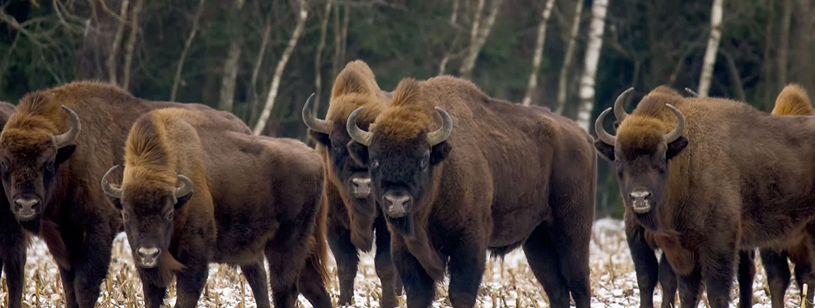
The European bison (Bison bonasus), also called the wisent, is a large plant-eating mammal native to Europe. It survived in captivity after disappearing from the wild and has been reintroduced through conservation programmes. It is distinct from the American bison.
European bison feed on grasses and other vegetation. Their recovery depends on continued management, suitable habitat and connected populations.
Quick facts
| Common name | European bison |
| Scientific name | Bison bonasus |
| Typical lifespan | About 20-25 years in the wild, up to about 30 years in captivity |
| Maximum speed | About 50 km/h |
| Height | About 1.7–2 m at the shoulder |
| Length | About 2.5 - 3.5 m |
| Weight | About 600 - 900 kg or more (males), 400 - 550 kg (females) |
| Diet | Herbivore (grass, leaves, shoots, bark, acorns) |
| Main predators | Wolves (mainly calves and weak animals); people |
| Conservation status | Near Threatened (IUCN; category changed from Vulnerable in 2020) |
| Distribution | Europe (Poland, Belarus, Russia, Lithuania, Ukraine, Romania, Germany and others) |
| Habitat | Temperate forests with glades, meadows, mountain pastures |
- Primary category:Mammals
- Explore this animal's categories:
Interesting facts
- Digging through snow - In winter, the European bison sweeps away the snow with its head and hooves to reach the plants underneath.
- A winter coat - In summer its coat is shorter and lighter, while in winter it becomes thick, long and darker.
- A quiet giant - European bison are mostly quiet, but bulls grunt and roar during the breeding season.
- Back from the brink - After the last wild European bison were killed in the 1920s, the whole species was saved from just 12 animals kept in zoos and private parks.
- Surprisingly agile - Despite their size, European bison can run at about 50 km/h and jump over obstacles almost 2 m high.
- Healthy adults are large and powerful, but vulnerability depends on age and condition. Young bison can be taken by predators.
- Forest gardeners - By grazing, browsing and rolling in dust, European bison create open patches in the forest that help many other plants and animals.
Records and remarkable features
- The European bison (Bison bonasus), also called the wisent, is a large plant-eating mammal native to Europe.
- The heaviest land animal in Europe - Large bulls can weigh up to about 900 kg or more.
- A conservation success - From 12 founding animals, the population has grown to more than 10,000 today.
Physical Features and Unique Adaptations
The European bison is a massive, powerful animal with a series of adaptations that help it survive in cold forests and grasslands.
Essential physical adaptations
- A massive body - Adult bulls usually weigh about 600-900 kg, and cows about 400-550 kg.
- Thick fur - Its dense winter coat protects it from the cold.
- Mane and beard - Bulls have a shaggy mane on the head and neck and a beard under the chin.
- A large head and broad forehead - Used for sweeping away snow and for pushing contests between bulls.
- Strong hooves - Allow it to walk long distances over rough and muddy ground.
- Curved horns - Both sexes have short, curved horns, larger in males, used in fights and for defence.
- Longer legs than the American bison - The European bison is taller and less heavily built at the front, which suits life in forests.
Habits and behaviour
The European bison is a social animal that lives in herds of different sizes.
Way of life
- Mixed herds - Cows, calves and young bulls form herds usually led by an experienced cow, while adult bulls live alone or in small bachelor groups.
- Communication - Bison communicate with body postures, grunts and head movements.
- Marking - Bulls scrape the ground with their hooves and rub their heads and horns on trees.
- Fights between bulls - In the breeding season, bulls push and clash heads to win access to cows.
- European bison do not hibernate. Winter activity and use of shelter depend on food and weather.
Social interactions
- Protecting calves - Cows guard their calves, and the herd may group together to face a threat such as wolves.
- Tolerating people - In protected areas, bison can become used to people, but they are wild animals and can be dangerous if approached.
- Rubbing and dust baths - They rub against trees and roll in dust to get rid of parasites.
Defence techniques
- Size and strength - Healthy adults have few predators; a bison can injure or kill an attacking wolf.
- Grouping together - When threatened, the herd may bunch together, with calves in the middle.
- Using horns - Bulls use their horns both in contests and for defence.
Habitat and geographic distribution
The European bison lives in forests, especially mixed and broadleaved forests with open glades, and in mountain pastures and meadows.
Species distribution
| Region | Population information |
|---|---|
| Poland (including the Białowieża Forest) | The largest population, more than 2,000 animals |
| Belarus, Russia, Ukraine, Lithuania | Several thousand animals in total |
| Romania (Southern Carpathians, Vânători-Neamț) | A few hundred, mostly released since 2012 |
| Germany, Slovakia, Bulgaria and other countries | Small reintroduced herds |
| Caucasus | Reintroduced herds of mixed origin |
Habitats
- Deciduous and mixed forests - Provide food and shelter, especially where there are glades and meadows.
- Mountain pastures - In the Carpathians and the Caucasus, bison graze on mountain meadows.
- Mixed landscapes - A mix of forest and open grassland gives them varied food and water.
Impact of climate change
- Milder winters - May change how bison use their habitat and how much extra food they need in winter.
- Habitat loss - Roads, farms and settlements split up suitable habitat into small patches.
- European bison sometimes enter farmland or areas near settlements, creating potential conflicts.
Diet and feeding
The European bison is a herbivore that both grazes and browses, eating grasses as well as leaves, shoots and bark.
What does the European bison eat?
| Food type | Specific examples |
|---|---|
| Grasses and herbs | Grasses, sedges, clover, dandelions |
| Leaves and shoots | Oak, hornbeam, ash, maple, hazel |
| Tree bark | Ash, willow, aspen (especially in winter) |
| Fruit and seeds | Acorns, beech nuts, wild apples |
| Other | Lichens, mosses and mushrooms occasionally |
Feeding methods
- Walking and grazing - A European bison may walk several kilometres a day while feeding.
- In winter, European bison may use their heads and hooves to reach vegetation beneath snow.
- Drinking - They drink every day, usually from streams, ponds and lakes.
- Chewing the cud - Like cattle, European bison are ruminants: they bring up their food and chew it again to digest it better.
Reproduction and life cycle
European bison breed once a year, and the calves are born in spring and early summer, when food is plentiful.
Breeding season
- The breeding season (rut) is from about August to October.
- Bulls follow and guard cows that are ready to mate.
- Rival bulls threaten each other and sometimes fight by pushing head to head.
Pregnancy and birth
| Characteristic | Details |
|---|---|
| Duration of pregnancy | About 9 months |
| Number of calves per birth | 1 calf (twins are very rare) |
| Calf weight at birth | About 15-35 kg |
| Nursing period | About 7-12 months |
Raising calves
- Calves can stand and walk within a few hours of birth and stay close to their mothers for at least a year.
- The whole herd helps protect calves from danger.
- Calves start eating plants within a few weeks, but continue to drink milk for many months.
- Young bulls leave the herd at about 2-3 years old, while young cows usually stay.
Survival rate
- In the wild, European bison can live about 20-25 years, and up to about 30 years in captivity.
Name and history
Origin of name
- The name "wisent" comes from German, from an old Germanic word for the animal; the word "bison" also comes from a Germanic word, through Latin.
- The species name bonasus comes from bonasos, the name used by the ancient Greek writer Aristotle for a wild ox.
Taxonomic Classification
| Classification | Name |
|---|---|
| Kingdom | Animalia |
| Phylum | Chordata |
| Class | Mammalia |
| Order | Artiodactyla |
| Family | Bovidae |
| Genus | Bison |
| Species | Bison bonasus |
History
- Prehistory - People have hunted bison since prehistoric times, and bison are among the most common animals in Ice Age cave paintings.
- Decline - The European bison once lived across much of Europe, but hunting and forest clearing pushed it back to a few forests, such as Białowieża.
- Extinction in the wild - The last wild lowland bison was killed in Białowieża in 1919, and the last wild Caucasian bison in 1927.
- Rescue - In the 1920s, conservationists set up a breeding programme with the few animals left in zoos; their descendants have been released in many countries since 1952.
Cultural significance and mythology
The European bison has long been a symbol of strength and of the ancient forests of Central and Eastern Europe.
- "The Song of the Bison" - In 1523, the poet Nicolaus Hussovianus wrote a famous Latin poem about the bison of the Lithuanian forests.
- Royal hunts - For centuries, the bison of Białowieża were protected as the game of Polish kings and Russian tsars.
- Symbols - The European bison appears on the coats of arms of several towns and regions in Poland, Belarus and Lithuania.
Conservation status and threats
Conservation work brought European bison back to the wild. Continued management remains important, and IUCN moved the species from Vulnerable to Near Threatened in 2020.
Conservation status
| Population | Status | Population Estimate |
|---|---|---|
| European bison (Bison bonasus) | Near Threatened (IUCN) | More than 10,000, about 7,000 or more of them living free |
| Caucasian bison (Bison bonasus caucasicus) | Extinct since 1927 (some of its genes survive in the mixed line) | 0 |
Main threats
- Habitat fragmentation - Roads, farms and settlements divide habitat and keep herds apart.
- Poaching and conflicts with people - Although protected, some animals are killed illegally or because of damage to crops and forests.
- Low genetic diversity - All European bison descend from just 12 animals, which makes them more vulnerable to disease.
- Disease - Diseases such as foot infections and those spread from livestock can affect herds.
- Conflict with farmers - Bison may damage crops, hay stores and young trees.
Protection measures
- Reintroduction - European bison have been reintroduced to Romania, Poland, Germany, Slovakia, Bulgaria and other countries.
- Protected areas and conservation programmes support European bison in several countries, including Romania.
- Some conservation projects use GPS collars to follow the movements of reintroduced European bison.
- Education - Campaigns help reduce conflicts between people and bison.
In popular culture
- Brands - In Poland, the European bison (żubr) appears on the labels of Żubr beer and Żubrówka, a vodka flavoured with "bison grass".
- Tourism - Białowieża Forest attracts visitors from around the world who hope to see wild European bison.
- Rewilding - The European bison has become a symbol of efforts to bring large wild animals back to Europe's landscapes.